Jinfanshurich Cast Iron Frying Pan Review
Introduction
The cast iron skillet is a staple of sustainable cooking, a tool that lasts generations when well chosen and maintained. On our site dedicated to long-lasting cookware, we always examine this type of product through a demanding lens: that of "buy-it-for-life". The Jinfanshurich Cast Iron Frying Pan fits directly into this category with its promise of raw, natural cast iron. Here, no complex synthetic coatings, no mysterious modern alloys, just raw iron, an ancestral material whose qualities are perfectly known. Our analysis therefore goes beyond marketing to assess whether this pan has the technical attributes and the necessary robustness to join the arsenal of a serious cook, who demands professional-grade tools.
Strengths
- Pure and Healthy Material: A construction of raw cast iron (advertised as 99% natural iron), without any chemical coating. This is a crucial point for those seeking cooking without contact with polymers like PTFE/PFOA.
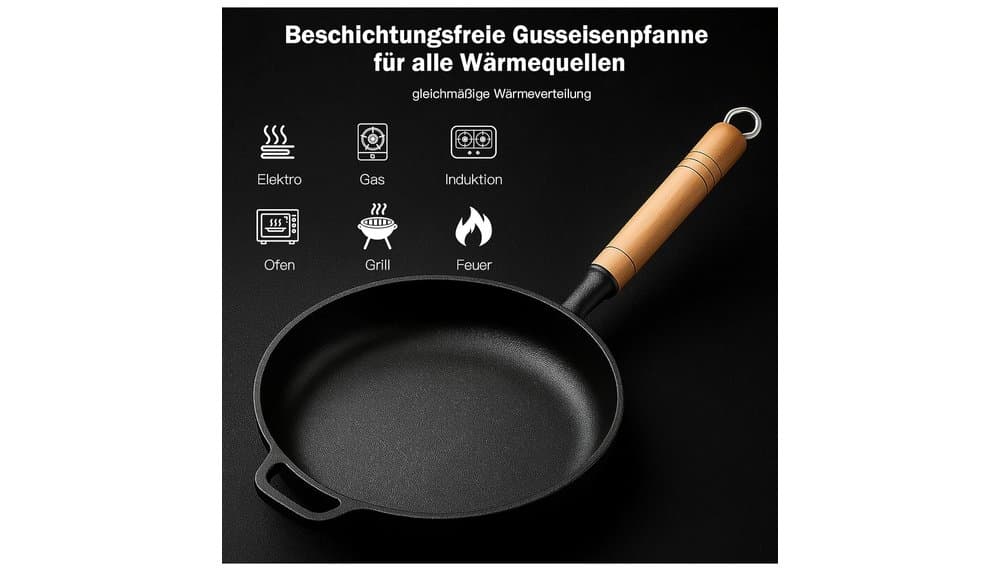
- Total Thermal Versatility: Stated compatibility with all heat sources, including induction, gas, ceramic glass, and even the oven or a wood fire. Its resistance to very high temperatures is intrinsic to the material.
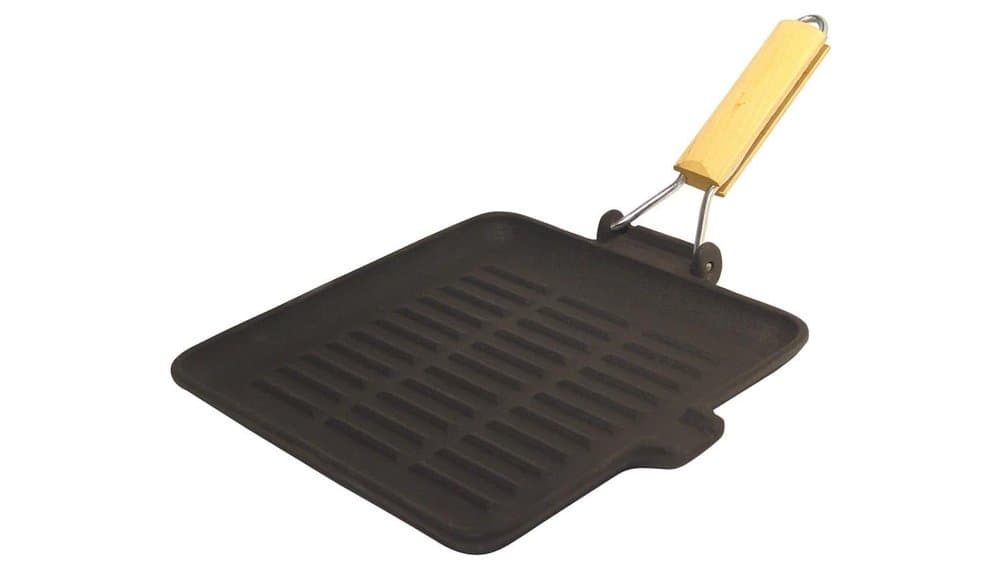
- Removable Handle Concept: The detachable wooden handle is a major practical asset, facilitating storage in tight spaces and allowing for oven use without limitation.
- Development of Natural Patina: Like any good cast iron, it is designed to develop over time and use a natural seasoning layer that improves its non-stick performance and protects it.
Weaknesses
- Weight and Handling: As expected with cast iron, the weight is significant (2.5 kg for the 27 cm model). According to feedback, this can be a drawback for some users, particularly during handling or cleaning.
- Potentially Rough Surface Finish: Contextual expert reviews highlight that compared to established brands, the surface polish may be less perfect out of the box, sometimes requiring several cooking and seasoning cycles to optimize non-stick performance.
- Maintenance Commitment: This is not a weakness of the product per se, but an inherent characteristic of the material. It requires a strict maintenance protocol (immediate drying, occasional oiling) or it risks rusting. It is not suited for those wanting a hassle-free experience.
- Lack of Certification Documentation: One user noted the absence of explicit certificates of compliance (like EU standards for materials in contact with food), which may raise questions for the more meticulous.
Detailed Analysis
Construction and Materials: The Return to Basics
The Jinfanshurich bets everything on the radical simplicity of the material. Cast iron is, by nature, extremely durable and resistant to thermal shock. Unlike a carbon steel pan which is forged and rolled, cast iron is poured into a mold. This method can sometimes leave a more granular surface texture than on high-end American or French cast iron that undergoes surface machining. According to web context, this is often the case with this type of good value-for-money product: the fundamental performance is there, but the finish finesse can be the compromise.
The great advantage of this "raw" approach is the total absence of coating. You start with an almost blank slate, simply protected at the factory by a thin layer of vegetable oil. It is up to you, the user, to build the patina through seasoning. This polymerized layer, made of cooking fats, becomes the true cooking surface. It is natural, infinitely repairable and improves with time. From a "buy-it-for-life" perspective, it's ideal: the product does not degrade chemically, it improves with use, and any flaw (scratch, rust) can be corrected by sanding and re-seasoning.
See priceCooking Performance: Cast Iron Logic
On paper, the cooking characteristics are those of classic cast iron, and user feedback confirms this.
- Heat Retention and Distribution: Excellent. The significant mass of the pan (between 1.8 and 2.9 kg depending on size) allows it to store a large amount of thermal energy. Once hot, it releases it in a stable and uniform manner, avoiding localized hot spots. It's perfect for successful searing, long cooking times, or dishes requiring thermal inertia.
- Transition to Natural Non-Stick: As experts note, the non-stick quality is not immediate. It depends entirely on the quality and thickness of the patina you develop. Initial uses can be tricky with delicate foods like eggs. However, the community agrees that with patience and good seasoning technique, the results are there.
- Extreme Versatility: Its compatibility with all heat sources, including induction, and its oven resistance (thanks to the removable handle or by removing it) make it a truly universal tool. It can go from the hob to embers without flinching.
Ergonomics and Daily Use
This is often where cast iron falls short, and the Jinfanshurich is no exception.
- Weight and Handling: Its weight is its main ergonomic flaw. For 27 cm models and larger, lifting and tilting the pan with one hand can be difficult, especially when full. This is an important consideration for cooks who appreciate lightness.
- The Removable Wooden Handle: This is an ingenious feature. The wood stays relatively cool during stovetop cooking, more so than metal. The ability to unscrew it is an undeniable asset for drawer storage or for oven cooking where fixed metal handles can become an obstacle. However, its sturdiness and long-term durability (screws, potential play) will depend on the quality of the fastening, a point that long-term feedback does not yet allow for a full assessment.
- Mandatory Maintenance: The ergonomics of the overall experience includes maintenance. Here, it is non-negotiable: no dishwasher, immediate and complete drying after rinsing with hot water, occasional oiling. This is the price to pay for maximum durability and healthy cooking.
Durability and "Buy-It-For-Life" Perspective
Provided it is properly maintained, the intrinsic durability of this pan is potentially limitless. Cast iron, if not cracked by violent thermal shock (going from a very hot oven to cold water) or a major physical impact, does not wear out. It is a solid block of metal. The seasoning surface can be damaged, but it is entirely renewable. In this, it perfectly meets the "buy-it-for-life" philosophy. It has no electronic parts, no coating that flakes, no gasket that rots.
The comparison with brands like Lodge or Le Creuset, often cited as references, is instructive. According to contextual analyses, the Jinfanshurich would offer similar thermal performance for a lower cost, with the compromise being mainly on the finesse of the surface finish and perhaps machining details (edges, polish). For a serious cook willing to invest a little time in initial seasoning, this compromise is often quite acceptable.
Technical Specifications
| Characteristic | Detail |
|---|---|
| Product Name | Jinfanshurich Cast Iron Frying Pan |
| Main Material | Raw cast iron (advertised as 99% iron) |
| Coating | None. Factory pre-seasoned with vegetable oil. |
| Compatible With | Induction, Gas, Ceramic Glass, Oven, Wood Fire |
| Handle | Natural wood, removable (unscrewable) |
| Available Sizes | 23 cm, 25 cm, 27 cm, 29 cm |
| Weight (e.g., 27 cm) | Approximately 2.5 kg (varies by size) |
| Oven Safe | Yes (wooden handle removable or heat-resistant) |
| Dishwasher Safe | No, strictly not advised |
| Shape | Round, relatively low sides |
| Maintenance | Rinse with hot water, immediate drying, occasional oiling |
What Users Say
A synthesis of customer reviews and contextual expert feedback gives us a nuanced but overall positive picture of the product, with clearly defined expectations.
The recurring praises focus on its perceived sturdiness ("solid", "very thick", "old school pan"), its thermal stability (it "doesn't warp" on induction, a common problem with thinner pans), and its versatility. The removable handle is consistently cited as a major advantage for storage. Satisfied users appreciate getting a "pure" cast iron performance without a premium brand name.
Criticisms and reservations also follow clear trends. The weight is the first negative point mentioned, making it potentially less manageable. Some note that the surface finish may seem a bit rough and require several uses and seasonings to become perfectly smooth and non-stick. One user raised an important reservation concerning the absence of explicit certification documentation, which, without calling the product's safety into question, may lack transparency for some. Finally, an isolated but severe negative review criticizes the quality ("Keine gute Qualität"), although the exact reason is not detailed.
The overall rating of 3.9/5 is representative of this profile: a product highly appreciated by those who understand and accept the constraints of cast iron, and potentially disappointing for those expecting perfect non-stick performance right away or modern lightness.
Conclusion
The Jinfanshurich Cast Iron Frying Pan is an honest, no-frills proposition in the world of culinary cast iron. It does not claim to revolutionize the genre, but to provide reliable access to the fundamental qualities of this timeless material.
For the serious and demanding cook we target, it represents a viable professional tool under several conditions. If you seek absolute thermal versatility, the extreme durability of a raw and repairable material, and are willing to devote time to its maintenance and the patient development of its patina, then this pan can become a lifelong kitchen companion. Its removable handle is a welcome practical touch that enhances its usefulness.
On the other hand, if your priority is perfect maneuverability, an immediate non-stick surface without effort, or an aesthetic finish and perfectly smooth feel out of the box, you might be disappointed. More established (and more expensive) brands often offer better initial machining, but fundamentally, they cook in the same way.
In summary, the Jinfanshurich is a workhorse cast iron, robust and effective, which asks its owner for a bit of know-how and patience to reveal its full potential. In this relationship between the tool and the artisan lies the very essence of serious and sustainable cooking.