Jradse SJ1812M Manual Sharpening Kit Review
Introduction
For the serious knife enthusiast, sharpening is a ritual as crucial as the choice of the blade itself. Freehand stones offer ultimate control but require years of practice. Guided systems promise to bridge that gap, offering precision and repeatability. The Jradse SJ1812M Manual Knife Sharpening Kit positions itself precisely in this niche: a complete system meant to deliver professional results at home, without an excessive learning curve. In this article, we will dissect this kit from the demanding perspective of "buy-it-for-life." Is it a durable investment for maintaining your high-carbon steel or Japanese steel knives, or does it remain a complementary tool with obvious limitations? Our analysis is based on its technical specifications, the convergent feedback from the community, and available expert evaluations.
Strengths and Weaknesses
Strengths
- Angle Precision and Reproducibility: The graduated guide system from 15° to 30° eliminates guesswork. According to user feedback, this allows for a uniform edge suitable for the knife type, from the first to the last pass.
- Ease of Use and Time Savings: The double-sided concept that sharpens both sides of the blade simultaneously is overwhelmingly praised. Users confirm it makes the process much faster and more intuitive than with a traditional stone.
- Complete Grit Range: The presence of 8 diamond surfaces (360, 600, 800, 1000) covers all stages, from repairing a heavily damaged edge to refining for a smoother edge.
- Secure Setup: The adjustable clamp and non-slip base are described as effective for firmly holding most knives, a critical point for safety and result quality.
Weaknesses
- Questionable Material Durability: Expert testers highlight that the quality of the diamond stones and mechanism is average. The longevity of the abrasives, especially on hard steels (HRC 60+), is a question mark for intensive use.
- Limited Long-Term Stability: Web context indicates that the robustness of the mount (clamp and base) can show its limits with repeated use or with wide/heavy knives, sometimes requiring manual stabilization of the assembly.
- Performance Ceiling: While the kit excels for routine maintenance, experts note that it struggles to produce a professional-level razor edge or to effectively handle heavy repairs on high-end blades.
- Mechanical Precision: Potential play in the angle adjustment mechanism or pivot axis could, over time, affect the consistency of the micro-bevel, especially compared to high-end guided systems.
Detailed Analysis of the Jradse SJ1812M
Design and Operating Principle
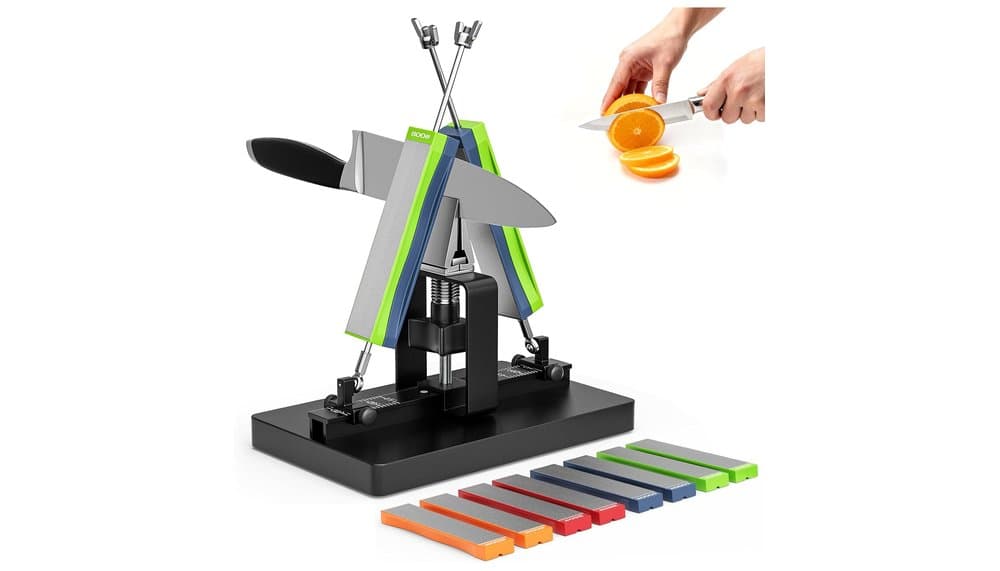
The Jradse SJ1812M is a guided sharpening system of the "rod and stones" type. The principle is proven: the knife is immobilized in a clamp, and an angle-adjustable guide allows a rod with fixed stones to pivot, guaranteeing a constant angle with each pass. The innovation here lies in the double-sided design of the stones, allowing engagement of both sides of the edge in a single back-and-forth motion. On paper, this approach maximizes efficiency and minimizes the risk of creating an uneven bevel, which is a nightmare with freehand stones for a beginner.
See priceMaterials and Finish: A complete kit, but for how long?
The kit is primarily made of metal (likely aluminum and alloys) for the chassis and diamond stones for the abrasives. The technical sheet does not specify the binder or diamond concentration, crucial data for estimating longevity. The community notes that the stones are effective immediately, but expert reviews temper this enthusiasm by pointing out a relatively rapid wear of the abrasive surfaces, especially on the 360 grit used for the most aggressive repairs. The storage box, although practical, is generally made of plastic and serves a portability function more than robust lifelong protection. It is far from the millimeter-perfect solidity and premium materials found on systems designed for intensive professional use.
Performance in Use: Between Immediate Satisfaction and Technical Limits
It is on performance that opinions diverge the most between novice users and seasoned experts.
- For regular maintenance of standard knives: The consensus is excellent. Users are unanimous: the kit restores a very functional and safe edge to common kitchen knives (stainless steels, moderate carbon steels). The progression from 360 to 1000 grit allows for correcting small dullness and achieving an edge that glides easily through tomatoes and onions.
- Facing hard steels and demanding chef's knives: The limits appear. Experts explain that high-carbon steels (like VG-10, AUS-10, or Japanese carbon steels) with a Rockwell hardness (HRC) of 58+ have excellent edge retention but are slower to sharpen and require quality abrasives to avoid being "burnt" or leaving deep, unsightly scratches. The Jradse, with its medium-quality stones, can seem ineffective or lack finesse on this type of blade. It will likely not achieve the mirror edge and characteristic bite obtained with a quality set of water stones.
- Angle Adjustment Precision: Although the graduation is present, the mechanical stability of the system over time is key. For a Japanese double-bevel knife requiring a precise 15° angle, any play in the system compromises the result. Feedback suggests the kit is more comfortable and reliable in the 17°-22° range, typical of Western knives.
Ergonomics and Handling
On this point, user feedback is very positive. The ergonomic handle is described as comfortable, even during prolonged sessions. Angle adjustment is simple, and handling the stones (separable into 8 individual blocks) is intuitive. The main ergonomic pitfall, highlighted by testers, is not related to the tool itself, but to the potential need to hold the base unit with one hand during sharpening if suction or the knife's weight threatens stability. This breaks the workflow and can cause fatigue over several knives.
Durability and "Buy-It-For-Life" Perspective
This is the main question mark. A "for life" tool is judged on its ability to function perfectly in ten years. The elements that raise doubts here are:
- Abrasive Wear: Diamond stones, especially of entry/mid-range quality, wear out. Is their replacement planned by the manufacturer? The technical sheet does not mention the availability of spare parts, a negative signal.
- Robustness of Moving Parts: The pivot axes, clamping mechanism, and clamp are subjected to repeated stress. Their resistance to fatigue will determine if the system retains its original precision.
- Future Adaptability: Could higher-quality stones be adapted to it? Nothing indicates a standardization of the fixings.
The Jradse SJ1812M therefore seems to be an excellent introductory and routine maintenance tool, capable of significantly extending the life of standard knives. On the other hand, for the enthusiast who invests in high-performance blades designed to last a lifetime, this kit could itself become a bottleneck, eventually requiring a move to more robust systems or mastery of freehand stones.
Technical Specifications
| Category | Details |
|---|---|
| Product Name | Jradse SJ1812M Manual Knife Sharpening Kit |
| Type | Manual guided sharpening system with double-sided stones |
| Angle Range | Adjustable from 15° to 30° |
| Included Abrasives | 4 double-sided diamond stones (i.e., 8 usable surfaces) |
| Available Grits | 360 (coarse), 600 (medium), 800 (fine), 1000 (very fine) |
| Compatible With | Kitchen knives, chef's knives, Santoku, pocket knives |
| Special Features | Adjustable clamp, non-slip base, simultaneous double-sided sharpening |
| Main Material | Metal (chassis), diamond stones |
| Dimensions (L x W x H) | Approximately 20 x 12.5 x 22 cm (assembled tool) |
| Net Weight | 595 g |
| Kit Contents | 1 sharpening tool with clamp and guide, 8 abrasive blocks, 1 storage box, 1 manual |
What Users and Testers Say
A synthesis of Amazon customer feedback and available expert analyses paints a clear picture.
The recurring praise revolves around immediate effectiveness and ease of use. Phrases like "finally sharp knives," "revolution in my kitchen," or "excellent value for money" are frequent. Users particularly appreciate the stability of the clamp, the clarity of the angle adjustment, and the time savings offered by the double-sided system. The complete storage box is also seen as a notable plus for keeping everything organized.
Criticisms and reservations mainly come from more technical analyses. They point to the average quality of materials, especially the stones which could wear out prematurely on hard steels. The overall system stability is also questioned; some note that it may need to be braced or held during use, especially with wide knives. Finally, several expert sources highlight the performance ceiling: the kit is perfect for correct and regular maintenance, but will not rival expert freehand sharpening for achieving an exceptional edge on a high-end blade. The learning curve, although low, exists: some users mention needing a few tries to properly understand the motion and adjustment.
Conclusion
The Jradse SJ1812M Manual Knife Sharpening Kit is a convincing proposition for a specific audience: the home cook, perhaps a beginner in the art of sharpening, who wants to regain control over knife maintenance without embarking on a long and tedious learning process. It offers a safe, fast, and systematic solution for maintaining a very decent edge on the majority of common kitchen knives.
However, from the strict perspective of "buy-it-for-life" and equipment for the demanding cook, its compromises become evident. Its materials and construction do not seem destined for intensive professional use over several decades. While it can certainly extend the life of your knives, it likely will not be the sharpening tool that accompanies you "for life." For the enthusiast of Japanese knives, high-carbon steels, or razor edges, this kit represents an excellent gateway into the world of precision sharpening. It is an instructive step, but the quest for the perfect edge will very likely, in time, lead to investing in a high-end guided system or mastering traditional water stones.