Kamberg 28 cm Saute Pan Review & Test
Complete Analysis: Kamberg 28 cm Sauté Pan – A Sustainable Choice?
In the world of serious culinary equipment, the quest for the lifetime tool, the one that lasts through the years and thousands of meals, is a grail. On our site, we celebrate carbon steel, raw cast iron, hardened Japanese steels. So, where does the Kamberg 28 cm Sauté Pan, presented as an aluminum cast utensil with a "stone" coating, stand? This technical and practical analysis, cross-referencing specifications, user feedback, and expert insights, aims to determine if this item can claim a place in a demanding kitchen, or if it belongs to another category.
Strengths
In summary of the data, the Kamberg 28 cm offers immediate and tangible advantages.
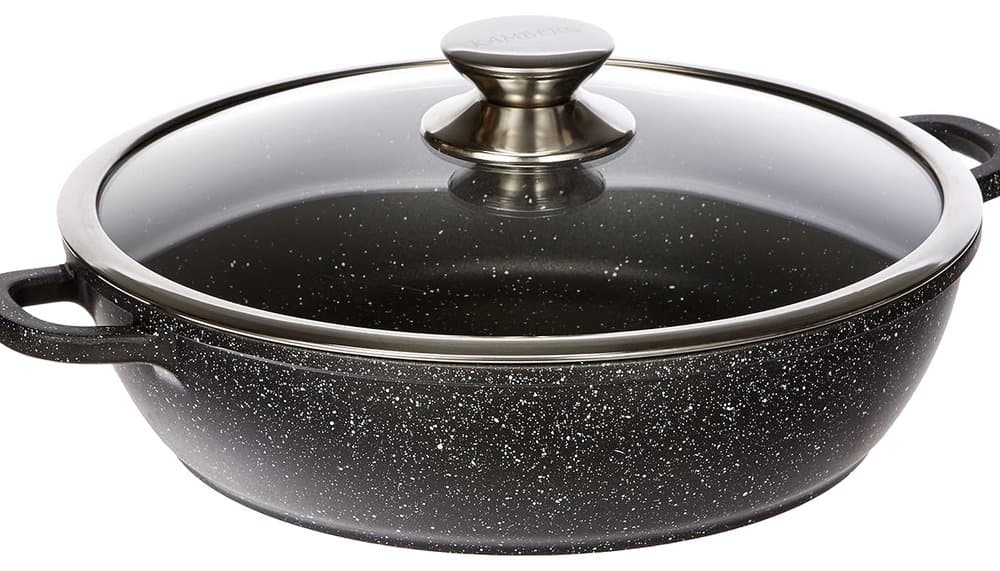
Immediate versatility and practicality. According to user feedback, the pan is highly appreciated for its practical aspect. Its non-stick coating works well initially, allowing for cooking with little or no fat and extremely easy cleaning, including in the dishwasher for many. Its compatibility with all stovetops, induction included, and its oven-safe nature (up to 220°C, without silicone handles) make it a flexible utensil. Its weight, around 1.7 kg for the 28 cm, is perceived as an advantage for easy handling, far from the heaviness of traditional cast iron.
A perceived attractive price-quality ratio. This is the leitmotif of positive reviews. For a moderate investment, the user receives a complete set: the sauté pan, a glass lid with steam vent, and removable silicone handle covers. The overall finish is considered decent for the price. The fairly high shape (7.5 cm) and 28 cm diameter offer useful volume for family preparations, from sautéed vegetables to sauce cookings.
Weaknesses
The identified weaknesses touch the core of the "buy-it-for-life" philosophy: intrinsic durability and material integrity.
Limited coating durability. This is the major critical point, both in customer reviews and technical analyses. The so-called "stone" or "stone coating" is, according to experts, a standard PTFE non-stick coating (Teflon-type) with mineral particles included. It is therefore a marketing argument, not a pure ceramic or mineral coating. Consequently, it is subject to inevitable wear. Several users report a noticeable degradation of the non-stick properties after several months of regular use (around 6 to 12 months), with food starting to stick, forcing the use of more fat. This is not a material that can be "renewed" like cast iron or carbon steel through seasoning.
Ergonomics and construction issues. A recurring flaw in reviews concerns handles that get hot, despite the provided silicone handle covers. This indicates insufficient thermal insulation of the main handle. Another user reported a mechanical failure of the lid attachment after ten months, with the thread having deteriorated. These elements point towards material choices and a finish oriented towards cost control rather than extreme robustness.
Detailed Analysis
Let's dive into a systematic evaluation from the angle of materials and long-term performance.
Materials and Construction: Cast Aluminum and the "Stone" Myth
The body is made of cast aluminum, meaning pressure-cast aluminum. On paper, this provides good heat distribution, more even than simple rolled aluminum. This is a positive point for uniform cooking. However, aluminum is a soft material. It is sensitive to shocks and deformation if handled roughly, although casting gives it some rigidity.
The real subject is the coating. Unlike a carbon steel or cast iron pan that you season and whose performance improves over time, the Kamberg's coating is a consumable. It is PFOA-free (a positive health point), but its nature as modified PTFE makes it vulnerable to metal utensils, excessively high temperatures (beyond 260°C, it degrades and can release toxic fumes), and thermal shocks. Its lifespan is intrinsically limited. We are not talking here about Rockwell hardness, edge retention, or potential "patina": it is a product with built-in obsolescence, whose cooking surface will one day become less effective, then unusable.
See priceCulinary Performance and Ergonomics
Testers and users highlight rapid heat-up and efficient cooking thanks to the aluminum. The sauté pan shape is suitable for stews and sautés requiring a bit of height. The initial non-stick works very well, offering a "worry-free" cooking experience, particularly appealing to occasional cooks or those who avoid tedious cleaning.
Regarding ergonomics, the black mark is confirmed: the handles get hot during prolonged use over medium to high heat. This forces the use of a towel or oven mitt, which is a major inconvenience for a tool meant to be practical for daily use. The silicone handle covers therefore seem to be more of an aesthetic solution than an effective long-term functional one.
Comparison with Our "Lifetime" References
The comparison is clear-cut. A carbon steel sauté pan, once properly seasoned, offers natural non-stick properties that regenerate, withstands extreme temperatures, metal utensils, and abrasives. It can last several lifetimes. An enameled cast iron pan offers exceptional thermal inertia and a very durable vitrified coating (but fragile to shocks). The Kamberg, on the other hand, falls into the category of high-performance non-stick with limited lifespan. It is not suitable for intensive professional use or for a demanding cook wanting a single tool for decades. It is, however, perfectly suitable as a secondary, practical utensil for specific tasks (scrambled eggs, delicate fish cooking, reheating) where one accepts replacing it in a few years.
Technical Specifications
| Characteristic | Detail |
|---|---|
| Body Material | Cast aluminum (molded aluminum) |
| Inner Coating | "Stone effect" non-stick (PTFE with mineral particles), PFOA-free |
| Diameter | 28 cm (usable base ~24-26 cm) |
| Height / Depth | 7.5 cm |
| Capacity | Approximately 4.6 liters |
| Weight | 1.73 kg |
| Compatible | All stovetops: induction, gas, electric, ceramic |
| Oven Safe | Yes, up to 220°C (without silicone handles) |
| Handles | Two fixed handles with removable silicone covers |
| Lid | Tempered glass with steam vent, stainless steel handle |
| Maintenance | Dishwasher safe declared (risk of accelerating coating wear) |
What Users and Experts Say
The synthesis of 1,761 reviews (overall rating 4.5/5) and available technical analyses reveals a clear consensus.
Praise focuses on:
- Excellent initial non-stick performance: "food doesn't stick at all", "healthy cooking without fat".
- Lightness and handiness.
- Ease of cleaning.
- Good price-quality ratio for a complete set.
- Versatility with the lid and induction compatibility.
Recurring criticisms concern:
- Limited coating durability: several testimonies report a loss of effectiveness after less than a year of regular use.
- Handles that get hot despite the heat protectors, a frequently cited problem.
- Occasional but significant construction failures (lid screw, finish).
- The "stone" designation perceived as misleading, as it is indeed a classic non-stick coating, not a pure mineral surface.
Expert analyses confirm these points: the Kamberg is a good non-stick pan in its price category, but it offers neither the durability, nor the high-temperature performance, nor the "lifetime relationship" of raw materials like steel or cast iron.
Conclusion
The Kamberg 28 cm Sauté Pan is a product that perfectly fulfills its promise in the short and medium term. It is light, practical, easy to maintain, and effective for all everyday cooking that benefits from good non-stick. Its price makes it a very accessible option.
However, from the strict perspective of a "buy-it-for-life" purchase and for a serious cook demanding professional-grade tools, it cannot be recommended as a centerpiece. Its PTFE coating is a consumable whose lifespan is limited to a few years, even with extreme care. The issues with handle heating and doubts about the sturdiness of certain attachments also distance it from the stainless robustness we typically seek.
Our verdict: Consider the Kamberg as an excellent secondary, practical utensil for tasks where non-stick is king, accepting that it will need periodic replacement. But for the core of your cookware, investing in a carbon steel sauté pan to season or in a triple-ply stainless steel one will be, without any comparison, more judicious and more economical over 20 or 30 years. The Kamberg is an immediate convenience solution; steel and cast iron are culinary partners for life.