Kanngou Gyuto Chef Knife: Hands-On Review & Test
Introduction
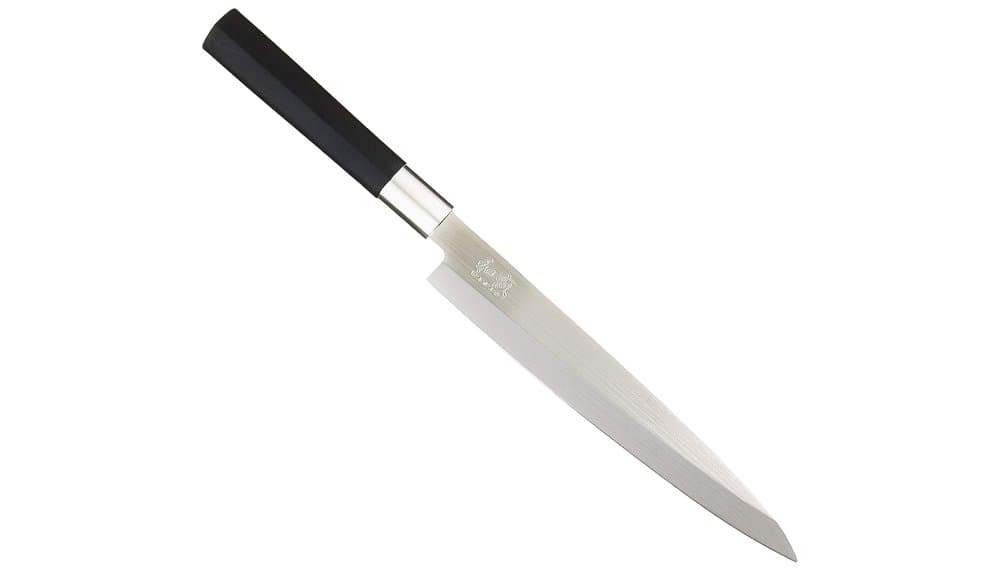
In a market saturated with chef's knife options, the Kanngou Gyuto Chef Knife Japanese Kitchen Knife presents itself as an accessible Japanese cutting instrument, promising the sharpness and aesthetics of a Damascus knife at a constrained budget. This 21 cm Gyuto, the heart of any serious kitchen arsenal, is advertised as forged from VG-10 steel and fitted with a Pakkawood handle. But do these technical specifications hold their promises in the long run, and does this knife constitute a lasting investment for the demanding passionate cook? Our analysis is based on official specifications, a synthesis of available user feedback, and an evaluation of its design to determine if it is a buy-it-for-life tool or a more ephemeral proposition.
Strengths
- Initial Sharpness and Cutting Performance: The knife arrives with a remarkable factory edge that allows for precise and smooth slicing through a wide variety of foods.
- Acceptable Edge Retention: The VG-10 steel, treated to a high Rockwell hardness, offers good cutting performance between sharpenings for regular home use.
- Ergonomics and Balance: The Pakkawood handle design and the knife's overall balance are frequently praised for grip comfort and maneuverability during prolonged use.
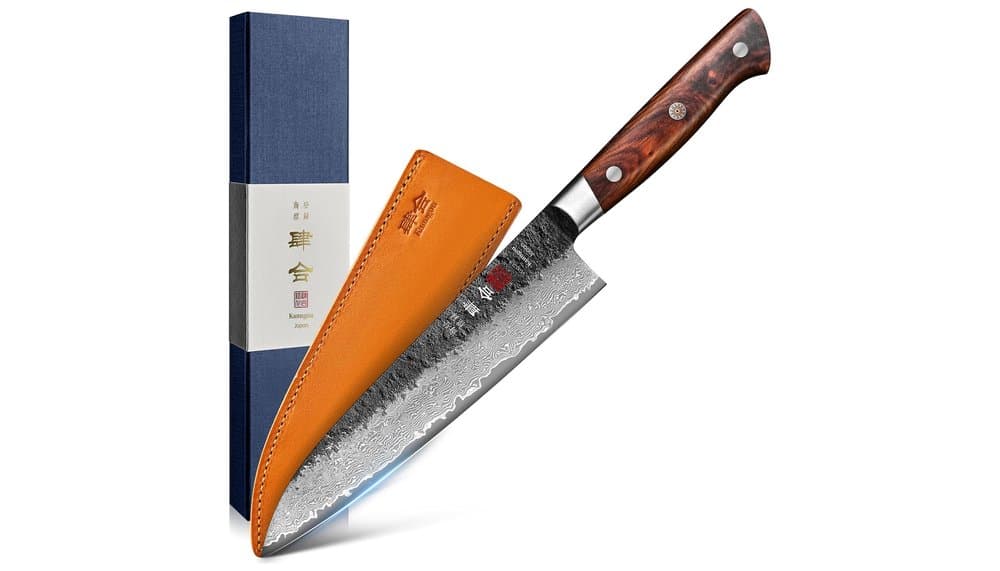
- Presentation and Accessories: The inclusion of a leather sheath and a neat gift box makes it an attractive unboxing product, perceived as offering good value for money in its segment.
Weaknesses
- Contested Origin and Authenticity: The "Made in China" mention on the packaging creates a gap between the "Japanese" marketing and manufacturing reality, raising doubts about the authenticity of the announced traditional forging processes.
- Aesthetic Damascus Finish: The Damascus pattern on the blade is, according to several users, most likely laser-etched rather than the result of multi-layer forging, reducing it to a purely decorative finish with no impact on performance.
- Handle Durability: Without regular oil/wax maintenance, the wooden handle risks losing its luster and drying out over time, requiring proactive maintenance for its longevity.
- Lack of Transparency: The absence of independent expert testing and the ambiguity surrounding the exact manufacturing processes make a complete assessment of its intrinsic long-term quality difficult.
Detailed Analysis
The Blade: Between Promising Specifications and Manufacturing Reality
The core of the analysis lies in the blade. On paper, the specifications announce a VG-10 steel core, surrounded by 67 layers of stainless steel to create a Damascus pattern, all with a Rockwell Hardness (HRC) of 61±1. This figure is crucial. An HRC of 61 places this knife in the high range for home and light professional use. This translates, in theory and according to feedback, into excellent edge retention: users confirm it stays sharp for a long time, with some only needing to sharpen it twice in a year of daily use.
However, sharpening and maintenance require attention. VG-10 at this hardness is less forgiving than softer steel. To maintain it, a quality whetstone is strongly recommended over an abrasive mechanical sharpener, which would degrade the blade's geometry. This is where "buy-it-for-life" comes into play: a user willing to learn the basics of sharpening on a stone will be able to preserve this tool for decades.
The main question mark concerns the "Damascus" construction. Testers and knowledgeable users point out that the pattern appears too perfect and regular, characteristic of laser etching rather than traditional forging. This practice is common in entry-level ranges, but it is purely aesthetic. It does not offer the potential friction-reduction benefits of genuine forged Damascus. The hollow edge (Granton edge) finish is present and indeed helps reduce food sticking, as noted in the specifications.
See priceThe Handle and Ergonomics: Comfort Conditioned on Maintenance
The Pakkawood handle (a stabilized composite wood) is a consensus strength. User feedback describes it as comfortable, well-calibrated, and offering a secure grip. Its ergonomics and the knife's balance (weighing 170g) help reduce fatigue during long cooking sessions, an essential criterion for the serious cook.
A point of caution emerges, however: as with any untreated wooden handle, maintenance is required. An experienced user recommends oiling and waxing the handle upon receipt to prevent drying and micro-cracks. This small maintenance ritual, simple but regular, is the price to pay to guarantee the lifelong durability of this part of the knife.
Construction, Finishes, and Accessories
The technical sheet mentions a "forged" construction but without further details on the process. The presence of the leather sheath is a real plus for safe storage and protecting the edge. The gift box enhances its appeal as a gift offering, which user reviews confirm.
However, the gap between the "traditional Japanese" positioning and the visible "Made in China" mention on the box is, for a portion of the clientele, a real barrier to trust, perceived as a marketing ambiguity. This does not detract from the perceived performance but impacts the perceived value and authenticity of the object.
Technical Specifications
| Characteristic | Detail |
|---|---|
| Model | Kanngou Gyuto Chef Knife Japanese Kitchen Knife |
| Blade Length | 21 cm (approximately 8.25 inches) |
| Blade Type | Gyuto (Japanese chef's knife), straight edge |
| Blade Material | VG-10 steel core, surrounded by 67 layers of stainless steel (Damascus pattern) |
| Hardness (HRC) | 61 ± 1 |
| Blade Finish | Damascus pattern, hollow edge (Granton edge) |
| Handle Material | Pakkawood (stabilized composite wood) |
| Construction | Advertised as forged, riveted handle |
| Weight | 170 grams |
| Included Equipment | Protective leather sheath, gift box |
| Maintenance | Manual sharpening recommended (whetstone). Hand wash only. |
What Users Say
A synthesis of 64 customer reviews available (overall rating of 4.4/5) reveals clear trends, both positive and negative.
The recurring positive points revolve around the immediate experience:
- Exceptional Sharpness Upon Receipt: Terms like "razor," "cuts like butter" come up constantly. This is the primary point of satisfaction.
- Comfort of Use: The balance and grip are described as "perfect," "well-balanced," reducing effort.
- Good Perceived Value for Money: For its price, many feel they got an excellent deal, obtaining performance superior to mainstream knives.
- Beautiful Gift Product: Its careful packaging makes it a much-appreciated gift for cooking enthusiasts.
Criticisms and reservations focus on deeper aspects:
- Question of Origin: Several French comments express clear disappointment upon discovering the "Made in China" mention, contradicting the conveyed "Japanese" image.
- "Fake" Damascus: Knowledgeable users note that the Damascus pattern seems to be an etching and not the result of layered forging, calling it "fake" or "too perfect."
- Necessity of Handle Maintenance: Valuable feedback from an experienced user warns: to last, the handle must be oiled and waxed soon after purchase.
Conclusion
The Kanngou Gyuto Chef Knife Japanese Kitchen Knife is a two-faced product. On one side, it delivers very convincing cutting performance right out of the box, with an aggressive edge, good edge retention thanks to its VG-10 at HRC 61, and ergonomics that make work easier. It easily outperforms the majority of supermarket knives and can satisfy a demanding amateur cook for years, provided it is properly maintained.
On the other side, one must not be mistaken about its nature. This is not traditional Japanese craftsmanship. Its Damascus pattern is most likely aesthetic, and its place of manufacture tempers the marketing narrative. In this, it represents rather the democratization of high technical specifications (good steel, good hardness) via efficient industrial production.
Our verdict for the buy-it-for-life buyer is therefore nuanced. If you are looking for a performant, durable, and aesthetic tool on a constrained budget, and you accept its origin and finishes for what they are, the Kanngou Gyuto is a solid choice. Its longevity will entirely depend on your commitment to sharpen it on a stone and maintain its wooden handle. On the other hand, if cultural authenticity, forging tradition, and total transparency about manufacturing are non-negotiable criteria for your lifelong investment, you should probably look towards established Japanese brands, with the corresponding budget.