Kela Calido Cast Iron Wok Test & Review
Introduction
In the world of durable cookware, the wok holds a special place. It is the tool of fire mastery, rapid searing, and balanced cooking. The arrival of a model like the Kela Calido Cast Iron Wok directly questions our "buy-it-for-life" philosophy: can an enameled cast iron rival the legendary agility of a carbon steel wok? Here, we are not faced with a traditional Asian utensil, but with a robust European interpretation, promising versatility and durability. Our analysis will dissect this proposition by examining its materials, thermal behavior, ergonomics, and relevance for the demanding cook looking for a lifelong tool.
Strong Points
- Thermal Versatility and Universal Compatibility: Its major asset is its compatibility with all heat sources, including induction, a rare and valuable feature for modern kitchens.
- Exceptional Thermal Inertia: As true cast iron, it accumulates and redistributes heat very evenly, eliminating hot spots and allowing for maintaining a stable temperature for simmering or frying.
- Robust Construction and Finish: The manufacturer Kela's reputation and user feedback agree on solid build quality. The exterior enamel is reputed to be resistant and aesthetic.
- Simplified Maintenance via Enamel: Unlike raw cast iron or carbon steel, the enameled interior does not require complex seasoning and is easier to clean, a significant argument for many.
- Complete Set: The inclusion of a fitting glass lid adds real versatility, transforming the wok into a casserole for braising or steaming.
Weak Points
- Weight and Limited Maneuverability: At 4.7 kg (wok alone), it is massive. The dynamic gestures of wok tossing are practically impossible, making it a more static tool.
- Handles Become Burning Hot: The most criticized ergonomic flaw. The integral cast iron handles conduct heat enormously and quickly become too hot to touch without a potholder, a notable inconvenience during handling.
- "Grating" Cooking Surface: The textured interior enamel, presented as an asset for flavors, is perceived by some users as a surface where food tends to stick more than on a smooth finish or perfectly polished seasoning.
- Slow Heat-Up: The inertia that is an asset for stability is a drawback for responsiveness. It requires a longer preheat than a carbon steel wok to reach searing temperature.
- Potential Enamel Fragility: Although durable, the enamel can crack or chip in case of severe impact or sudden thermal shock, unlike steel which can dent but remains functional.
Detailed Analysis
Materials and Manufacturing: The Robustness of Enameled Cast Iron
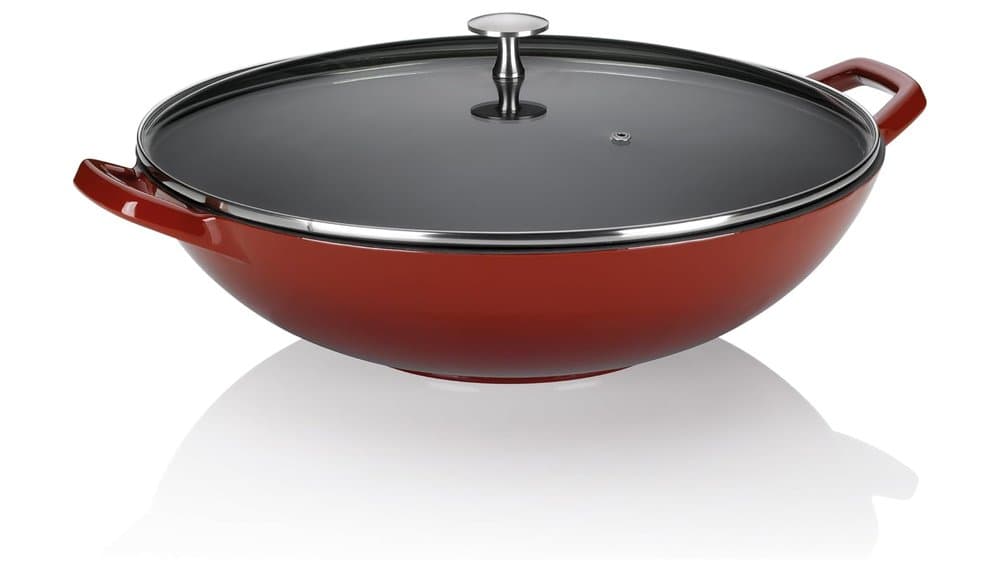
The Kela Calido is made from enameled cast iron. This is where its deep identity lies. Cast iron, an alloy of iron and carbon, is the king material for heat retention and homogeneous distribution. Its significant mass (1 kg for the product alone, approximately 4.7 kg with the lid according to feedback) is the direct counterpart. The enamel, a layer of glass fused at high temperature onto the cast iron, gives it several advantages: it makes the surface stainless, eliminates any need for seasoning to prevent rust, and simplifies maintenance. However, this finish radically distinguishes it from traditional carbon steel woks, which rely on a layer of polymerized seasoning (carbonized oil) to be non-stick. The durability of cast iron is proverbial, potentially lasting several generations if the enamel is preserved.
See priceCooking Performance: Stability Over Agility
Thermal performance is its domain of excellence. According to user feedback and expert tests, once hot, the Kela Calido maintains an incredibly stable temperature. This is a major asset for frying (the oil doesn't drop in temperature when food is added) and for saucy dishes requiring gentle, constant simmering. Its induction compatibility is a decisive argument for modern kitchens where gas is not available. On the other hand, its responsiveness is low. It is not suited for the ultra-fast "high-heat" cooking style where power is constantly adjusted: it takes time to heat up and cool down. The texture of the interior enamel, described as "rough" or "grating," divides opinions. Some see it as an advantage for searing food, others find that certain ingredients, especially eggs or lean meats, can stick if the preheating technique and amount of fat are not mastered.
Ergonomics and Handling: The Weight/Heat Compromise
This is the point where the design shows its limitations for typical "wok" use. Its high weight relegates it to an almost fixed position on the cooktop. The iconic chef's gesture of tossing food is not safely achievable. The second problem, consistently reported, is the thermal conductivity of the handles. Made of solid cast iron, they heat up as quickly as the body of the wok. Testers emphasize that it is imperative to use potholders or a folded towel for every manipulation, even to move it slightly. This negatively impacts fluidity and safety in the kitchen. The handles are, however, well-sized for a solid grip with protection.
Durability and Maintenance: "Buy-It-For-Life" Under Conditions
The construction appears robust and without major flaws according to the community. The cast iron itself is almost indestructible under normal use conditions. The "buy-it-for-life" promise therefore rests entirely on the integrity of the enamel. With respectful treatment (no violent thermal shocks, no dropping, no use of aggressive metal utensils), it should last decades. Maintenance is a strong point: no risk of rust, cleaning with simple mild soap is sufficient. Be careful, however: dishwasher use, although often indicated as possible by enamelware manufacturers, is discouraged by purists to preserve the enamel's shine and integrity over the very long term.
Technical Specifications
| Characteristic | Detail |
|---|---|
| Product Name | Kela Calido Cast Iron Wok |
| Diameter | 36 cm |
| Capacity | 4 Liters |
| Main Material | Enameled cast iron |
| Compatible With | All heat sources (Gas, Electric, Ceramic, Induction) |
| Weight (indicative) | ~4.7 kg (with lid, according to feedback) |
| Interior Finish | Textured enamel |
| Handles | Two fixed handles in enameled cast iron |
| Lid | Yes, glass with steel handle |
| Oven Resistance | Wok: 300°C / Lid: 220°C |
| Maintenance | Hand washing recommended |
What Users Say
The synthesis of customer reviews and expert feedback consulted paints a clear consensus on several points.
The praise mainly focuses on:
- The perceived build quality: users describe it as "solid," "beautiful," "high-end."
- The cooking performance: many highlight the even cooking and heat retention for "crispy" or perfectly simmered results.
- The versatility offered by induction compatibility and the presence of the lid.
- The ease of cleaning compared to a non-enameled wok, often cited as a relief.
The recurring criticisms are unequivocal on two aspects:
- The weight: The heaviness is the first drawback mentioned, often humorously but also as a warning for people with weak wrists.
- The burning handles: This is the most frequent and consensual negative point. Almost all comments mention the absolute necessity of using potholders, lamenting a lack of design in this area.
A debate exists on non-stick properties. Some users are satisfied by using a sufficient amount of oil and an adapted preheating technique. Another part, a minority but significant, expresses disappointment, expecting perfect non-stick behavior and finding that food sticks too easily on the textured surface. This suggests that this wok requires learning its heat curve and fat management.
Conclusion
The Kela Calido Cast Iron Wok is a formidable kitchen tool, but it does not match the profile of the agile and reactive traditional wok. It is a hybrid casserole-wok, excellent in its own domain.
It constitutes a durable and wise investment for the serious cook who:
- Owns an induction cooktop or regularly changes stove types.
- Prioritizes simmered dishes, stable frying, and one-pot saucy meals.
- Seeks maintenance simplicity without the seasoning process.
- Accepts trading quick-handling agility for professional thermal inertia.
On the other hand, it will not suit the enthusiast of "by-the-minute" wok cooking, who values lightness, responsiveness, and the ability to handle the vessel with one hand for energetic stirring. Its weight and burning handles make it a rather static tool, requiring foresight and vigilance.
In short, if you are looking for a versatile and indestructible thermal autoclave for your kitchen, the Kela Calido is a very convincing option. If you dream of replicating wok hei (the "breath of the wok") and the gestures of the Asian street chef, a traditional carbon steel wok, despite its more demanding maintenance, will remain the most adapted tool for that specific practice. The choice here is between robust European-style versatility and specialized Asian-style agility.