King Finishing Stone S S-3 #6000 Whetstone Review & Test
Introduction: The Finishing Edge of a Japanese Legend
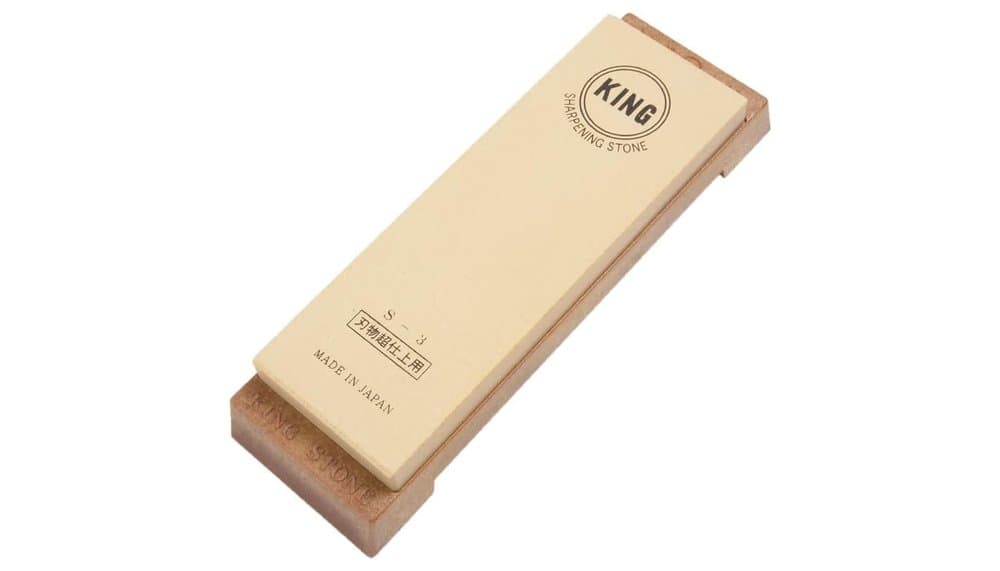
In the demanding world of precision sharpening, the finish is what separates a simply sharp knife from an instrument with a razor-sharp, mirror-like edge. For the passionate cook, lover of Japanese knives or well-tempered Western blades, the final stone in the process is crucial. It removes only micrometers of material, but it defines the bite of the blade into food. The King Finishing Stone S S-3 Grit #6000 fits into this tradition by presenting itself as the accessible finishing stone from a historic Japanese brand. Manufactured by Matsunaga, a name respected for decades, this tool promises to transform a good sharpening into an exceptional result. Here, we will dissect this object not as an accessory, but as an investment in the longevity and performance of your knife collection. Its "buy-it-for-life" approach lies not necessarily in the stone's own indestructible durability, but in its ability to indefinitely maintain the optimal edge of your blades, provided you understand its character and needs.
Strengths and Weaknesses: A Balanced Profile
Strengths
- Remarkable finishing result: According to user feedback and testers, the #6000 grit produces a razor-sharp edge and a highly appreciated mirror or semi-mirror polish on fine blades, perfect for sushi knives or gyutos.
- Prized tactile feedback: The community unanimously notes that this stone offers a smooth and velvety sensation during sharpening. This feedback is often described as pleasant and intuitive, allowing for a better feel of the blade contact.
- Attractive price-to-quality ratio: On paper, the S-3 positions itself as an affordable entry point to Japanese quality, offering performance far superior to low-end stones.
- Ease of use: A water stone that requires only a 3 to 5 minute soak (splash-and-go type) is simpler to set up than oil stones and avoids the complications of dry sharpening.
- Complete kit: The inclusion of a non-slip plastic base is a significant plus for stability, especially for beginners.
Weaknesses
- Limited durability of the matrix: The most frequently cited flaw is the relatively soft stone. It wears and dishes faster than high-end models, requiring frequent flattening to maintain a perfectly flat surface.
- Limited compatibility with hard steels: Experts agree that this stone, with its alumina-based abrasive, is not ideal for modern high-carbon steels (like powdered steels such as S35VN, Maxamet) or steels hardened above 64 HRC. It would skate on these steels and wear out even faster.
- Support stability could be improved: Several customer reviews point out that the provided plastic base can sometimes lack stability, with a risk of tipping if pressure is not perfectly centered, especially on a wet surface.
- Restrictive stone width: At 6 cm wide, some users find the surface a bit narrow for comfortably sharpening large Western chef's knives, requiring more precise passes.
Detailed Technical Analysis: Beyond the #6000 Grit
Materials and Manufacturing: The Matsunaga Legacy
The King S-3 is a composite water stone. It is not made from a single block of natural material, but from abrasives (likely alumina) bonded in a matrix. Its marketing strength lies in its origin: made in Japan by Matsunaga, a company whose reputation in the field of grinding wheels and sharpening stones is well-established. This heritage guarantees a quality control and consistency not always found in low-cost productions. The product exudes authenticity, which, for an enthusiast, holds significant value.
See priceSharpening Performance: The Specialist in Fineness
This stone is in no way a repair or reprofiling stone. Its role is exclusively edge finishing and polishing. On paper, the specs announce a #6000 grit, but expert feedback and community comparisons indicate that the resulting polish is sometimes slightly less fine, closer to a #5000 grit, and leaves a slightly hazy mirror finish rather than a perfect mirror. This is not a flaw, but a characteristic. For a brilliant mirror finish, a follow-up on a strop loaded with 1-micron or less polishing paste is often recommended after this stone.
Its abrasion is slow and controlled, which is ideal for finishing. The tactile feedback is its major asset: the sensation is described as smooth, almost "clay-like," allowing for excellent contact with the blade's edge. The formation of an abrasive slurry during use aids in polishing and provides this characteristic feel.
Compatibility with Steels: The Target Audience
This is where its "buy-it-for-life" positioning for your knife collection plays out.
- Japanese Carbon Steels (White #1, #2, Blue #1, #2): This is its preferred territory. Testers emphasize that these steels, even hard ones (around 62-64 HRC), respond magnificently to the King #6000. The stone bites effectively and produces an extremely sharp edge with a beautiful polish.
- Japanese Stainless Steels (VG-10, AUS-8/10, Silver-3/Ginsan): Excellent results as well. VG-10, very common, is regularly cited as perfectly compatible.
- German/European Stainless Steels (X50CrMoV15, 1.4116 - ~55-58 HRC): Very well suited. The stone polishes them without difficulty and allows for a much more aggressive edge than with a classic steel.
- Modern High-Carbon, High-Alloy Steels (CPM, powdered, etc.): Not recommended. As expert context states, alumina is not hard enough to effectively cut the vanadium or tungsten carbides present in these steels. Sharpening would be ineffective, frustrating, and wear out the stone prematurely. For these steels, one must turn to diamond or CBN stones.
Durability and Maintenance: A Necessary Commitment
Durability is the point of divergence from the "buy-it-for-life" ideal for the object itself. The stone is soft. This means that with regular use, it will require rigorous maintenance. Periodic flattening with a flattening plate (diamond plate, coarse-grit stone) is essential to maintain its flatness. This is the price to pay for its pleasant sharpening feel and contained price. Its longevity therefore depends entirely on the frequency and rigor of its maintenance. Well maintained, it can last for years for home use. Neglected, it will dish quickly and become unusable.
Technical Specifications
| Characteristic | Detail |
|---|---|
| Product Name | King Finishing Stone S S-3 Grit #6000 |
| Brand | King (Matsunaga) |
| Country of Manufacture | Japan |
| Grit Type | #6000 (Fine finish) |
| Stone Type | Water stone (quick soak) |
| Dimensions (L x W x H) | 185 mm x 62 mm x 15 mm |
| Weight | Approximately 458 g |
| Material | Abrasive composite (alumina) |
| Included Accessory | Non-slip plastic base |
| Recommended Use | Edge finishing and polishing |
What Users Say: A Synthesis of Feedback
Analyzing nearly 800 customer reviews and online expert discussions reveals a strong consensus, with some nuances.
Praise is majority and repeated: The words "perfect", "mirror", "razor sharp", and "excellent finish" come up repeatedly. Users, especially those moving from low-end stones, are won over by the quality of the result and ease of use. The smooth sensation is also highly praised. The mention "Made in Japan" is consistently highlighted as a mark of trust.
Criticisms are targeted and consistent:
- Rapid wear: This is the main complaint. Many users confirm the stone dishes and requires regular maintenance.
- Unstable base: Several testimonials mention that the plastic base can be wobbly, sometimes forcing one to wedge it or use a heavier base.
- Unsuitability for very hard steels: Knowledgeable users and experts warn against its use on modern high-carbon steels, confirming it is a tool designed for traditional cutlery steels or common kitchen steels.
An experienced user sums up the mindset well: it is a stone that "requires a good level of expertise" and is not meant for "simple sharpening" but for the "finish of a Japanese blade".
Conclusion: Who is This Finishing Stone For?
The King Finishing Stone S S-3 Grit #6000 is not a universal tool, and that is precisely what makes it an honest recommendation. It is not the most durable stone on the market, nor the one suited to the most exotic steels.
However, it is an excellent finishing stone for the serious and passionate cook who owns a collection centered on traditional Japanese knives (carbon or stainless steels like VG-10) or quality Western knives. For this user, it represents a wise investment: it allows reaching a professional level of sharpness at a moderate cost, while offering a very pleasant sharpening sensation. Its "buy-it-for-life" philosophy applies to your knives, not to the stone itself, which will require attentive care.
If you are ready to integrate regular flattening into your maintenance routine, and your blades are primarily made of compatible steels, the King S-3 #6000 is a hard-to-beat choice in its price category. It will accompany you for years in perfecting the edge of your best knives. For intensive, daily use on very hard steels, or if you are looking for a maintenance-free stone, you will then need to look towards higher-end, harder ranges, such as Shapton Pro or Naniwa Chosera/Professional, with a significant investment.