kjök Premium Manual Knife Sharpener Review
Introduction
On a site dedicated to durable and high-performance kitchen tools, the question of sharpening is never trivial. It is the maintenance that determines the longevity and efficiency of a knife, whether it's a carbon steel sabatier or a Japanese VG-10 gyuto. The arrival on the market of the kjök Premium Manual Knife and Scissors Sharpener promises a compact, versatile, and accessible solution for maintaining an edge. But can this type of guided-slot sharpener meet the demands of a serious cook, an enthusiast of "buy-it-for-life" knives? We analyze this product here from the perspective of materials, real-world effectiveness, and its place in a demanding culinary arsenal.
Strengths
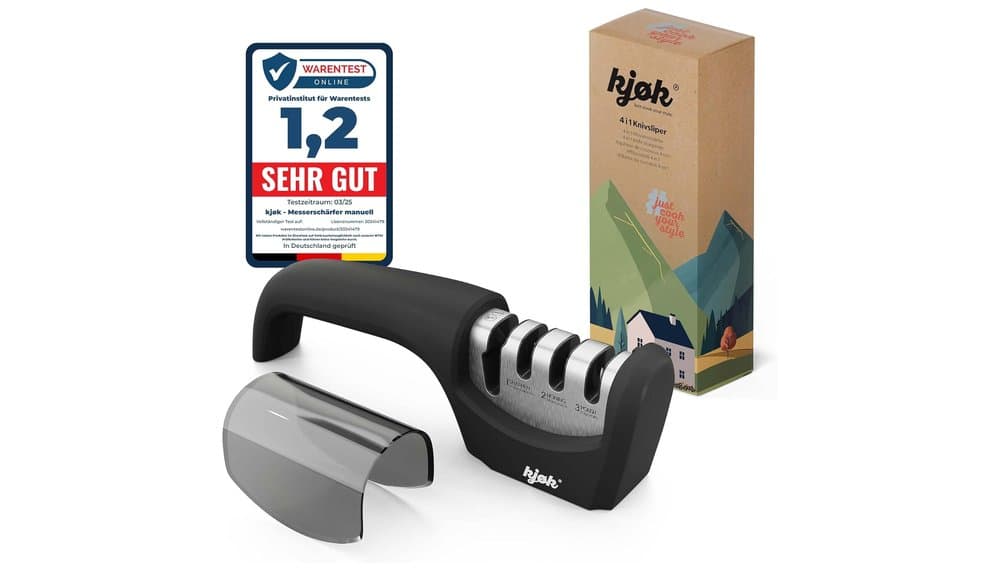
- Immediate Versatility: The ability to handle four types of blades (coarse sharpening, fine sharpening, scissors, serrated blades) with a simple rotating knob is its main selling point. It's a practical all-in-one for a standard household.
- Ease of Use and Safety: No technical skill is required. The guided slot system eliminates the risk of a bad angle and the non-slip feet ensure stability, a point often highlighted by users for its reassuring aspect.
- Compact and Self-Contained Design: At 21 cm long and 191 grams, it fits in any drawer. Its manual operation makes it usable anywhere, from camping to the workshop.
- Quick Results on a Dull Edge: For a standard western kitchen knife that has lost its bite after regular use, feedback confirms that it restores a functional edge in a few passes.
Weaknesses
- Technical Limit for Quality Knives: According to expert analysis, it acts more as an abrasive "blade reconditioner" than a true sharpener. It is unsuitable for recreating a completely lost cutting edge or for restoring a badly damaged blade.
- Risk for High-End Blades: Japanese knives with acute angles (15-18°) or hard steels (HRC 60+) require precise sharpening on a stone. The abrasive action and fixed angle of this type of sharpener can damage the burr, wear the blade unevenly and reduce its lifespan.
- Limited Effectiveness on Scissors and Very Dull Blades: User experience notes that its action on scissors is adequate but not exceptional, especially on very old models.
- Durability of Sharpening Components in Question: The tungsten carbide and ceramic rods are hard materials, but their long-term wear, at this product's price point, is not documented. This is an unknown from a "buy-it-for-life" perspective.
Detailed Analysis
Materials and Construction: Plastic vs. Performance
The housing is made of ABS, a robust and lightweight technical plastic, a logical choice for an object at this positioning. What interests us here are the active elements. The kjök Premium uses a mix of diamond, ceramic, and tungsten carbide rods. These materials are abrasive and effective at quickly removing material.
However, this is where the problem lies for the knife enthusiast. Unlike a ceramic or diamond whetstone where the angle and pressure are manually controlled, the slots of this type of sharpener impose a fixed and standardized angle, often around 20-22°. This angle is acceptable for most western knives, but it is too obtuse for Japanese knives, crushing their fine edge. Furthermore, the process is purely abrasive: it tears away material without performing the polishing and fine burr removal offered by a progression of grits on a stone. The result is an aggressive but less durable and less precise edge than that obtained by traditional methods.
See priceErgonomics and Handling
User feedback agrees on the ease of use and stability provided by the rubber pads. The ergonomics are designed to keep hands away from the blade, which is a real plus for novice safety. For quick maintenance of a few knives, the handling is considered comfortable. On the other hand, for a prolonged sharpening session of a full set of knives, the repetitive manipulation of the rotating knob and the blade passing can become less pleasant than sharpening on a stone, where the motion is more natural and controlled.
Comparison with Professional Methods
It is crucial to situate this tool within the sharpening ecosystem:
- Versus Whetstones: There is no comparison possible in terms of finish quality and control. A stone allows you to adapt the angle to each blade, work with very hard steels (like VG-10 or Shirogami), and produce a razor edge that lasts. The kjök is a quick-fix or basic maintenance solution.
- Versus High-End Electric Sharpeners: As expert tests point out, brands like Chef'sChoice, with their multi-stage guided diamond wheel systems, offer a far superior, more consistent, and more durable result. The manual kjök is an economical and manual alternative, but the final result and edge longevity are not in the same league.
- In a "Buy-It-For-Life" Approach: A true "for life" sharpening tool would be a set of quality stones (for example, a 1000/6000 grit combination) which, with practice, will last decades. The kjök Premium is a convenient accessory whose longevity will depend on the durability of its abrasive rods, a factor difficult to assess in the long term.
Target Audience: Who Is This Sharpener For?
The kjök Premium Manual Sharpener fits perfectly with the occasional or family cook who owns a set of standard stainless steel knives and is looking for a simple, no-fuss way to restore their bite regularly. It is also useful as a quick backup tool in a workshop or for basic cutting tools.
Conversely, it is not suitable for the passionate chef knife enthusiast, the owner of fine Japanese blades or high-hardness carbon steel knives. For these users, its use could even be counterproductive, degrading previous sharpening work. Web experts are clear: for quality blades, investment in learning (hand sharpening on a stone) or in a professional electric sharpener is essential.
Technical Specifications
| Feature | Detail |
|---|---|
| Product Name | kjök Premium Manual Knife and Scissors Sharpener |
| Housing Material | ABS (matte black) |
| Sharpening Components | Diamond, ceramic, and tungsten carbide rods |
| Functions | 4-in-1: Coarse sharpening, fine sharpening, scissors, serrated blades (bread) |
| Dimensions (L x W x H) | 21 x 5.1 x 6.8 cm |
| Weight | 191 grams |
| Power Source | Manual |
| Stability | Non-slip rubber feet |
| Target Audience | Domestic use, versatility |
What Users and Experts Say
The synthesis of customer reviews (notably on Amazon, with a rating of 4.4/5) and available expert analyses online paints a nuanced consensus.
The recurring positive points are the ease of use ("simple", "practical", "stable"), satisfaction with results on average knives ("completely dull knife that got a second life", "afilador increíble"), and the appreciated versatility (knives, scissors). The compactness is also a major asset.
The criticisms and highlighted limitations converge on several points:
- Lack of Clear Instructions: Several users regret the absence of a detailed paper manual in French.
- Durability of Markings: One tester notes that the markings on the rotating knob wear off quickly (after a month of use).
- Confirmed Technical Limits: Expert analyses validate that it is good for regular maintenance, but not a renovation tool for badly damaged blades. Its effectiveness on scissors is judged inconsistent.
- Unsuitable for Quality Blades: The knife enthusiast community warns against its use on fine blades or hard steel, systematically recommending whetstones for these models.
Conclusion
The kjök Premium Manual Knife and Scissors Sharpener is a legitimate tool in its segment. It fulfills its promise very well: to offer a versatile, simple, safe, and compact solution for the basic maintenance of standard household knives and scissors. For the vast majority of households, it represents a clear improvement over doing nothing or using an improperly handled steel.
However, within the specific context of a site dedicated to "buy-it-for-life" culinary tools and professional-quality knives, its role must be clearly defined. It cannot be considered a professional sharpener. It is incompatible with the maintenance philosophy for Japanese knives, carbon steels, or high-hardness tempered blades. For the latter, it even represents a risk of uncontrolled wear.
Our verdict: This sharpener is an excellent backup option for the serious cook who wants to slightly extend the edge of their daily-use western knives between two real sharpening sessions on a stone. But it should in no way replace the whetstone, the essential and truly durable tool for anyone who owns and cherishes quality blades. Consider it the handy multitool of sharpening, not its foundation.