LAGUIOLE 3-Step Knife Sharpener Review
Introduction
When investing in quality knives—be they Japanese, high-carbon steel, or modern steels like VG-10—their maintenance becomes a crucial question. Poor sharpening can ruin years of faithful service in an instant. The LAGUIOLE Knife Sharpener in 3 Steps presents itself as a dedicated and simplified solution, promising to restore the edge to the brand's iconic blades. But in the world of "buy it for life" tools, where waterstones and manual know-how reign supreme, where does this object stand? We analyze this product from the perspective of durability, technical relevance, and its suitability for the demands of serious cooks.
Strengths
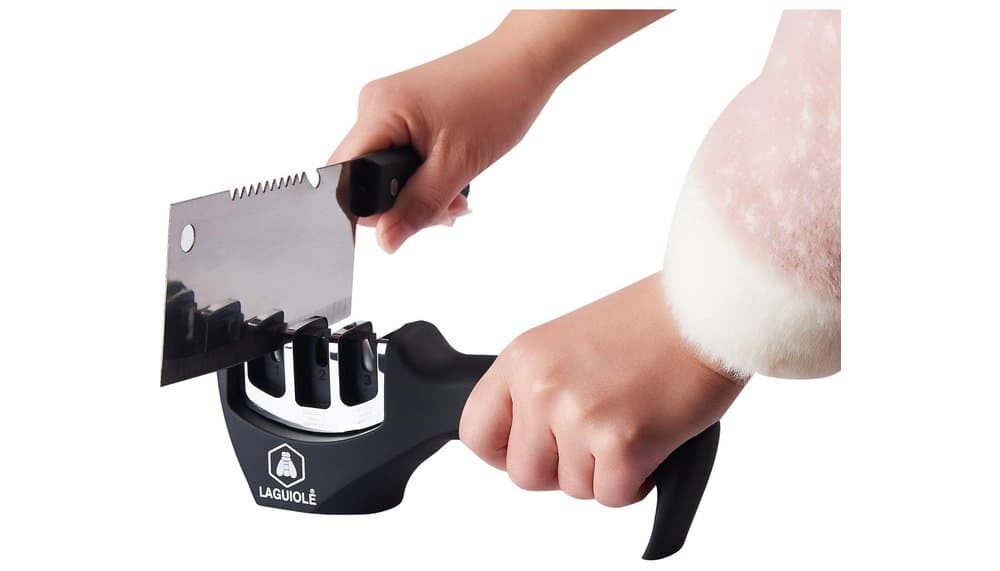
- Ease of use: The three-step method (diamond, carbide, ceramic) guides the user and eliminates the intimidating learning curve of traditional stones.
- Structured approach: The sequential process is designed to remove burrs, sharpen, and polish, offering a complete maintenance routine in a single tool.
- Robust construction and finish: The object, made of stainless steel, has a build quality that seems solid at first glance and comes in a gift box, in line with the Laguiole brand image.
- Protection of delicate blades: Unlike some abrasive electric sharpeners, its manual and graduated action limits the risks of overheating the edge and excessive material removal on precious steels.
Weaknesses
- Lack of angle precision: The sharpening angle is predefined and fixed. For very hard steels (like VG-10, AUS-10, white steel) where a precise and constant angle is crucial for edge retention and performance, this lack of control can be a drawback.
- Limited to regular maintenance: According to expert feedback, this tool is designed for regular upkeep, not for restoring a very dull or damaged blade. Its effectiveness on real damage is limited.
- Risk for thin edges: The carbide rods, while effective, can be too aggressive for the extremely fine edges of Japanese knives like Santoku or Gyuto, risking creating an irregular burr.
- Uncertain versatility: Although some user reviews mention its use on "all types of knives," its design is optimized for Laguiole table knives. Its effectiveness on very different blade geometries (e.g., a flat-edged Nakiri) is not guaranteed.
Detailed Analysis
Materials and Operating Principle: A Cascading Approach
The LAGUIOLE Knife Sharpener in 3 Steps relies on a system with abrasive rods that are interchangeable in their function. Analyzing the materials used is essential:
- Step 1 - Diamond: Diamond is the hardest material, used here to "repair and remove the burr." In theory, it prepares the edge by creating a new apex, a crucial step for slightly damaged blades.
- Step 2 - Carbide: Tungsten carbide is a very effective and fast abrasive for sharpening. This is the main working stage. However, its hardness and relatively coarse grit require a light touch to avoid excessive scratching of the blade or altering its profile.
- Step 3 - Ceramic: The ceramic (usually zirconium oxide) acts like a fine stone. It polishes the edge created by the carbide, smooths out micro-imperfections, and aligns the cutting edge, contributing to a more durable and finer edge.
This logical progression is its main marketing asset. However, for the demanding user, the central question remains: does this predefined angle match the factory angle of my knives? A Western chef's knife is often sharpened at 20°, a Japanese one can go down to 15° or less. An unsuitable angle will degrade the blade's geometry over time.
See priceSuitability for High-End Steels
Our site focuses on performance steels. This sharpener's behavior with them is mixed.
- Hard steels (HRC 60-63+ like VG-10, white steel): These steels have excellent edge retention but are more brittle and difficult to sharpen once dull. The Laguiole system, with its first diamond step, can help "wake them up." However, the lack of control over the angle and the fineness of the final result (heavily dependent on the ceramic stage) cannot compete with manual sharpening on an appropriate grit stone (e.g., a Shapton Glass 3000). It is more suitable for regular interim maintenance than for a complete restoration.
- Softer steels (tool steels, some Western cutlery): Here, the tool will likely be more effective and less risky. The carbide will bite well without overly challenging the user, and the ceramic will give an acceptable finish for daily use.
Ergonomics and Long-Term Durability
The object seems compact and heavy (200g), which ensures stability during use. Its format allows for easy storage. The tool's own durability will depend on the quality of the abrasive rods' fastening and their wear resistance. The diamond and ceramic rods are very durable, while the carbide can wear over time on very hard steels. It is not a "for life" tool like a Nagura waterstone that can be used for decades, but rather a convenient system whose lifespan is linked to the wear of its fixed components.
Target Audience: Between Novice and Enlightened Amateur
This sharpener is clearly not designed for the professional or sharpening purist. It targets:
- The owner of Laguiole knives who wants to maintain their investment with a dedicated and aesthetically consistent tool, without seeking absolute perfection.
- The home cook who owns a set of standard knives and looks for a quick, effective, and less intimidating solution than a stone, for an "more than adequate" edge in daily use.
- The person seeking a practical and premium gift for a cooking enthusiast.
For the serious home cook demanding professional performance, this tool will be seen as a compromise. It is useful for quick fixes or maintenance, but will never replace the precision, control, and satisfaction of manual sharpening on progressive grit stones, the only method capable of revealing the full potential of a high-end blade.
Technical Specifications
| Feature | Detail |
|---|---|
| Product name | LAGUIOLE Knife Sharpener in 3 Steps |
| Brand | Laguiole |
| Main material | Stainless steel |
| Dimensions (L x W x H) | 21.3 x 5 x 7.8 cm |
| Weight | 200 grams |
| Sharpening system | 3-step system with fixed abrasive rods |
| Step 1 (Repair) | Diamond-coated rods |
| Step 2 (Sharpening) | Carbide-coated rods |
| Step 3 (Polishing) | Ceramic-coated rods |
| Grit type | Fine |
| Includes | 1 sharpener |
What Users and Experts Say
The synthesis of customer reviews and available technical analyses reveals a consensus with nuances.
Positive feedback unanimously highlights ease of use and effectiveness for daily use. Satisfied users report regaining a functional edge on their common kitchen knives, often in just a few passes. Phrases like "works great," "very easy to sharpen," and "robust" come up frequently. The build quality and gift aspect (with its box) are also praised.
Criticisms and limitations mainly emerge on two fronts:
- Inconsistent results: Several negative (or moderate) reviews indicate that the tool "doesn't sharpen at all" or that the result is disappointing, especially on very dull blades. This validates expert opinions: it's a maintenance tool, not for heavy repair.
- Not for badly damaged Laguiole: A notable review specifies it is effective "except for dull Laguioles," which is an important admission regarding its limit with the very blades it is branded for.
The expert context provides crucial insight: this product is an intermediate solution. It is placed between the electric sharpener (too aggressive) and the hand stone (too technical). Testers confirm it reduces the margin for error and is ideal for regular and simplified maintenance. However, they remind us that for perfect angle control and optimal results on noble steels, manual sharpening remains the benchmark.
Conclusion
The LAGUIOLE Knife Sharpener in 3 Steps is a well-designed tool that fills a specific niche. It is neither a miracle solution nor a useless gadget.
For the general user or the owner of Laguiole knives who wants to extend the life of their blades without training in the art of sharpening, it's a sensible purchase. It offers a structured method, decent build quality, and satisfactory results for a daily-use edge. Its simplicity is its main asset.
On the other hand, for the passionate cook who invests in Japanese knives, carbon steels, or blades with high edge retention, this sharpener must be seen for what it is: a practical compromise. It can serve as a troubleshooting or quick maintenance tool between two real sharpening sessions on a stone. But it will never replace the control, precision, and intimate relationship with the tool offered by using a waterstone or diamond stone. Its fixed angle and standardized abrasive action will not optimize the performance of an exceptional blade.
In short, it's a good product for simple and regular maintenance, but not the ultimate tool for the sharp-blade purist.