Lansky Deluxe Diamond Sharpening Kit Review
Introduction
In the world of precision knife sharpening tools, few names are as instantly recognizable as Lansky. The Lansky Deluxe Diamond Sharpening Kit (4 Stones) is often presented as the ideal bridge between freehand sharpening, which requires considerable skill, and expensive professional systems. On our site, dedicated to durable and high-performance culinary tools, the question is not just whether it sharpens, but whether it constitutes a "buy-it-for-life" investment for the serious cook. Can it handle the hardness of a Japanese white steel (Shirogami) knife or the endurance of a Western VG-10 blade? With technical analysis and hands-on experience to back it up, we dissect this guided system to determine its place in a demanding culinary arsenal.
Key Strengths
- Systematic Angular Precision: The clamp and guide rod system eliminates the main difficulty of freehand sharpening: maintaining a constant angle. This guarantees a uniform and reproducible edge with each use.
- Angle Versatility: The four preset angles (17°, 20°, 25°, 30°) cover a broad spectrum of uses, from razor blades to robust pocket knives, including the 20° angle often recommended for Western and Japanese kitchen knives.
- Efficiency of Diamond Stones: The diamond plates are fast, require no soaking or oiling (simple cleaning with water is sufficient), and are known for their longevity. They are ideal for modern hard steels.
- Accessibility and Learning: It is an excellent pedagogical tool. It teaches the principles of bevel formation and grit progression in a tangible way, much more so than a freehand stone for a beginner.
- Compactness and Storage: The integrated carrying case allows everything to be stored in an organized and protected manner, an asset for long-term durability.
Weaknesses
- Limited Ergonomics on Long Blades: For chef's knives longer than 20 cm, the need to move and re-tighten the clamp along the blade makes the process tedious and poorly suited for quick sharpening in the kitchen.
- Difficult Access to the Heel on Small Blades: On paring or small utility knives, the clamp itself can hinder the stone's access to the base of the blade, especially at the lowest angles (17°-20°).
- Construction with Potential Weak Points: Some plastic components, notably the stone housings or the tightening knob, are reported as potential weak points that can crack under excessive pressure.
- Methodical and Slow Process: This is not a tool for express sharpening. Setup, adjustment, and the meticulous pass on each section of the blade require time and patience.
- Edge Finish: While the resulting edge is very sharp and functional, purists note that the final polish (the "mirror" appearance of the bevel) and the absolute finesse of the edge do not equal those achieved with perfect mastery of Japanese water stones or high-end guided systems.
Detailed Analysis: A "Buy-It-For-Life" Tool?
Construction and Materials: The Devil is in the Details
The system relies on an extruded aluminum clamp, a choice offering a good compromise between lightness and rigidity. However, it is at the attachment points that compromises appear. The guide rods are steel, but the diamond stones are mounted on molded plastic holders. According to user feedback, this is where indestructible durability is called into question. Over-tightening the rod's screw can damage this housing. For careful domestic use, this is generally not a problem, but it distances it from the indestructibility of a ceramic sharpening stone or a solid steel block. The clamp's tightening knob, also plastic, may show signs of wear after years of intensive use according to some accounts.
See pricePerformance on Modern Steels and Rockwell Hardness
This is where the Lansky Deluxe Diamond kit truly shines. Diamond plates are hard and fast abrasives, perfectly suited to high-carbon steels and modern alloy steels whose Rockwell hardness (HRC) often exceeds 58-60. Sharpening a VG-10 (HRC 60-62) or AUS-10 (HRC 58-60) knife with traditional water stones can be time-consuming for a beginner. Diamond bites immediately into these hard steels, allowing for reprofiling an edge or correcting dullness much faster. The 70-grit (ultra-coarse) is designed for this reshaping work, while the progression up to 600-grit allows for a very fine razor edge. For tool steels like simple carbon steels (white steel, HRC 60-65), efficiency is also present, although these steels are generally easier to sharpen, even on traditional stones.
Ergonomics and Practicality for the Serious Cook
This is the major point of divergence. For the owner of a collection of Japanese chef's knives or standard-sized Western knives (15-20 cm), the system works. However, the handling is considered cumbersome and interrupted. You must secure the knife, adjust the clamp, sharpen a section, loosen, move the clamp, re-tighten, and start again. This methodical approach is the antithesis of the speed with which a cook often wishes to maintain their edge on a water stone. The tool excels in dedicated, planned sharpening sessions to restore several knives at once. It is less suited for a "quick touch-up" on the stone after service. For knives with curved blades (like a santoku or gyuto), achieving uniform sharpening along the entire curve requires particular attention to clamp movement.
Comparison with Freehand Sharpening and Other Systems
The Lansky occupies a precise niche. Compared to a freehand Japanese water stone, it sacrifices speed, "feeling," and the potential for ultimate finish for reproducibility and ease of learning. Compared to professional guided systems like KME or Wicked Edge, it sacrifices robustness, micometric precision, and speed of stone changing for a much more accessible entry price. Testers emphasize that it is often an excellent first step into the world of precision sharpening. Many start with it, understand the principles, then evolve either towards freehand for speed and feel, or towards more advanced guided systems for superior finish and speed.
Technical Specifications
| Characteristic | Detail |
|---|---|
| Product Name | Lansky Deluxe Diamond Sharpening Kit (4 Stones) |
| Type | Fixed-angle guided sharpening system |
| Main Material | Extruded aluminum clamp, steel rods |
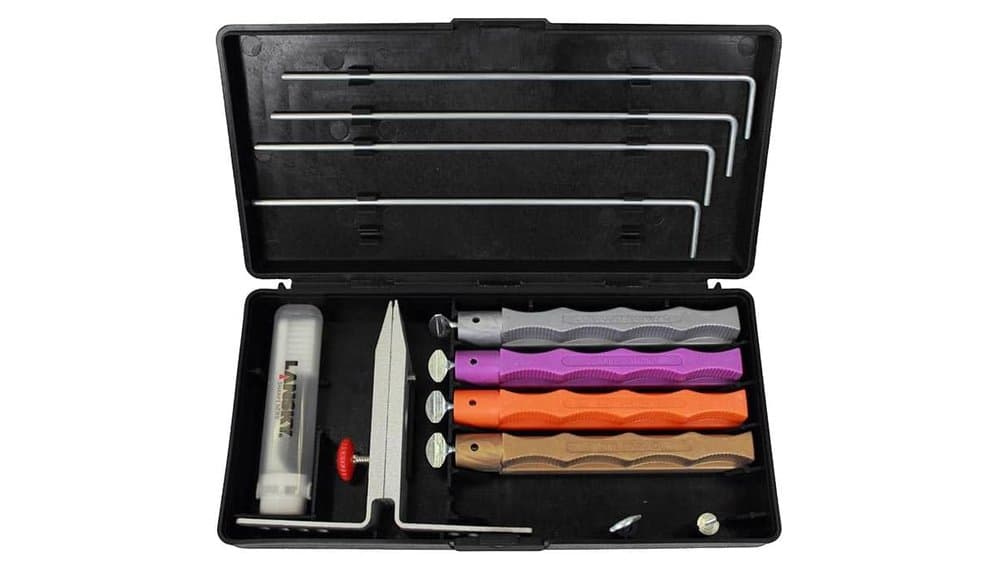
| Included Abrasives | 4 diamond stones on plastic holders |
| Available Grits | Ultra-Coarse (70) - Coarse (120) - Medium (280) - Fine (600) |
| Preset Angles | 17°, 20°, 25°, 30° |
| Included Accessories | Clamp, 4 guide rods, 4 stones, cleaning brush, storage case |
| Stone Size | Useful abrasive length of approximately 5 cm |
| Stone Maintenance | Cleaning with water and soap, quick drying |
What Users and Reviewers Say
An analysis of hundreds of customer reviews and expert feedback on forums reveals very clear trends.
Praise is recurrent and focuses on specific points:
- Guaranteed Sharp Result: The vast majority of users agree that the system produces an exceptionally sharp edge, capable of slicing paper in the air or cutting a tomato effortlessly. The phrase "my knives have never been this sharp" constantly reappears.
- Ideal for Beginners: Many emphasize that this kit is what taught them to sharpen properly, making them understand the importance of a constant angle.
- Fast Material Removal: The diamond stones are unanimously praised for their efficiency, especially on hard steels or badly damaged blades.
- Good Versatility: Users successfully employ it on a wide variety of blades: kitchen knives, pocket knives, hunting knives, and even scissors.
Criticisms and frustrations are just as specific:
- Construction Issues: Several reports mention broken plastic parts (stone holder, knob), often during first use or after tightening deemed normal.
- Ergonomic Limits: The incompatibility with large knives (blades >20cm) is the most frequently cited negative point. The process is described as "tedious," "laborious," or "too long" for a chef's blade.
- Perfectible Finish: A minority of experienced users, accustomed to Japanese stones, find the edge "aggressive" or less refined, even after the 600-grit. They often recommend adding a complementary finishing stone (like the Lansky blue sapphire stone) for superior polish.
- Clamping and Stability: Some note that the clamp can struggle to hold thick or heavy blades firmly without slipping, requiring constant adjustments.
Conclusion
The Lansky Deluxe Diamond Sharpening Kit (4 Stones) is an effective, pedagogical, and precise tool that largely delivers on its promises for anyone wishing to achieve a professional and reproducible edge without mastering the complex gestures of freehand sharpening. Its great strength is democratizing angular precision.
However, from a "buy-it-for-life" and demanding serious cook perspective, the analysis is nuanced. It is an excellent learning and maintenance tool for a varied collection of small to medium-sized knives. It handles hard steels very well and will likely serve you for many years if cared for. On the other hand, its ergonomic limits on large chef's knives and the points of fragility in its construction make it a specialized tool rather than a universal and unbreakable solution.
We highly recommend it to the user who is starting out in precision sharpening and wants a guaranteed result, or to the one who mainly has pocket knives, hunting knives, or standard-sized kitchen knives to maintain. For the professional or culinary enthusiast who uses large chef's blades daily and seeks speed of execution and a master-craftsman finish, it will likely be a step towards more accomplished systems or a return to mastering freehand stones. It is less a tool for life than an excellent teacher for life.