oFuun Santoku Damascus Kitchen Knife Review
Introduction
When it comes to equipping one's kitchen with serious tools, the santoku knife holds a prominent place. Versatile and precise, it is the ally of daily preparations. Among the many offerings, the oFuun Santoku Damascus Kitchen Knife stands out for its remarkable appearance and enticing technical promises. But beyond its aesthetic reminiscent of waves on a lake, is this knife a true "buy-it-for-life" tool, worthy of the attention of demanding cooks? Here we analyze this blade from the perspective of construction, materials, performance, and durability, cross-referencing its specifications with community feedback and expert observations.
Strengths and Weaknesses
At first glance, the oFuun Santoku Damascus presents appealing strengths, but also some compromises to be aware of.
Strengths:
- Exceptional factory sharpness: Most users describe it as a "razor," capable of slicing paper effortlessly.
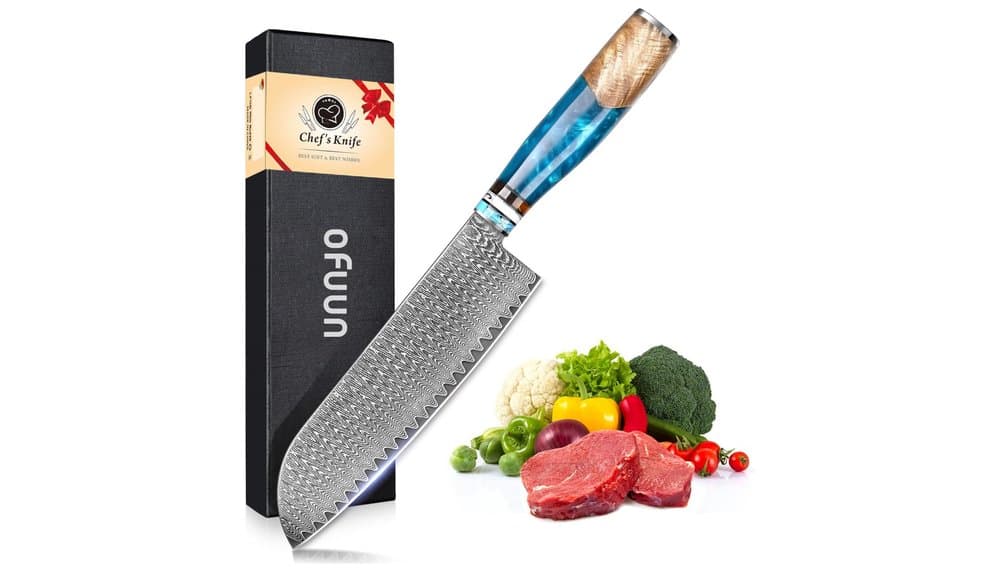
- Careful aesthetics and finish: The 67-layer Damascus pattern and the blue resin handle make it a beautiful object, delivered in a gift box.
- Asserted versatility: The 17.5 cm blade is suited for cutting vegetables, herbs, meat, and fish with great precision.
- Good edge retention: Thanks to the high hardness of the steel (HRC 60-62), the sharp edge holds up well over time.
Weaknesses:
- Lack of a guard or pronounced heel: Several users note that the finger can slip onto the sharp angle of the blade, which represents a potential risk.
- Potentially slippery handle: In wet or greasy conditions, the grip on the resin handle can become less secure.
- Demanding maintenance: Like any quality steel, it requires immediate hand washing and drying, prohibiting the dishwasher.
- Damascus primarily decorative: The 67-layer pattern is primarily aesthetic; cutting performance relies on the steel core.
Detailed Analysis of the oFuun Santoku Damascus
Blade Construction and Materials
On paper, the specs announce a construction of 67-layer forged Damascus steel enveloping a VG-10 steel core. This latter information, often highlighted in detailed product descriptions, is the most crucial. VG-10 is a renowned Japanese stainless steel (grade: 10Cr15CoMoV), containing cobalt and molybdenum for increased fineness of grain and durability. It is a benchmark material in the world of quality knives, balancing performance and corrosion resistance well.
The announced Rockwell hardness (HRC) is 60-62. This is an ideal range for a versatile kitchen knife. At this level:
- Edge retention is very good. The blade resists dulling much longer than a standard knife in softer steel.
- Sharpening requires suitable tools. It will be necessary to use a whetstone (ideally fine to very fine grit) or a ceramic rod to realign it. The hardness level makes it less forgiving than softer steel, but not as complex to maintain as a high-end carbon steel (like "White Steel") which requires constant attention against rust.
The Damascus pattern, forged from these 67 layers of steel, primarily offers an aesthetic benefit and a micro-texture that slightly reduces food sticking to the blade. According to feedback, its execution is generally judged to be beautiful and careful.
Balance and Handle Ergonomics
The handle is presented as being made of resin, offering an ergonomic design. The community mostly notes a comfortable and well-balanced grip. The light weight (approximately 169g for some models) reduces fatigue during prolonged use.
However, two recurring criticisms emerge from user reviews:
- The lack of a guard or a marked heel. For people accustomed to a grip where the index finger rests against the blade, this can be uncomfortable or even dangerous, as the finger can meet the cutting edge.
- The smooth surface of the resin can become slippery with wet or greasy hands, as one user points out. This point is crucial for safety during intensive use.
The knife is fully polished on both sides of the blade, making it ambidextrous, which is a real plus.
See priceCutting Performance and Versatility
This is where the oFuun Santoku Damascus collects praise. Testers and amateur users alike agree on its exceptional sharpness upon receipt. Expressions like "cutting like hell," "surgical precision," or "effortless paper test" consistently reappear. This fineness of cut, allowed by a very low sharpening angle (16° on each side), transforms ingredient preparation.
As a santoku, it excels at chopping, mincing, and slicing vegetables, herbs, and fruit. Users also report very good results on boneless meat and fish. On the other hand, its thin, hard blade is not designed to cut through bones or frozen products – a use that could severely damage it.
Durability and Maintenance ("Buy-It-For-Life" Perspective)
Can this knife be considered a purchase for life? The answer is conditional on maintenance and expectations.
- Construction: The forged blade (and not simply stamped) is a guarantee of superior durability and metallurgical density.
- Core material: The VG-10 is a robust steel with reasonable corrosion resistance. It is not a pure carbon steel that would rust in minutes, but it is not as immune as some mass-market stainless steels. Immediate drying after hand washing is imperative.
- Resharpening potential: With its hardness of 60-62 HRC, the blade can be resharpened many times over decades, provided the right techniques (whetstone) are used. This criterion makes it a potentially "for life" object.
- Point of vigilance: The resin handle, although solid, is the point whose long-term durability (20-30 years) is more difficult to assess compared to a stabilized wood or G10 micarta handle, renowned for their indestructibility.
Experts in the web context unanimously emphasize the importance of using a cutting board made of soft wood or polyethylene to preserve the edge, and of banning any dishwasher.
Technical Specifications
| Characteristic | Detail |
|---|---|
| Model | oFuun Santoku Damascus Kitchen Knife |
| Blade Type | Santoku (versatile) |
| Total Length | Approximately 30.5 cm |
| Blade Length | 17.5 cm |
| Construction | Forged |
| Blade Material | 67-layer Damascus steel with VG-10 core (10Cr15CoMoV) |
| Hardness (HRC) | 60 - 62 |
| Sharpening Angle | 16° on each side (double bevel) |
| Edge | Smooth (Plain Edge) |
| Handle Material | Resin (blue "Lake" design) |
| Balance | Light handle, overall balance reported as good |
| Weight (approx.) | 169g - 300g (varies by source) |
| Maintenance | Hand wash required, immediate drying. Sharpening with stone or ceramic rod. |
| Special Feature | Blade polished on both sides (ambidextrous), delivered with gift box. |
What Users Say
The synthesis of nearly 600 customer reviews, with an overall rating of 4.4/5, as well as expert feedback, paints a clear consensus.
Praise is massive on cutting performance: "The sharpness is perfectly achieved," "a razor," "cutting like hell," "the best I've ever had" (statement from a chef with 30 years of experience). The aesthetics and finish, along with the gift box, are also highly praised, making it a product appreciated for gifting. The lightness and precision are regularly commended.
Criticism focuses on a few points:
- The lack of a guard is the most frequently noted flaw, considered a risk for safety and comfort.
- The slippery handle in wet conditions is reported by several users.
- An isolated but present doubt concerns the authenticity of the Damascus pattern, with one user believing it could be a laser-etched pattern rather than forged layers.
- As expected, the necessity for meticulous maintenance (hand washing/drying) is reiterated, which can be a negative point for those seeking invulnerability.
Conclusion
The oFuun Santoku Damascus Kitchen Knife is a knife that impresses with its phenomenal initial sharpness and its carefully crafted aesthetic. Its heart of VG-10 steel tempered to 60-62 HRC makes it a serious tool, capable of excellent edge retention and endowed with real longevity potential, provided it is given the maintenance it deserves.
It represents a very convincing entry point into the world of high-performance Japanese knives, offering a cutting experience far superior to that of mass-market equipment. It is perfectly suited for the serious home cook who seeks precision and is ready to adopt good maintenance practices.
However, its guardless and potentially slippery handle, along with its demanding maintenance, make it a tool that requires a certain level of attention and familiarity. It is not the "indestructible" knife that can be mistreated, but rather the precision tool to be cherished. For the informed user, aware of these characteristics, it constitutes an excellent kitchen companion, beautiful and high-performing, which can indeed last a lifetime with proper care.