Opinel Les Forgés 1890 Trio Knife Set Review
Introduction
When discussing durable culinary equipment, major Japanese or German brands often monopolize the attention. Yet, a French icon with centuries-old craftsmanship claims its place in our kitchens: Opinel. The Opinel Les Forgés 1890 Trio Knife Set embodies this philosophy, promising to marry the artisanal heritage of a traditional forge with the needs of the modern cook. On a site dedicated to tools built to last, this set deserves a thorough analysis. Is it a reliable companion for decades of preparation, or a beautiful homage to the past with limited performance? We will dissect its specifications, confront user feedback and expert analyses to determine if this trio deserves its place in a serious kitchen, alongside cast iron and carbon steels.
Strong Points of the Set
Based on technical data and consolidated feedback, several major strengths emerge for this Opinel set.
Forged Construction and a Well-Chosen Steel: The central point is the use of X50CrMoV15 stainless steel. This grade is a robust European standard, renowned for offering an excellent balance. It combines good corrosion resistance (thanks to its chrome content) with decent edge-taking ability, all in a relatively easy-to-maintain steel. The "Forgés" mention is not trivial; it indicates a forging process that densifies the steel structure, purported to improve resilience and long-term durability compared to a simply stamped blade.
Highly Praised Ergonomics and Finish: The community agrees on the comfort of the beechwood handles. Sourced from French forests, varnished to resist moisture, they are described as pleasant in hand, with an ergonomic shape that fits the palm well. The overall balance of the knives is also praised, promoting natural control without excessive fatigue during prolonged use.
The Promise of "Made in France" and a Solid Guarantee: Manufacturing in Savoie is not just a marketing argument. It symbolizes control over the production chain and historical know-how. Opinel reinforces this trust with a lifetime warranty against manufacturing defects, a rare commitment that speaks directly to the "buy-it-for-life" mindset.
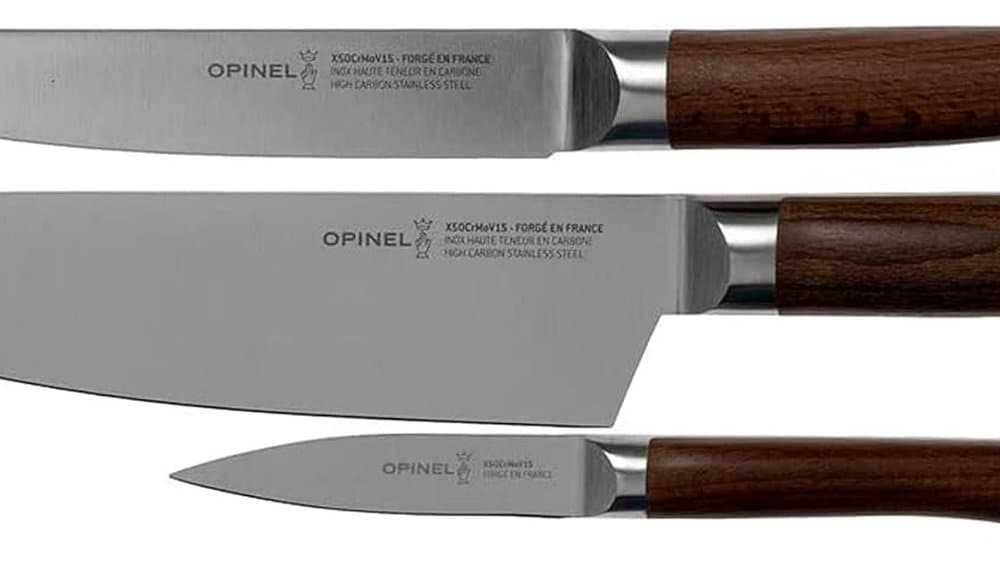
A Coherent and Aesthetic Set: The trio (chef's knife, slicing knife, paring knife) covers the essentials of daily tasks. Its uniform look, with its wood handles and "full tang" finish (blade running through the entire handle), exudes a rustic and timeless elegance that fits into most kitchens.
Points to Consider
No product is perfect for all uses. Here are the limits identified by testers and the community.
A Chef's Knife with a Potentially Limiting Size: This is the point most often raised by experts. With a blade of approximately 17 cm (for a total length of 20 cm), the chef's knife is considered by some as a bit short and light for the heavy, repetitive tasks of professional or very intensive cooking. It excels for daily preparation but might be less suitable than a 20 or 24 cm chef's knife for cutting large pieces of meat or very hard root vegetables.
Specific Maintenance for Wooden Handles: While the beauty of the wood is undeniable, it imposes a specific maintenance routine. The varnished wooden handles must absolutely not go in the dishwasher. Users insist on the necessity of hand washing and immediate drying to prevent any swelling, cracking, or dulling of the wood over time.
A Different Philosophy from High-End Professional Gear: One should not look for the characteristics of a Japanese knife in high-carbon steel (like Blue #2) or a Western knife in AEB-L or VG-10 hardened above 60 HRC. Opinel's choice prioritizes robustness, ease of maintenance, and rust resistance over extreme edge retention.
Detailed Analysis: A "For Life" Set?
The Steel and the Blade: The Heart of Performance
The technical sheet is clear: X50CrMoV15 at a hardness of 56-57 HRC. Let's decipher what this means in our search for durable tools.
The X50CrMoV15 is a martensitic steel containing about 0.5% carbon, 15% chromium, molybdenum, and vanadium. It is an excellent choice for demanding domestic use. The chromium ensures corrosion resistance, a real plus for those who don't want to worry about drying their blade immediately. The carbon and vanadium contribute to the formation of hard carbides, which give the sharpness.
A hardness of 56-57 HRC places these knives in a medium category. This is significantly harder than many mass-market knives (often below 54 HRC), promising decent edge retention for regular use. Conversely, it is less hard than professional references (often between 59 and 65 HRC). The trade-off is positive: steel at this hardness is relatively easy to sharpen. Regular passes on a medium sharpening stone (around 1000 grit) or a sharpening steel will suffice to maintain a very effective cutting edge. This is a crucial point for longevity: an easy-to-maintain knife is a knife that gets maintained.
See priceErgonomics and Construction: Comfort and Long-Term Strength
Feedback is unanimous: the varnished beechwood handle is a success. The historic Opinel shape, slightly oval and curved, seems to avoid pressure points. The varnished wood offers a non-slip grip, even with wet hands, without being rough. The so-called "full tang" construction where the blade extends the full length of the handle is a guarantee of strength and balance. It distributes weight better and resists twisting well, essential for long-term durability. The assembly seems high-quality, with no reported play or defects.
Comparison with Other Materials
- Vs. Carbon Steel (type blue/white steel): The Opinel steel is less prone to corrosion and more forgiving, but it will not offer the same ultimate sharpness fineness and ease of honing on a stone as a true carbon steel.
- Vs. "Super" Stainless Steels (VG-10, AUS-10): These steels, often hardened higher (60+ HRC), will offer better edge retention. They can also be slower to sharpen and are sometimes more fragile (micro-chipping). The X50CrMoV15 is a more "laid-back" and balanced choice.
- Vs. Stamped Blades: The forging process attributed to this 1890 line should theoretically offer a denser, more resilient, and better-balanced blade than one cut from a sheet of steel with a press.
For Which Cook?
This set is probably not the tool of choice for the professional chef cutting crates of vegetables 8 hours a day, who would prefer longer blades and steels with maximum retention. However, for the serious home cook, the one who cooks daily and values reliability, aesthetics, and simple maintenance, the Les Forgés 1890 trio is a very solid option. It is also ideal for equipping a secondary residence or serving as a first quality set for a young adult, with the guarantee that it will last for years.
Technical Specifications
| Component | Detail |
|---|---|
| Set | Opinel Les Forgés 1890 Trio |
| Contents | 1 Chef's Knife (20 cm), 1 Slicing Knife, 1 Paring Knife |
| Blade Material | X50CrMoV15 Stainless Steel |
| Hardness (HRC) | 56-57 HRC |
| Blade Type | Forged, straight edge |
| Construction | Full Tang |
| Handle Material | Varnished French beechwood |
| Finish | Polished |
| Blade Maintenance | Manual sharpening recommended |
| Dishwasher | No - Hand wash only |
| Warranty | Lifetime warranty against manufacturing defects |
| Manufacturing Origin | Made in France (Chambéry, Savoie) |
What Users and Experts Say
The synthesis of customer reviews and available analyses paints a remarkably positive consensus, with notes of enthusiasm.
Recurrent Praise:
- Sharpness and Performance: Users employ terms like "perfect cut" and emphasize that the edge is convincing for home use, holding up well over time.
- Comfort and Grip: The ergonomics of the beechwood handle is highly praised. It is described as comfortable, pleasant, and offering a good grip, even with wet hands.
- Finishes and Aesthetics: The beauty of the set, the harmonious look, and the refined feel are greatly appreciated. The case (when included) is seen as a plus.
- Perceived Robustness: Phrases like "clearly built to last" recur, conveying an impression of solidity and quality of manufacture.
- Value for Money: Many consider it a very honest offer for forged steel and quality wood, made in France.
Remarks and Criticisms:
- Wood Maintenance: This is the most cited drawback. All remind of the imperative of hand washing and immediate drying of the handles to preserve the wood. Some even recommend occasional light oiling with food-safe oil.
- Chef's Knife Length: As noted by experts, a few advanced users or those with large hands might find it a bit short for some large-volume tasks.
- Storage: A few reviews mention the lack of supplied blade guards, necessitating a separate purchase for safe drawer storage.
The overall picture is that of a very reliable product that perfectly meets expectations for regular domestic use, provided one accepts its small maintenance ritual.
Conclusion
The Opinel Les Forgés 1890 Trio Knife Set is much more than a simple tribute to heritage. It is the successful materialization of a philosophy of durable, accessible, and functional tools. By choosing a forged X50CrMoV15 steel at a reasonable hardness (56-57 HRC), Opinel bets on balance: good edge retention coupled with ease of sharpening, all protected by excellent rust resistance. The varnished beechwood handles, despite the maintenance they require, offer unmatched comfort and warmth compared to polymers.
This set does not claim to compete with the specialized blades of Japanese artisans or oversized professional chef's knives. Its strength lies in its consistency, reliability, and discreet elegance. It is the perfect ally for the passionate cook who, day after day, prepares meals with care and seeks tools that will age with them, without unnecessary complication. The lifetime warranty and French manufacturing seal this pact of durability. If you are ready to give it the minimum maintenance it deserves – hand washing and quick drying – this Opinel trio has all the characteristics to become a pillar of your kitchen for decades to come.