pasoli Hand Hammered Carbon Steel Wok Review
Introduction
In the universe of durable cookware, the carbon steel wok occupies a special place. It is a transformational tool that, in skilled hands, becomes an extension of the cook. The pasoli Traditional Hand Hammered Carbon Steel Wok presents itself as a gateway to this tradition, promising the responsiveness and longevity of a professional-grade material. Here, we will dissect this object not as a mere kitchen accessory, but as a potential lifetime investment for cooking. Our analysis is based on a rigorous study of its technical specifications and a synthesis of feedback from the user community, to determine if it meets the requirements of serious and passionate cooks.
Strengths
The immediately apparent characteristics place this wok in an interesting category for purists.
- Reactive and Traditional Material: The heart of this product is its forged carbon steel. On paper, it is the material of choice for wok cooking: a thin thickness (1.2 mm) that allows for a near-instantaneous thermal response. It goes from high heat to rest in seconds, a major asset for perfect searing.
- "Pre-Seasoned" Finish and Multi-Fuel Compatibility: The presence of a factory seasoning is a practical advantage to get started, even though the community agrees that reinforced home seasoning is necessary. Its flat bottom makes it compatible with all types of stovetops, including induction, significantly broadening its audience.
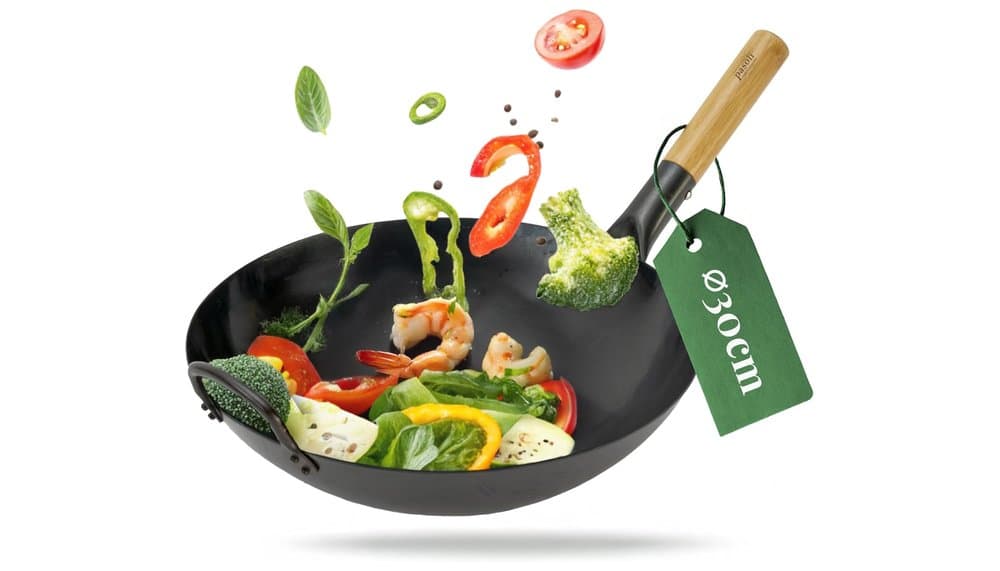
- Artisanal Construction and Lightness: The hand-hammered aspect is not just aesthetic. According to forging principles, this hammering can help stiffen the structure and create a microscopically textured surface that, theoretically, could aid in oil retention during seasoning. At 1.1 kg, it remains relatively light for its size, facilitating the typical tossing and stirring maneuvers of wok cooking.
Weaknesses
These same technical characteristics involve compromises and requirements that user feedback highlights.
- Demanding and Non-Negotiable Maintenance: This is the critical point. A bare carbon steel wok is prone to rust. Despite the pre-seasoning, a large portion of negative feedback comes from users who neglected the crucial step of initial reinforced seasoning or post-cooking care (immediate drying and light oiling). It is not a "ready-to-use" tool in the plug-and-play sense.
- Thickness and Long-Term Durability: A thickness of 1.2 mm is excellent for responsiveness, but it can be a point of concern for resistance to deformation over the very long term, especially if used on heat sources that are too small or poorly distributed. It is not the heavy, non-deformable workhorse of a cast iron pan.
- Mixed Handle and Questionable Comfort: The combined wood and steel handle is described as sturdy. However, some testers point out that the grip comfort is not optimal, particularly during prolonged use requiring lifting and tossing the wok with one hand. The ergonomics could be improved.
Detailed Product Analysis
Materials and Construction: The Soul of Carbon Steel
The choice of carbon steel is fundamental here. Unlike stainless steel alloyed with chromium, carbon steel is a raw, conductive, and sensitive material. It has no coating: its non-stick performance and protection against corrosion depend entirely on the layer of seasoning (the patina) that the user will build and maintain. This patina is a polymer of carbonized oil bonded to the metal's surface. The fact that it is hand-hammered suggests attentive craftsmanship, but the inherent variability of this process means each unit may have slight differences.
See priceCooking Performance: Responsiveness Above All
According to feedback, the great strength of this wok lies in its extremely rapid heat-up time. It is the ideal tool for the wok hei technique, that "breath of the wok" flavor obtained through explosive cooking. Heat distribution is logically concentrated in the center (the bottom), in line with the physics of a traditional fire. On an induction or electric cooktop, this means proper preheating and possibly moving food for even cooking. Its 5-liter capacity and 30 cm diameter make it a perfect family-sized tool for stir-fried vegetables, fried noodles, or saucy dishes.
Ergonomics and Handling: A Compromise to Evaluate
The fixed handle made of two materials is sturdy, but its design is not unanimously praised. The junction between wood and metal as well as the overall shape may, for some hands, lack comfort during energetic stirring motions. This is a point to consider if you plan on long and intense use. The wok being light, weight generally does not exacerbate this issue.
Durability & "Buy-It-For-Life" Philosophy
This is where the debate crystallizes. The pasoli Traditional Hand Hammered Carbon Steel Wok has the potential to be a lifetime object, but under conditions.
- For: Carbon steel is a simple and repairable material. If it rusts superficially, light sanding and a new seasoning will restore it. There is no coating that chips, no Teflon surface to avoid scratching. With meticulous care (cleaning with hot water without abrasive detergent, drying over heat, light oiling), it can improve with decades of use.
- Against: Its relative thinness (1.2 mm) makes it more vulnerable to physical shocks and thermal deformation than a carbon steel wok of 2 mm or more. Its absolute durability therefore also depends on the user's rigor in handling it (avoiding shocks, using a heat source suited to its diameter).
Comparison with other materials:
- Vs. Cast Iron: Much lighter and more responsive, but less good for heat retention and long, gentle cooking.
- Vs. Stainless Steel: Much more non-stick once seasoned, and a better heat conductor, but requires specific care unlike the ease of cleaning stainless steel.
- Vs. Coated Wok (Teflon, Ceramic): Offers a far superior searing surface at high temperature (coatings degrade above 250°C) and potentially infinite longevity, in exchange for demanding maintenance.
Technical Specifications
| Characteristic | Detail |
|---|---|
| Model | pasoli Traditional Hand Hammered Carbon Steel Wok |
| Diameter | 30 cm |
| Body Material | Carbon Steel |
| Thickness | 1.2 millimeters |
| Weight | 1.1 Kilograms |
| Finish | Pre-seasoned |
| Bottom | Flat |
| Compatibility | All stovetops (Gas, Electric, Ceramic Glass, Induction, Halogen) |
| Capacity | 5 Liters (approx., for 4 people) |
| Handle Type | Fixed, combined Wood and Steel |
| Maintenance | Hand wash only. Not suitable for dishwasher. |
| Uses | Stir-fries, frying, steaming, braising |
What Users Say
An analysis of hundreds of available reviews reveals a very clear polarization of opinions, directly correlated with understanding the product.
The recurring positive points are driven by users who have accepted the rules of the game:
- Culinary Performance: Once properly seasoned, users describe an effective naturally non-stick surface and appreciate the thermal responsiveness for fast, seared cooking.
- Versatility and Authentic Feel: Many emphasize the satisfaction of using a traditional tool that allows authentic Asian cooking techniques. Induction compatibility is highly appreciated.
- Long-Term Satisfaction: Users who rigorously followed seasoning and maintenance steps (drying over heat, protective oil film) report excellent durability over time and a patina that improves.
The recurring negative points are, unsurprisingly, the inverse mirror:
- Major Rust Problems: This is the main cause of low ratings. These reviews show photos of rust appearing after the first wash or after a few uses. Analysis of the comments consistently reveals a lack of understanding of the need for an initial thorough seasoning (beyond the pre-seasoning) or perfect immediate drying after washing.
- Food Sticking: Linked to the previous point. Without a sufficiently developed patina, bare carbon steel is very sticky.
- Disappointment with Maintenance: A portion of buyers seems to have been surprised by the maintenance demands, perhaps expecting the ease of a modern coating. Phrases like "you have to season it before complaining!" often appear in positive reviews, addressed to detractors.
Community Verdict: The pasoli wok divides. It is highly rated by those who understand and accept its demanding nature, and poorly rated by those who approach it as a standard utensil. The implicit expert reviews (knowledgeable amateur cooks in the comments) all insist on the same point: this is not a plug-and-play product, but a project requiring an initial time investment for seasoning.
Conclusion
The pasoli Traditional Hand Hammered Carbon Steel Wok is an object that is both simple and demanding. Its technical analysis reveals a tool perfectly suited for serious cooks wishing to master wok cooking in its most authentic form. Its responsiveness, induction compatibility, and potential longevity are its main assets.
However, it makes no concessions. It does not fall into the "buy-it-for-life" category without effort, but rather into "buy-it-for-life if you take care of it." Its thin carbon steel is a high-performance athlete: capable, but requiring rigorous warm-up (seasoning) and recovery (maintenance).
Who is it for? The passionate cook who sees seasoning not as a chore, but as a ritual of appropriating their tool. For those seeking the feel and results of high-heat cooking. Who should avoid it? Those who primarily seek the convenience and "no-worry" aspect of a modern coating, or who are not ready to dedicate specific minutes to maintenance after each use.
In short, this wok is not a simple purchased kitchen utensil; it is a kitchen companion that one adopts and nurtures. For the right audience, it represents excellent value for money to enter the demanding and rewarding world of carbon steel.