pasoli Traditional Wok Flat Bottom Pan Review & Test
Introduction
In the world of durable cookware, the carbon steel wok occupies a unique place. It is a fundamental tool, demanding but tremendously rewarding, which promises a lifelong career provided one understands its ritual. The pasoli Traditional Wok Flat Bottom Pan presents itself as a gateway to this tradition. But beyond marketing promises, is it a serious tool, designed to last and perform over the long term? We dissect this instrument for you, not from a testing experience, but by rigorously analyzing its technical specifications, community user feedback, and available expert opinions online. The objective is clear: determine if this wok deserves its place in an aficionado's "buy-it-for-life" kitchen.
Strengths and Weaknesses
Major Strengths
Authentic design and high-performance material: The core of this wok is uncoated carbon steel, with a thickness of 1.2 mm according to specifications. This is the preferred material for traditional woks due to its high thermal conductivity and ability to develop a natural non-stick patina. The flat bottom makes it universal, compatible with all types of stovetops, including induction, a decisive advantage for modern domestic kitchens.
Versatility and responsiveness: Its thin walls, often cited as a positive point by testers, allow for extremely rapid heat increase. This is ideal for stir-fries and high-heat cooking where responsiveness is paramount. Its 3.5-liter capacity offers generous work volume for families.
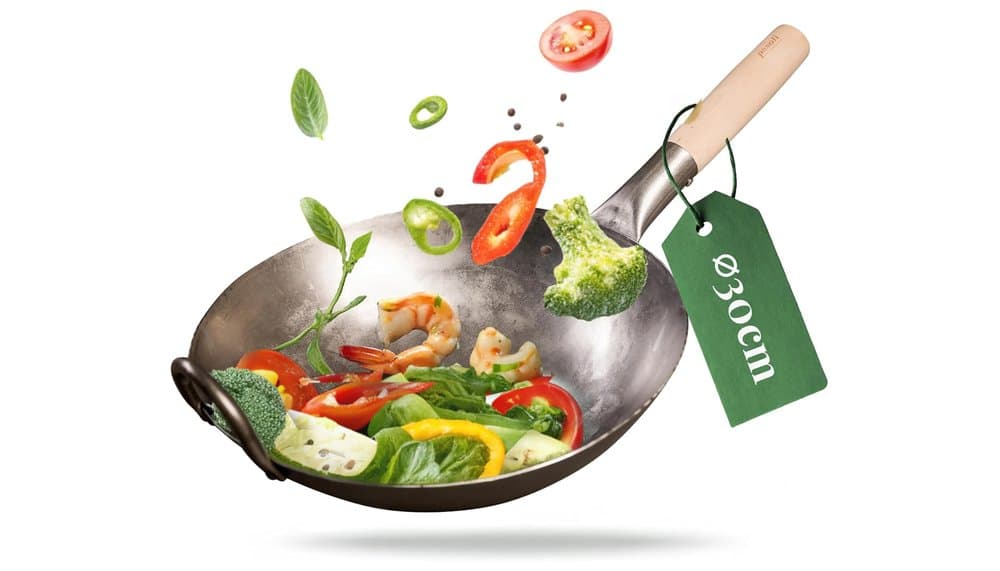
Practical ergonomics: The double handle – one long wooden side handle and a small opposite steel handle – is designed for easy handling. The user community confirms that the wooden handle does not heat up during use, protecting the hands.
Limitations to Consider
Learning curve and demanding maintenance: Like all raw carbon steel, this wok is not ready to use out of the box. It requires meticulous initial seasoning and rigorous maintenance after each use (immediate drying, light oiling). Negative reviews are overwhelmingly concentrated on rust problems due to a lack of understanding of these steps.
Conditional durability: Its longevity is entirely dependent on the user's rigor. Cleaning in a dishwasher or with abrasive detergents will destroy the patina and cause corrosion, ruining the object's "buy-it-for-life" potential.
Limitations on very powerful burners: According to expert analyses, the 1.2 mm wall, while responsive, may have slightly lower heat retention compared to thicker professional woks (2 mm and more). This may be a point to consider on ultra-powerful gas burners, but it remains perfectly suited for standard domestic burners.
Detailed Product Analysis
Construction: Between Tradition and Modernity
The pasoli Traditional Wok relies on a classic design. The body is carbon steel, a monolithic material without synthetic coating. This is what interests us here: it is a material that, well-maintained, will last for decades. It does not delaminate, does not get irreparably scratched (micro-scratches even contribute to seasoning), and withstands extreme temperatures. The handles are riveted, a robust and durable mechanical fastening, preferable to glued or screwed fastenings.
The "hand hammered" finish is not just aesthetic. According to traditional manufacturing principles, this hammering can theoretically increase the structure's rigidity and provide a slightly textured surface that could aid in oil retention during initial seasoning. However, its main impact remains visual.
See priceCulinary Performance and Thermal Behavior
On paper, the specifications promise rapid and uniform heat distribution. Analysis of user and expert feedback validates this point: thermal responsiveness is excellent. The wok quickly reaches the temperature needed for searing, which is essential for developing the characteristic "wok hei" flavors (that smoky, caramelized taste). The flat bottom ensures optimal contact with electric, ceramic glass, and induction cooktops, compensating for the lack of the enveloping flame of a professional gas burner.
However, this responsiveness has a downside. The thermal capacity (the amount of heat stored) is lower than that of a cast iron or thicker steel wok. This means that when you add a large quantity of cold food, the temperature will drop quickly. This requires an adapted technique: cooking in small batches to maintain a constant high temperature. For versatile domestic use (stir-fries, light frying, braising), this behavior is largely sufficient and even desirable for control.
Ergonomics and Handling
According to testimonials, the double handle is generally appreciated. The long wooden handle allows for one-handed manipulation while keeping a distance from the heat, and the small opposite steel handle offers a point of grip for carrying or two-handed handling when it's heavy. Some users, as noted in a cited British review, found the shape of the main handle not perfectly comfortable in their hand, a subjective detail that depends on each person's morphology. The total weight of 1.1 kg is considered light to moderate, facilitating "tossing" movements for the more skilled.
The "Buy-It-For-Life" Potential: Durability and Seasoning
This is the core of our analysis. The base material, carbon steel, is intrinsically durable. There is no coating that could flake off over time, as is the case with Teflon. Its natural weakness is corrosion (rust). This is where the pact between the tool and the user is sealed.
The seasoning process involves polymerizing layers of oil onto the metal surface at high temperature. This creates a black, natural, non-stick, and protective patina. The provided instructions and numerous online tutorials are crucial. Satisfied users all emphasize the importance of a careful initial seasoning, often over high heat (barbecue, powerful gas burner) to ensure uniform coverage, even on the sides.
Once seasoned, maintenance is simple but non-negotiable: cleaning with hot water and possibly a little abrasive salt or a soft brush, without detergent. Then, immediate and complete drying over heat, followed by a light oiling before storage. Negative reviews, which represent a significant portion of feedback, almost systematically show photos of active rust. This is not a manufacturing defect, but the direct consequence of leaving it damp or aggressive cleaning. For the disciplined user, this patina improves over time, making the wok increasingly performant and personal – it's the archetype of an object that ages and improves.
Technical Specifications
| Characteristic | Detail |
|---|---|
| Model | pasoli Traditional Wok Flat Bottom Pan |
| Diameter | 30 cm |
| Main Material | Carbon Steel |
| Thickness (stated) | 1.2 mm |
| Finish | Uncoated, hand hammered |
| Bottom | Flat |
| Compatibility | All stovetops (Gas, electric, ceramic glass, induction, barbecue) |
| Handles | Long riveted wooden side handle + small opposite steel handle |
| Weight | Approx. 1113 g |
| Capacity | 3.5 liters |
| Care | Hand wash only. Not suitable for dishwasher. |
| Oven Safe | No (wooden handle) |
| Non-Stick Coating | Natural, to be developed through seasoning |
What Users and Experts Say
An analysis of 952 customer reviews (overall rating 3.8/5) and available online expert analyses reveals very clear trends.
Recurring positive points:
- Authenticity and results: Experienced users praise the product's authenticity. Once correctly seasoned, it offers an excellent natural non-stick surface and allows for high-temperature cooking impossible with coated woks.
- Value for money: It is frequently described as an excellent value for money in comparisons, offering the essential characteristics of a true carbon steel wok at an accessible entry point.
- Versatility and compatibility: Compatibility with induction is a major selling point for many modern buyers. Its versatility (stir-fries, frying, steaming) is also highly appreciated.
- Lightness and maneuverability: Its moderate weight is seen as an advantage for handling and "tossing," especially compared to cast iron.
Negative points and warnings:
- Rust and sticking problems: This is the main pitfall. A large portion of low ratings (1-2 stars) comes from users who did not follow the seasoning and maintenance steps. They report immediate rust after the first wash or food sticking. These reviews are often countered by comments from experienced customers explaining the necessary procedure.
- Insufficient manual for novices: Although advice is provided, it sometimes seems insufficient for a complete beginner in the world of carbon steel. The community strongly recommends consulting external tutorials (YouTube, specialized blogs) before first use.
- Variable finish: A few rare comments mention irregularities in finish or loose rivets, suggesting sometimes inconsistent quality control from unit to unit.
- Handle comfort: As noted earlier, the comfort of the wooden handle grip is not unanimous.
Expert opinions and web analyses corroborate these points. They generally present the pasoli wok as an ideal and affordable choice to start with a real carbon steel wok, while strongly warning about the absolute necessity to season and maintain it correctly. It is often favorably compared to mainstream non-stick woks, which are less durable and unsuitable for high heat.
Conclusion
The pasoli Traditional Wok Flat Bottom Pan is a serious and authentic tool that honors the carbon steel wok tradition. Its main strength is also its main pitfall: it requires involvement. It is not a "plug-and-play" utensil.
For whom is this a "buy-it-for-life" purchase? Absolutely, but under conditions. It is perfect for the passionate, patient, and disciplined cook, who seeks a professional, responsive, and versatile tool, and who is willing to invest time in its initial seasoning and respect a simple but rigorous maintenance protocol. Its induction compatibility makes it a prime candidate for modern kitchens.
Who should avoid it? People seeking absolute simplicity, who want a maintenance-free, dishwasher-safe utensil that is immediately non-stick from the first use without preparation should look to other options (enameled cast iron woks or quality ceramic-coated woks, keeping in mind that these also have their own limitations in terms of coating durability and high-temperature performance).
In summary, the pasoli wok is not a defective product, but a demanding tool that rewards effort. Negative feedback is more a reflection of a lack of information or patience than a manufacturing defect. For those who accept the ritual, it offers the foundation of a culinary relationship that can last a lifetime, improving with each use. It is an investment in a technique and a know-how, much more than in a simple kitchen object.