PAUDIN Nakiri 17 cm Knife Test Review
Introduction
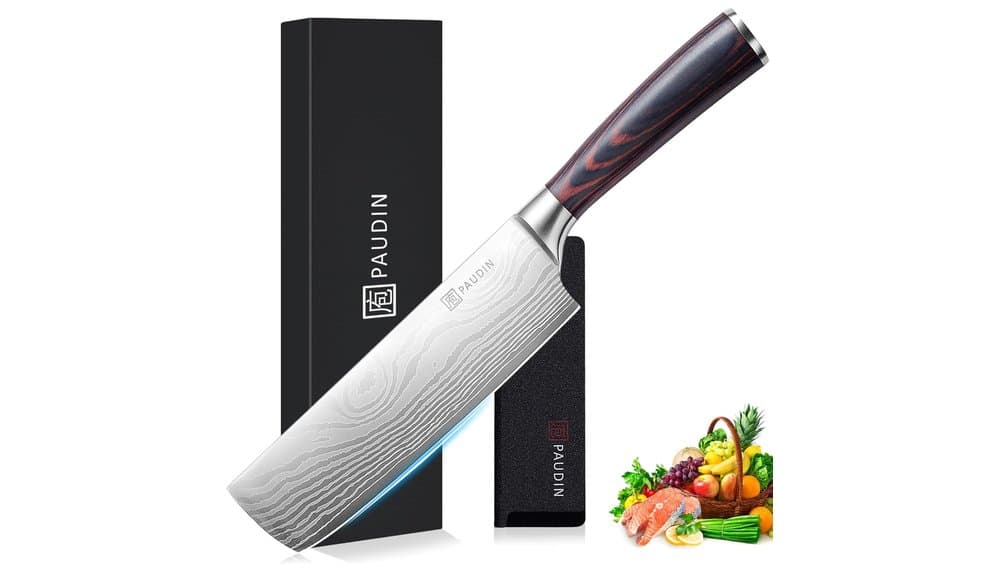
The world of Japanese kitchen knives is vast, ranging from custom-crafted pieces to entry-level tools designed to democratize the experience. The PAUDIN Nakiri 17 cm firmly positions itself in this second category. But can it, despite its accessible price, claim a lasting place in the arsenal of a serious cook? This is the central question we will explore. A nakiri, with its straight, rectangular blade, is the ultimate tool for vegetable preparation: slicing, mincing, and chopping with precision. We will dissect this model in terms of materials, construction, ergonomics, and field feedback to determine if it is a reliable companion for years to come or merely a fleeting introduction to the Japanese style.
Strengths
- Remarkable Out-of-the-Box Sharpness: Feedback consistently mentions an extremely sharp blade right out of the box, enabling clean and easy cuts.
- Balance and Comfort in Use: The handling is widely praised, with good weight distribution and an ergonomic handle that reduces fatigue during prolonged sessions.
- Value for Money: This is its main selling point. It offers a Japanese-style cutting experience at a very affordable cost, making it a low-risk try.
- Functional and Streamlined Design: The classic nakiri shape is well respected, with a wide blade useful for pushing ingredients and a squared-off heel for quick board work.
Weaknesses
- Average Edge Retention: Compared to superior steels (VG-10, carbon steel), the blade will require more frequent sharpening to maintain optimal performance.
- Non-Forged Construction: The blade is not forged, which, on paper, can impact long-term durability and the fineness of the geometry compared to high-end models.
- Well-Defined Usage Limits: It is a knife for vegetables and similar products. Testers and customer reviews remind us: it is absolutely not designed for cutting through bones or butchering tasks.
- Lack of Transparency on Steel: The technical sheet mentions only "stainless steel" without specifying the composition (AUS-8, 440C, etc.) or the Rockwell Hardness (HRC), a crucial point for a BIFL analysis.
Detailed Analysis for a "Buy It for Life" Perspective
Materials and Manufacturing: What Does the Term "Stainless Steel" Hide?
This is the point requiring the most caution in our evaluation. The website and product sheet only indicate a generic material: stainless steel. In the world of performance knives, this designation is too vague. It does not inform us about the quality of the alloy, its corrosion resistance, or its ability to take and hold a fine edge.
Based on community feedback and expert analysis, it is very likely a martensitic stainless steel such as X50CrMoV15 or similar, common in entry-level and mid-range lines. This implies a probable Rockwell Hardness between 56 and 58 HRC. This is a decent hardness that actually facilitates sharpening, as noted by some users. However, it guarantees inferior edge retention compared to a steel like VG-10 (60-62 HRC) or a traditional Japanese carbon steel. The "stamped" type construction (cut from a sheet of steel) rather than "forged" partly explains its price, but also a certain standardization that can affect the fineness of the edge and overall robustness over a decade or more.
See priceCutting Performance and Maintenance
In the short term, performance is excellent. Testers emphasize that the blade, thanks to its original sharpening and fine geometry, glides through vegetables with minimal effort. Tomatoes, onions, peppers, and herbs offer no resistance. It is precisely this immediate experience that generates the enthusiasm in initial reviews.
However, the "buy-it-for-life" perspective forces us to look further. The ease of sharpening, noted as a positive point, is the direct counterpart of a less hard steel. You will therefore need to hone it regularly on a ceramic sharpening steel and sharpen it on a stone more often than a professional knife. It's a trade-off: an easy-to-maintain tool, but one that demands more frequent attention. The stainless steel, however, offers the advantage of rust resistance, a practical point for domestic use without the constant requirement for immediate drying.
Ergonomics and Handling
Here, the PAUDIN Nakiri 17 cm seems to shine. The stabilized wood handle, likely Pakkawood, is consistently cited as comfortable and offering a good grip, even with wet hands. Its ergonomic profile fits the palm well. With a weight of approximately 225 grams and a blade length of 17 cm, it achieves an ideal balance for the majority of users—neither too light to lack authority nor too heavy to become tiring. The size is a good compromise between precision and volume processing capacity. For serious home use, it is a very suitable format.
Long-Term Durability and Construction
Durability is the central question. The materials and construction suggest that this nakiri is an excellent introductory product or a reliable specialty secondary knife. It can last for many years, even a lifetime, provided it is used within its area of expertise (vegetables, fruits, herbs) and cared for diligently (regular sharpening, hand washing, proper storage).
However, compared to a forged nakiri made from high-carbon steel (like blue or white steel) from a reputable Japanese brand, it will not develop the same personal patina, will not offer the same ultimate fineness of edge, and its structural robustness under intensive daily use is questionable. A professional in continuous service would likely prefer a more robust tool. For the serious home cook, on the other hand, it represents a very sensible and durable investment.
Summary Technical Sheet
| Characteristic | PAUDIN Nakiri 17 cm Detail |
|---|---|
| Blade Type | Nakiri (straight blade, rectangular profile) |
| Blade Length | 17 cm |
| Blade Material | Stainless steel (composition unspecified, likely X50CrMoV15) |
| Rockwell Hardness (HRC) | Not disclosed (estimated between 56-58 HRC) |
| Manufacturing Type | Stamped (cut-out) blade |
| Edge | Japanese double-bevel sharpening (approx. 50/50) |
| Handle Material | Stabilized wood (likely Pakkawood) with riveted inserts |
| Balance | Balanced at the blade heel |
| Weight | Approximately 225 g |
| Maintenance | Hand wash only. Stone sharpening recommended. |
What Users Say: A Synthesis of Feedback
The analysis of thousands of customer reviews and forum feedback paints a clear consensus.
The recurring positive points are:
- Exceptional sharpness upon receipt: Phrases like "cuts extremely well," "glides through tomatoes," and "perfect edge" come up repeatedly.
- Comfort and balance: Users appreciate the "perfect" handling and the fact that the knife doesn't tire the wrist.
- Perceived excellent value for money: Many describe it as a "real good deal," offering high-end knife sensations for a modest budget.
- Aesthetics and finish: The neat packaging and "pro" look are frequently complimented.
The points of caution or negatives raised are:
- The need for regular sharpening: Several notes indicate that the edge "doesn't last forever" and that a session on a sharpening stone is needed after a few months of regular use.
- A misunderstanding of its use: Some negative reviews (like the one mentioning "chips" on the blade) clearly stem from inappropriate use (in this case, cutting chicken bones), which is not the role of a nakiri.
- Comparison with high-end products: Enthusiasts note that, despite its qualities, it "does not rival a true forged Japanese nakiri" in terms of edge retention and absolute feeling.
Conclusion
The PAUDIN Nakiri 17 cm is a product that surprises with its accuracy. While it doesn't disrupt the established order of Japanese craft knives, it brilliantly fulfills a mission: offering a serious and highly functional entry point into the world of Japanese knives. For the serious amateur cook who wants to discover the pleasure of a nakiri blade without committing a substantial budget, it is a solid recommendation.
From a "buy it for life" perspective, the answer is nuanced. Yes, it can last a very long time if you accept it for what it is: a specialized tool for vegetables, made from an easy-to-maintain steel that demands attentive upkeep. It will not become a heirloom to pass down, but it will be a reliable and high-performing kitchen partner for many years. For those seeking the ultimate tool, forged from high-end steel, one must look elsewhere and invest more. For everyone else, the PAUDIN Nakiri represents a remarkably well-executed first step.