Petromax Cast Iron Frying Pan Review & Test
Introduction
In the universe of durable cookware, the cast iron skillet holds an iconic place. It embodies the very essence of "buy-it-for-life": a simple, massive, and nearly indestructible tool whose effectiveness improves with time. Today, we analyze the Petromax Cast Iron Frying Pan, a European reference that seeks to rival the American giants on their own turf. Is it up to the standards of a serious cook and can it become a cornerstone in a kitchen dedicated to performance and longevity? That is what we are going to untangle.
Strengths
- Extreme thermal versatility : Compatible with all heat sources, from campfire to induction, including the oven.
- Robust and flawless construction : Massive cast iron and an overall finish that inspires confidence for intensive use.
- Remarkable value for money : Often highlighted as a more accessible alternative to major brands without sacrificing fundamental quality.
- Long and practical handles : Specially adapted for outdoor use and safe handling when faced with high heat.
Weaknesses
- Sometimes rough initial surface : The pre-seasoned finish may require a few additional cooking cycles to reach its optimal non-stick potential.
- Considerable weight : Typical of cast iron, it is a handicap for certain handling, especially for the larger diameters.
- Risk of imperfect flatness : Although rare on frying pans, a slightly warped bottom is sometimes reported, potentially problematic on smooth cooktops.
- Learning curve : Like any "bare" cast iron, it requires an understanding of its maintenance and seasoning.
Detailed Analysis
The Raw Material: Cast Iron
The product is entirely made from raw cast iron. This is the classic and timeless choice for this type of utensil. Cast iron offers exceptional heat retention, ideal for searing at high temperature and maintaining constant heat during service. Its heat distribution is also excellent, although slightly less rapid than copper or aluminum-clad cores, which requires patient and even preheating. According to technical specifications and feedback, the quality of the cast iron used by Petromax seems dense and without major imperfections, guaranteeing longevity measured in decades, if not generations.
See priceConstruction and Ergonomics
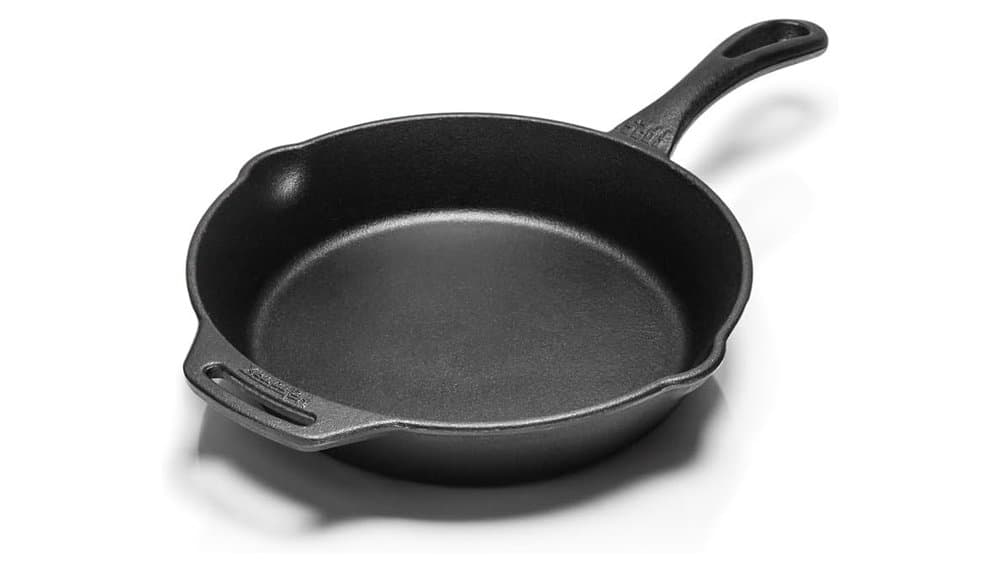
The construction is simple and effective: a single casting for the body and handles. It is this simplicity that guarantees its strength. The handles are made entirely of cast iron and are generously long, a notable advantage for outdoor cooking where you need to keep a safe distance from the fire. However, this integral design means they become burning hot over a prolonged heat source. The community consistently notes the usefulness (if not the necessity) of a silicone handle guard or a folded kitchen towel. The weight, although expected for cast iron (approximately 1 kg for the 15 cm model, and much more for larger models), is confirmed by users as a factor to consider, especially if you plan to handle it empty often.
Cooking Performance
Feedback is unanimous on fundamental performance. Once properly preheated, the skillet excels at searing and roasting, developing those sought-after grilled flavors. The ability to go in the oven (up to 300°C according to specs) makes it a perfect transitional tool, allowing you to sear meat on the stove and then finish cooking it in the oven without changing containers. Its induction compatibility is a major asset for modern kitchens. Testers emphasize that the natural non-stick quality, although present from the start thanks to the factory pre-seasoning, improves significantly with each use, forming an increasingly effective patina.
Maintenance and Lifelong Durability
It is in this chapter that the "buy-it-for-life" concept makes complete sense. Cast iron, if not cracked by a violent thermal shock (taking a hot pan under cold water), is practically eternal. The key lies in seasoning. Reviews converge: the factory treatment is a good starting point, but investing time in a few additional seasoning cycles (neutral oil, thin layer, hot oven) radically transforms the surface. Daily maintenance is Spartan: cleaning with hot water without aggressive detergent, immediate and complete drying, and sometimes a light oiling after drying. This very simplicity eliminates the risks of scratching or degrading a synthetic coating.
Technical Specifications
| Characteristic | Detail |
|---|---|
| Brand | Petromax |
| Main Material | Cast Iron |
| Surface Finish | Pre-seasoned (natural, without synthetic coating) |
| Available Diameters | 15 cm, 20 cm, 25 cm, 30 cm, 35 cm, 40 cm |
| Compatibility | Gas, electric, ceramic glass, induction, oven, campfire, barbecue |
| Max Temperature (Oven) | 300°C |
| Maintenance | Cleaning with hot water (no dishwasher), immediate drying, occasional oiling |
| Warranty | Subject to the seller's legal guarantees (2 years of conformity in the EU) |
| Weight (varies by size) | Ex: ~1.05 kg for the 15 cm model |
What Users Say
The synthesis of over 1400 customer reviews (overall rating 4.5/5) and discussions in specialized forums paints a clear consensus.
Recurrent praise focuses on:
- The sturdiness and "feel" of quality : "Something that will last!" is a typical phrase, reacting to the obsolescence of coated pans.
- Versatility : Its use on both a modern cooktop and a wood fire is highly appreciated, particularly by outdoor enthusiasts.
- Value for money : Many compare it favorably to brands like Lodge, noting that it offers a comparable experience at a often lower cost in Europe.
- Improvement over time : Users describe a surface that becomes increasingly "personal" and non-stick with use.
Frequent criticisms or warnings concern:
- Weight : This is the most cited negative point, with some people finding the larger models difficult to handle with one hand.
- The need for a handle guard : Almost considered a mandatory accessory by regular users.
- The initial surface : A few reviews mention a texture slightly more granular than other brands early on, even if this fades quickly with seasoning.
- Quality control to watch : Some isolated comments, particularly on Dutch ovens, mention a bottom that is not perfectly flat, causing wobbling on smooth cooktops. This point seems much less frequent on frying pans (skillets) like this one.
The general impression is that of a reliable, no-frills product that perfectly fulfills its mission for those who accept the inherent constraints of cast iron.
Conclusion
The Petromax Cast Iron Frying Pan is not a skillet seeking to revolutionize the genre. On the contrary, it fits into a tradition of robustness and functional simplicity. For the serious cook looking for a professional and versatile tool, it represents a very solid investment.
Its true strength, beyond its proven thermal performance, is its value for money in the European landscape. It provides access to the benefits of quality cast iron without the often-associated import premium of major American brands. It requires, like any worthy cast iron, a bit of initial commitment to perfect its seasoning and a familiarization with its maintenance rules.
If you are ready to accept its weight and adopt the right gestures to maintain it, this Petromax skillet has every chance of becoming a kitchen companion for life. It will be there for a perfect steak sear as well as for roasting vegetables in the oven, and will follow you unfailingly from the kitchen counter to the campfire. It is an honest, predictable, and durable tool, exactly what one expects from a "buy-it-for-life" product.