Plys Damascus CD-759 Review: Performance & Value Test
Analysis of the Plys Damascus CD-759 Chef's Knife
In a market saturated with knives claiming Japanese excellence, the Plys Damascus CD-759 stands out with its striking aesthetics and ambitious technical specifications. It is clearly an object designed to appeal to both the eye and the cook. But beyond its visual appearance, how does it perform over time? Is it a reliable tool for a passionate cook looking for a lasting investment? We investigate by dissecting its technical characteristics, cross-referencing user feedback, and analyzing it through the demanding lens of "buy-it-for-life."
Strengths
- Exceptional Out-of-the-Box Sharpness: The most unanimously praised feature, by both the spec sheet and testers, is its aggressively sharp edge right out of the box. A cutting angle of 15° on 62 HRC steel promises and delivers, according to feedback, a laser-like cutting ability.
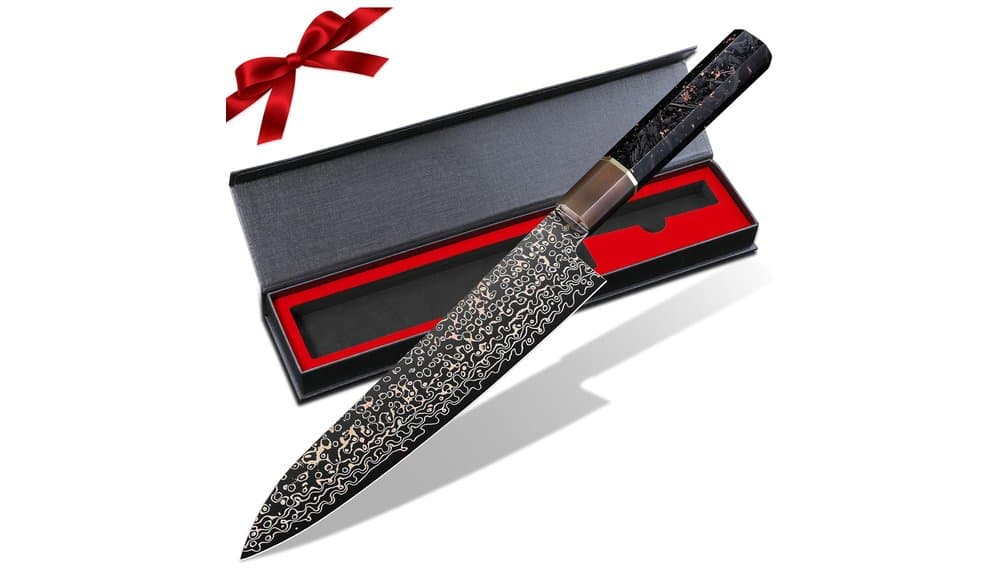
- Premium Aesthetics and Presentation: The Damascus pattern, integrating copper layers for a golden contrast, and the magnetic packaging box give it a high perceived value, often mentioned as an ideal gift.
- Versatility and Handling: With a 21.6 cm blade (Gyuto style) and a contained weight (approximately 400g), users describe a well-balanced and agile knife, suitable for most daily tasks (slicing, dicing, chopping).
- VG-10 Steel Core: The choice of VG-10, a reputable Japanese stainless steel, is a serious technical point. It combines high hardness for excellent edge retention with good corrosion resistance.
Weaknesses
- Questionable Finish and Build Solidity: Several reports point to assembly flaws, particularly at the junction between the blade and the handle where plastic can chip, or decorative rings that may be loose. This raises questions about long-term robustness.
- Resin Handle: Although the octagonal design is traditional and ergonomic, the material (resin) can be perceived as less noble and less durable than stabilized wood or high-end composites, especially for a product with such a refined appearance.
- Potential Edge Brittleness: Hard steel at 62 HRC is high-performing, but also more prone to micro-chipping if technique or the cutting surface (glass, ceramic, or bone board) is inadequate. This is not a robust "do-it-all" Western-style knife.
- Decorative (Likely) Damascus: The mention of "33 layers of stainless steel and copper forged together" suggests a "san-mai" type Damascus (VG-10 core sandwiched between decorative layers). While beautiful, this Damascus is primarily aesthetic and does not provide the same functional benefits (reducing food sticking) as true forged Damascus steel.
Detailed Analysis
The Blade: Heart of Performance
What interests us here is the promise of longevity and performance. The Plys Damascus CD-759 relies on a classic architecture in this field: a core of VG-10 steel sandwiched between layers of steel and copper. VG-10 is a cobalt-containing stainless steel that allows it to reach a Rockwell hardness (HRC) of 62 while remaining reasonably resilient.
Hardness at 62 HRC: What Impact? This value is in the high range for demanding domestic use. In practice, this translates to excellent edge retention. The knife will stay sharp longer than a standard knife at 55-58 HRC. However, the trade-off is increased difficulty in sharpening. Reproducing the original fine angle (15°) will require skills and quality sharpening stones (diamond or ceramic). This is an investment in time and equipment. This is not a knife you can quickly touch up on a ceramic rod in 30 seconds; it requires dedicated, less frequent but more technical sharpening sessions.
The Damascus finish is undeniably the striking visual argument. Based on descriptions, it is very likely a laser etching process or forging aimed primarily at decoration. Its role in cutting is marginal. Nonetheless, this finish, combined with the presence of copper, requires meticulous maintenance: immediate drying after washing to prevent any staining or oxidation of the copper layers.
See priceErgonomics and Construction
The octagonal resin handle is a proven shape that offers multiple contact points and good precision in grip. Feedback confirms a good grip and generally appreciated balance. The light weight reduces fatigue during prolonged use, a real plus for passionate amateur cooks.
The major point of concern, raised by users, pertains to assembly quality. A "buy-it-for-life" knife must display impeccable construction. Reports of rough finishing around the bolster (the blade/handle junction) or poorly set decorative rings are worrying. They do not necessarily call into question the immediate cutting performance but raise the question of long-term durability facing repeated cycles of washing, drying, and humidity variations.
Target Audience and Comparison
The Plys Damascus CD-759 does not target the professional brigade cook, but rather the serious amateur cook or enthusiast looking to upgrade. It constitutes an attractive entry point into the world of hard-edged Japanese knives.
Compared to a classic Western chef's knife (in X50CrMoV15 steel at ~58 HRC):
- Plys Advantage: Far superior sharpness out of the box, better edge retention, unique aesthetics.
- Western Knife Advantage: More forgiving (resists twisting better), easier to sharpen, often cheaper to purchase and maintain.
It thus positions itself as a specialist in precise cutting on fresh produce (vegetables, fruits, boned meats and fish). It is in no way designed for cutting bones, heavy butchering, or frozen items.
Technical Specifications
| Characteristic | Detail |
|---|---|
| Model | Plys Damascus CD-759 Japanese Chef's Knife |
| Blade Type | Gyuto (Japanese chef's knife) |
| Blade Length | 21.6 cm |
| Total Length | 37 cm |
| Core Material | VG-10 Steel (Japanese) |
| Construction | Forged blade, San-Mai type (sandwiched core) |
| Blade Pattern | Damascus (33 layers, integrating copper) |
| Hardness (HRC) | 62 HRC (Rockwell) |
| Cutting Angle | ~15° (per side) |
| Handle Material | Resin (Japanese octagonal shape) |
| Weight | Approximately 408 g |
| Maintenance | Hand wash only. Immediate drying. Sharpening on a water stone. |
What Users Say
A synthesis of customer reviews and collected expert feedback paints a nuanced but overall positive picture.
Recurrent praise revolves around three axes:
- The immediate sharpness, described as "razor-sharp," "impressive," allowing for "thin slices with precision."
- The aesthetics and packaging, described as "magnificent," "elegant," "spectacular," with special mention for the magnetic box.
- The feel in hand, judged as "pleasant," with good balance and a "light" weight that facilitates work.
Criticisms and reservations are less frequent but revealing:
- Several testers note finishing issues: "a bit of plastic chipping at the connection between the blade and the handle" or, in a German review, "the golden metal ring protrudes," indicating variable quality control.
- The nature of the handle is sometimes unclear ("it's not clear what material the handle is made of"), which may disappoint those expecting solid wood.
- The need for rigorous maintenance is emphasized by connoisseurs: hand washing, immediate drying, and the anticipation that sharpening will be a challenge for novices.
The overall high rating (4.4/5) confirms that for the majority of buyers, the product fulfills its initial promise of cutting performance and aesthetic pleasure. The finishing flaws seem random and do not affect all units.
Conclusion
The Plys Damascus CD-759 is a knife that plays on two fronts with some success. On paper, its technical specifications are solid: a VG-10 core at 62 HRC is a serious choice that promises excellent edge retention for intensive domestic use. Its out-of-the-box sharpness and design make it a high-performing and rewarding tool to use daily.
However, analysis of field feedback introduces a caveat regarding the rigor of the finish and the long-term solidity of the assembly. These elements are crucial in a "buy-it-for-life" perspective. It is not a piece of craftsmanship forged in tradition, but a factory product with ambitious design.
Verdict: It is an excellent choice for the demanding amateur cook who wants to experience the feel of a hard, aesthetic Japanese blade and is ready to accept its maintenance constraints (hand washing, technical sharpening). It is a knife that can last a lifetime provided it is treated with care and benefits from a unit without assembly defects. For those primarily seeking indestructible robustness and ultra-simple maintenance, a Western chef's knife in carbon steel or high-chromium steel may remain a more reassuring choice. The Plys Damascus CD-759 seduces with its looks and its edge, but requires a commitment from the user in terms of care and attention.