SHAN ZU 18 cm Santoku Knife Test & Review
Introduction
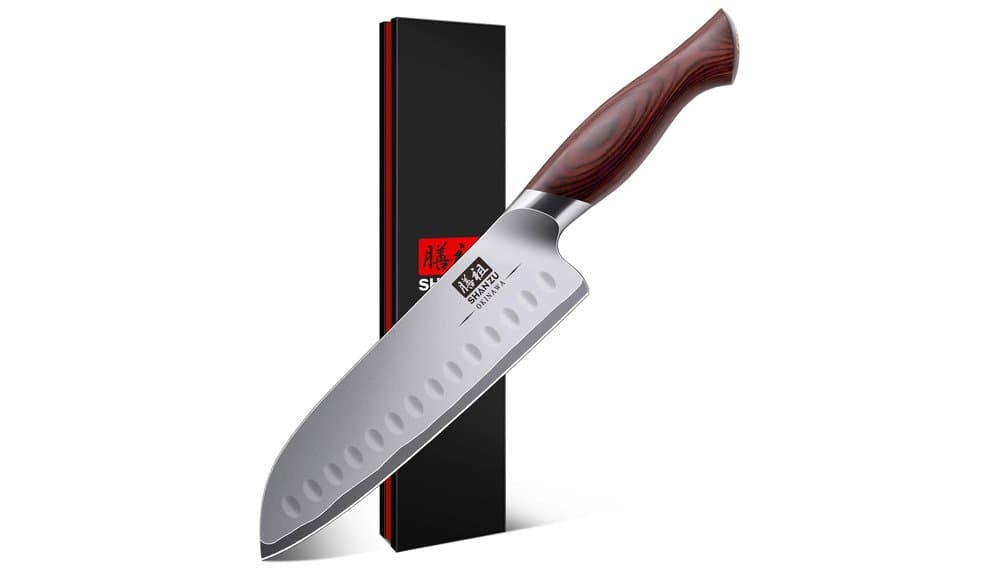
In the world of kitchen knives, the Santoku has established itself as a versatile model, combining Japanese grace and Western efficiency. The SHAN ZU Santoku Kitchen Knife 18 cm regularly appears in enthusiast discussions and on the shelves of serious amateur cooks. It promises a balance of high-end materials, extreme sharpness, and ergonomic design. For us, lovers of durable and high-performance tools, the central question is whether this knife is simply a good purchase or if it can claim a place in a "buy-it-for-life" kitchen arsenal. We will dissect its specifications, confront the manufacturer's promises with real-world feedback, and determine if it is a professional-grade tool worthy of the name or a well-finished entry-level product.
Strengths
- Exceptional Out-of-the-Box Sharpness: Feedback is unanimous: the knife arrives with a razor-sharp edge, due to a very aggressive cutting angle of 12° per side. This fineness allows for clean, effortless cutting right from the first use.
- Immediate Ergonomics and Comfort: The ergonomic shape of the Pakkawood handle is widely praised. Its non-slip grip and overall balance significantly reduce fatigue during prolonged use, a crucial point for intense cooking sessions.
- Perceived Excellent Value for Money: In the landscape of Japanese knives, the SHAN ZU positions itself as a very competitive option. For a contained investment, the user gets the impression of accessing finishes and sensations usually reserved for higher-end ranges.
- Refined Design and Finish: The matte anti-fingerprint finish and the overall aesthetics of the knife, with its Pakkawood and damascus-style blade, give it a high-end look that is visually appealing.
Weaknesses
- Limited Edge Retention: This is the most frequently raised drawback by experienced testers. Despite its advertised hardness, the blade seems to lose its exceptional sharpness relatively quickly, especially if used on hard or frozen foods. This necessitates a more frequent sharpening cycle.
- Steel and Finish Less Noble than Advertised: Although presented as "super hard Japanese steel," 10Cr15MoV is in reality a very good quality stainless steel, but of Chinese origin, common in the mid-range segment. The "Damascus" pattern is aesthetic (made by 5-layer forging) but does not correspond to the complexity of genuine hand-forged Japanese damascus steels.
- Potential Blade Fragility: A knife sharpened to 12° and with a hardness of 62 HRC is intrinsically more prone to micro-chipping than a blade with a 15-20° angle. It requires precise cutting technique (no twisting of the blade) and suitable support (wood or polyethylene cutting board, never glass or ceramic).
- Non-Negotiable Maintenance: Contrary to what the "dishwasher safe" mention might suggest, all experts agree: the dishwasher must be absolutely avoided. The heat, shocks, and aggressive detergents would irreparably damage the edge, the composite wood handle, and the blade's finish.
Detailed Analysis
The Blade: Between Stated Performance and Usage Reality
At the heart of our analysis is the blade. The SHAN ZU relies on 10Cr15MoV, a high-carbon stainless steel equivalent to Japanese standards like AUS-10 or VG-10 in terms of composition. With an announced Rockwell hardness of 62 HRC, it is in the high range for a kitchen knife, promising good edge retention. On paper, it's solid.
However, real user feedback tempers this promise. While the initial sharpness is spectacular, its durability over time is questioned. Several factors may explain this: the quality of the heat treatment applied to the steel, which is as important as the composition itself, and the extremely fine 12° angle. Such an acute angle is a gamble: it offers incredible cutting ability at the expense of edge robustness. For correct, intensive home use (on a suitable board), it may suffice. For brutal or professional use, this choice makes it more susceptible to dulling or chipping than a traditional Japanese Santoku with a more open angle.
The 5-layer forged (san mai) construction is a real plus. It provides greater rigidity and durability than a simply stamped blade. The core layer of 10Cr15MoV is sandwiched between softer steel layers, which, in theory, offers a good compromise between edge hardness and shock resistance.
See priceThe Handle: The Point of Converging Praise
It is on ergonomics that the SHAN ZU scores points almost uncontested. The Pakkawood handle (a wood and resin composite) is consistently described as comfortable, well-fitting, and offering a secure grip. Its shape, adapted to Western hands according to the manufacturer, does indeed seem well thought out for a variety of grips (pinch grip, handle grip). The knife's balance is also cited as a strong point, with a pivot point near the bolster, which facilitates wrist movement and reduces fatigue. For extended cooking sessions, this aspect is decisive and places this knife in the category of pleasant daily tools.
Durability and Maintenance: Is the "Buy-It-For-Life" Claim Sustainable?
This is the crucial question. The SHAN ZU Santoku has structural assets to last: forged construction, corrosion-resistant stainless steel (unlike carbon steels like "Blue Steel" which require meticulous care), handle made of moisture-resistant composite material.
However, its lifespan depends entirely on the user and its maintenance. An owner who respects the basic rules – immediate hand washing after use, thorough drying, storage on a magnetic block or protective sheath, and regular sharpening on a water stone – will be able to keep this knife for many years. The need for more frequent sharpening than with high-end steels (like SG2, ZDP-189) is not a fatal flaw, but a characteristic of its price segment. It's the trade-off for a steel that is easier for an amateur to sharpen.
Conversely, putting it in the dishwasher, leaving it in a drawer with other utensils, or using it on a glass cutting board would condemn it to a quick death. It is therefore not a "maintenance-free" tool, but a tool that will reward proper care.
Technical Specifications
| Characteristic | Detail |
|---|---|
| Model | SHAN ZU Santoku 18 cm |
| Blade Type | Santoku (multi-purpose) |
| Blade Length | 18 cm |
| Blade Material | 10Cr15MoV stainless steel (core) in 5-layer (san mai) construction |
| Hardness (HRC) | 62 HRC |
| Edge Angle | 12° per side (double bevel) |
| Blade Finish | Matte anti-fingerprint / Damascus pattern (aesthetic) |
| Construction Type | Forged |
| Handle Material | Pakkawood (composite wood) |
| Balance | At the bolster (according to user feedback) |
| Weight | Approximately 390 g |
| Maintenance | Hand wash imperative. Stone sharpening recommended. |
What Users Say
The synthesis of 897 reviews (with an average rating of 4.7/5) and available expert analyses online reveals clear trends.
The praise converges on three points:
- The initial sharpness is described as "incredible," "razor-sharp," "ultra-sharp." Many are surprised by this performance right out of the box.
- Ergonomics and comfort are highly praised. Mentions of "pleasant to hold," "well balanced," "comfortable handle" come up repeatedly, emphasizing that the knife seems made for long sessions.
- Value for money and aesthetics are very appreciated. Terms like "beautiful," "careful finishes," "professional quality," and "excellent value" dominate.
The criticisms and warnings are less frequent but recurrent and instructive:
- Edge retention is the main concern. Several users note that "the edge doesn't last as long as hoped" and that "regular sharpening is necessary." This is the major compromise.
- The need for meticulous maintenance is strongly emphasized by the informed community. The message is clear: this is not a knife for the dishwasher or the cutlery drawer.
- A few isolated notes point out minor finish defects upon arrival or packaging that could be improved, but this remains marginal.
Expert testers clearly position it as an excellent entry-level or intermediate option in the world of Japanese knives. It is perceived as an ideal bridge for the serious amateur cook who wants to upgrade without breaking the bank, while learning the basics of maintaining a good knife.
Conclusion
The SHAN ZU Santoku Kitchen Knife 18 cm is a product that demonstrates that with an intelligent selection of materials (10Cr15MoV, Pakkawood, forging) and careful finishing, one can obtain a remarkable kitchen tool at its price point. Its out-of-the-box sharpness and ergonomics are its master strengths, offering an immediate and pleasant cutting experience that will win over the vast majority of users.
However, from a "buy-it-for-life" perspective, one must be clear-eyed. This is not a high-end professional knife that will hold its edge for months under intensive use. It is an excellent "learning" knife for the serious amateur. It will force you to adopt good practices: regular sharpening, hand washing, proper storage. In return, it will offer you performance well above the market average and daily enjoyment of use.
If you are a passionate cook willing to invest a little time in maintenance to get exceptional performance/price ratio, the SHAN ZU Santoku is a very judicious choice. If you are looking for a "set-it-and-forget-it" tool with infinite edge retention, you will need to look towards more noble steels and a significantly higher budget.