SHAN ZU SZ-2017-002 Whetstone Review
Analysis of the SHAN ZU SZ-2017-002 Whetstone Knife Sharpening Stone Kit: A Sustainable Investment?
For the serious knife enthusiast or the passionate cook, the ability to maintain a perfect edge is as crucial as the quality of the blades themselves. Sharpening on a stone remains the gold standard, favoring control and finish over abrasive electric solutions. The SHAN ZU SZ-2017-002 kit presents itself as an all-in-one solution for starting or practicing this art. But beyond the marketing, what is it really worth from a buy-it-for-life perspective? This analysis dives into its specifications, its performance in real-world use, and its ability to meet the long-term demands of a demanding cook.
Strengths & Weaknesses
Strengths
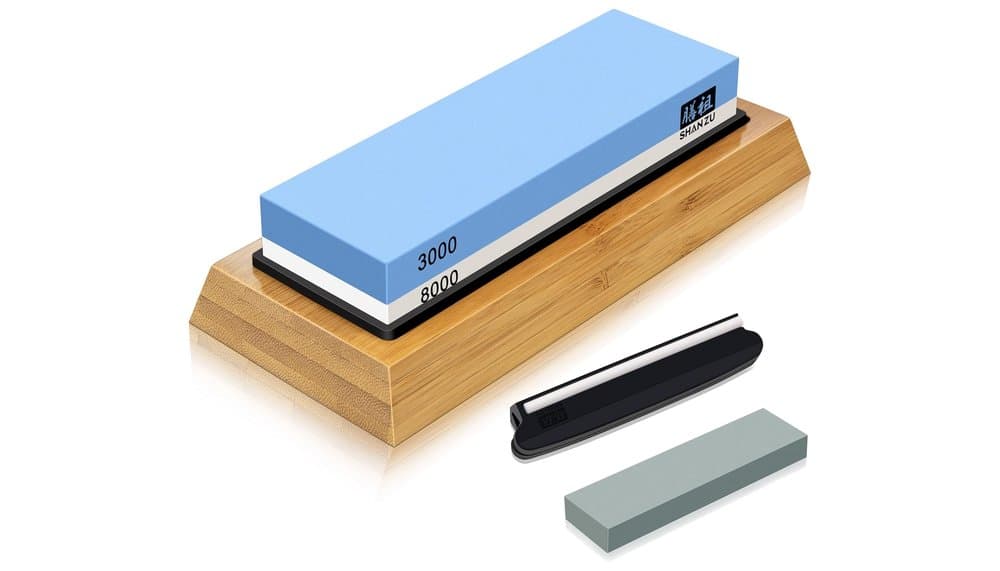
- Complete and well-thought-out kit for beginners: The inclusion of an angle guide and a flattening stone sets this kit apart from many of its competitors, offering a turnkey solution.
- Stable and secure work base: The bamboo base combined with the non-slip silica-gel pad is widely praised for its effectiveness in keeping the stone firmly in place, even when wet.
- Logical and versatile grit range: The combination of 3000 (sharpening) and 8000 (polishing) grits covers the majority of regular maintenance needs for common kitchen knives.
- Perceived excellent value for money: The community consistently highlights that the performance delivered far exceeds expectations for its price segment.
Weaknesses
- The angle guide, a transitional tool: While useful for the very first uses, most experienced users quickly abandon it, finding it limiting and imprecise in the long run.
- A very thirsty stone: Its material, white corundum (aluminum oxide), is described as particularly absorbent. A long soak (10-15 min) and constant watering during use are imperative.
- More frequent flattening needed: The stone tends to dish or wear unevenly faster than high-end Japanese stones, requiring regular maintenance with the included flattening stone.
- The advertised grits should be taken with a grain of salt: Several reviews, even after several years of use, note that the actual grits seem slightly coarser than the advertised 3000/8000 ratings. The result remains excellent, but the final polish may lack the absolute "mirror" finish of a true high-end 8000 stone.
Detailed Product Analysis
Construction & Materials: Solid, But With Compromises
The heart of the kit is the dual-sided white corundum stone. This is a common synthetic material, known for its durability and ability to remove material quickly. On paper, this choice is logical for a kit oriented towards value and robustness. However, the porous structure of this specific stone explains its very "thirsty" nature. This is not a defect per se, but a usage constraint to be aware of: it requires diligent preparation and watering.
The bamboo stand is a strong point. Beyond its aesthetics, it offers a comfortable working height and, coupled with the silicone pad, remarkable stability during blade passes. The community notes, however, that it should be avoided to let it soak in water and should be dried thoroughly after use to prevent any long-term warping or cracking.
See priceSharpening Performance: Effective and Versatile
The 3000 → 8000 sequence is intelligent for the target user. The 3000 grit allows for restoring a functional edge to a slightly dull knife, repairing micro-chips, or starting work on a very worn knife. The 8000 grit then serves to polish the edge, refine the burr, and achieve a smooth and aggressive edge, perfect for precise cuts of vegetables or fish fillets.
According to feedback, the stone works very well on a wide range of steels. It has been successfully tested on simple carbon steels (like Opinel), common kitchen stainless steels, and even harder steels. It doesn't "bite" as fast as a low-grit (e.g., 400) silicon carbide stone, but that's not its role. However, for very hard steels like VG-10 or AUS-10 (with a Rockwell hardness around 60 HRC), the 3000 grit may require a bit more time and patience to reform the bevel, but polishing with the 8000 grit is entirely achievable and effective.
The major element reported by the community is the final result: a "razor" or "very aggressive" edge is regularly achieved, even by beginners after a bit of practice. What interests us here is the concrete result, and it is largely up to par for kitchen knives.
Angle Guide & Learning Curve
The included plastic angle guide is the most discussed accessory. For an absolute novice, it provides a reassuring framework and allows for satisfactory results without knowing the angles. It avoids initial frustration and major mistakes. However, almost all users who have persisted with manual sharpening report abandoning it after a few sessions. They point out that it restricts natural movement, is difficult to attach securely to blades of various shapes, and that manual control of the angle (often around 15-20° per side for a Japanese knife) quickly becomes more precise and faster. It should therefore be seen as a learning crutch, not as a definitive tool.
Durability & Maintenance: The Key to "Buy-It-For-Life"
This is where the site's philosophy comes into play the most. A stone is not an inert object; it is a consumable that wears out. The durability of the SHAN ZU kit depends entirely on its maintenance. Two aspects are critical:
- Regular flattening: The supplied stone wears unevenly. If not flattened with the included flattening stone (by performing figure-8 motions on the surface), it will dish and become unusable. Experienced users confirm this: it is a non-negotiable step to preserve the investment. Fortunately, the tool is provided.
- Complete drying: After use, the stone must be left to air dry, never stored wet in its box. The bamboo stand should also be wiped down. This prevents mold development and premature degradation of the material.
A user testimony citing "5 years of use" and a "very decent" result demonstrates that with proper care, this kit can have a very long lifespan.
Technical Specifications
| Feature | Detail |
|---|---|
| Model | SHAN ZU SZ-2017-002 Whetstone Knife Sharpening Stone |
| Stone Type | Dual-sided water stone (soaking type) |
| Material | White corundum (Synthetic aluminum oxide) |
| Grits | #3000 (fine sharpening) / #8000 (polishing) |
| Stone Dimensions | Approx. 180 mm (L) x 60 mm (W) x 27 mm (H) |
| Stand | Bamboo base with non-slip silica-gel pad |
| Included Accessories | Plastic angle guide, Flattening stone |
| Total Weight | Approx. 1.07 kg |
| Recommended Use | Kitchen knives (chef's, sushi, etc.), pocket knives, garden tools (pruners) |
What Users Say: A Summary of Feedback
The analysis of nearly 20,000 global reviews (with a 4.5/5 rating) and detailed feedback gives a very consistent picture of the product.
The recurring praise revolves around immediate effectiveness. Terms like "magical," "impeccable," "perfect," "super effective" constantly come up. Users are surprised and satisfied with the edge obtained on their everyday knives. The stability provided by the bamboo/silicone stand is also a major point of satisfaction, making the experience safer and less frustrating. The inclusion of the flattening stone is seen as a real plus, showing the manufacturer thought about the product's longevity.
The criticisms and reservations are instructive. Besides the aforementioned abandonment of the angle guide, several technical points emerge:
- One user notes the stone is "very messy," which is characteristic of water stones that generate abrasive mud ("slurry").
- The necessity of a long soak (10-15 min minimum) is reiterated, and some would have preferred a splash-and-go stone.
- Several comments, including a very detailed one, confirm that the actual grits are coarser than indicated. The #8000 acts more like a fine 5000-6000, but the final result remains "a very good edge," even "razor-sharp."
- One review mentions a minor quality control issue: a slightly chipped flattening stone upon receipt.
The overall impression is that of an honest product that does what it's asked to do without excessive pretense. It will not replace a set of specialized Japanese Shapton or Naniwa stones for a purist, but it offers an excellent entry point or a robust solution for the regular maintenance of a varied kitchen knife collection.
Conclusion: Who Is This Kit For?
The SHAN ZU SZ-2017-002 kit is not a "for life" stone in the sense of an object that requires no maintenance. On the other hand, it is a sustainable investment if one understands and accepts its maintenance rules: soaking, regular flattening, and rigorous drying.
It is the ideal solution for three profiles:
- The serious amateur cook who wants to switch to manual sharpening and is looking for a complete, stable, and effective kit to start without breaking the bank.
- The professional or enthusiast needing a versatile and portable maintenance stone to use between sessions on more specialized grit stones.
- Anyone owning knives of varying quality (from Opinel to Japanese hard steel knives) and wanting a single sharpening method to maintain them all.
Its main merit is demystifying stone sharpening. By providing all the basic tools, including the one for its own maintenance (the flattening stone), it allows for achieving professional results while learning the fundamentals of the discipline. For those willing to dedicate the learning time and necessary maintenance, this SHAN ZU kit represents a very solid purchase and a satisfying gateway to self-sufficiency in knife maintenance.