Shapton Ha No Kuromaku 1000-5000-8000 Stone Review
Introduction
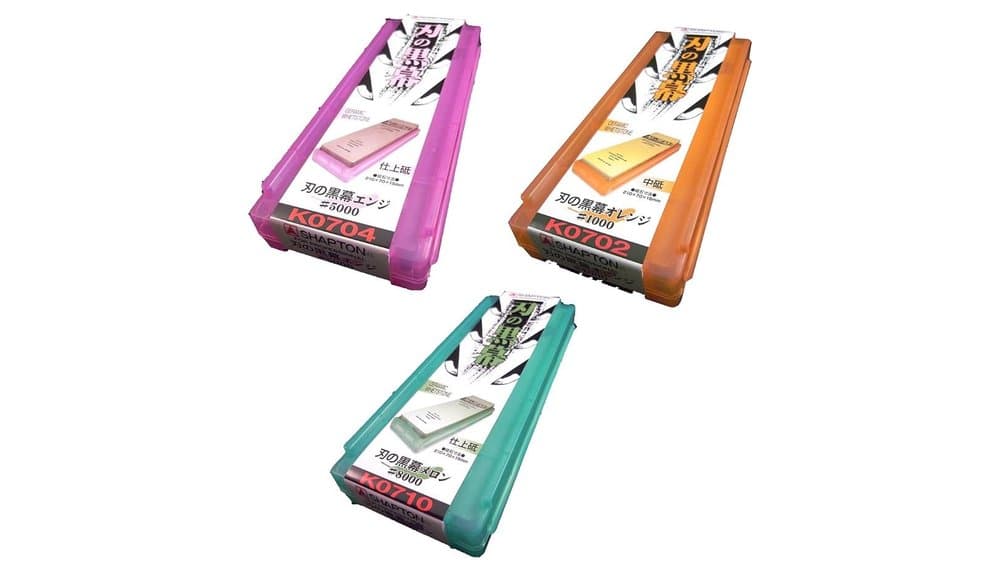
For the serious knife enthusiast, sharpening is not a chore, but an essential ritual to preserve the soul of their blades. The choice of stone is as crucial as the choice of the knife itself. The Shapton Ha No Kuromaku #1000-#5000-#8000 set fits into this quest for the perfect tool: a triad of Japanese ceramic stones designed to last a lifetime and perform at a professional level. On our site dedicated to sustainable culinary tools, we examine this product not as an accessory, but as a full-fledged investment. Can it become the ultimate sharpening partner for the demanding cook? Let's dive into a technical and practical analysis, stripped of all marketing, to understand what this Shapton set is made of.
Strong Points
This Shapton Kuromaku set stands out through several characteristics that make it a top-tier tool for intensive use.
Durability and "Splash & Go" Construction: The first major asset, confirmed by expert and user feedback, is its longevity. These stones are made of high-density ceramic, a material significantly harder and subject to much slower wear than traditional water stones. This hardness means they stay flat much longer, a considerable long-term advantage. Their "splash & go" technology is also a notable time-saver: a simple few-second splash of water is sufficient before use, eliminating the 10 to 20 minute soaking required by other stones. This makes them immediately operational and greatly facilitates their maintenance.
Cutting Speed and Versatility: The sharpening community agrees that Shapton Kuromaku stones bite quickly into metal. The #1000, in particular, is recognized for its efficiency in reshaping an edge on most steels, from simple stainless to harder Japanese carbon steels like VG-10 or Aogami (Blue Steel). This speed allows for effective work without unnecessarily wearing down the blade.
Logical and Complete Progression: The selection of grits (#1000, #5000, #8000) is not arbitrary. It covers the entire sharpening chain, from basic repair/reprofiling (#1000) to a razor polish (#5000) and up to a mirror finish (#8000). This range meets the needs of 95% of kitchen knives, from Western chef's knives to lightweight Japanese santokus. The Kuromaku color code system (black, green, white) offers instant identification, a practical detail that avoids confusion.
Weak Points
No tool is universal, and the specificities of the Shapton Kuromaku can present challenges for certain profiles.
A "Cold" Feel for Beginners: The trade-off for their great hardness and low wear is a less pronounced feedback sensation compared to softer stones. According to expert analyses, this can make learning more difficult for a novice who needs to "feel" the blade's contact on the stone to understand angles. The stone glides more, offering less tactile resistance.
Learning Curve and Risk of Over-Sharpening: The combination of fast cutting and fine grits (#5000 and #8000) is a powerful tool that requires control. Testers emphasize that it is crucial to perfectly master the technique on the #1000 before moving to higher grits. Without this, one risks spending too much time on the finer stones and rounding the edge, or simply not exploiting the potential of the finishing stones.
Potential Fragility: Although hard, ceramic stones are brittle. A drop on a corner or a violent impact can fracture them. Their handling and storage therefore require a minimum of precaution. The integrated plastic case offers basic protection, but it is advisable to store them in a stable place.
Detailed Product Analysis
Construction and "Buy-It-For-Life" Philosophy
The Shapton Kuromaku set is the antithesis of cheap, fast-consuming stones. Each stone is a matrix of ceramic aluminum oxide micro-grains bound together extremely solidly. This manufacturing process, unique to Shapton, aims to release abrasives consistently and minimize mud formation. The result is a stone that wears at a very slow rate. While a traditional stone may require regular flattening, a Kuromaku will retain its flatness much longer under normal home use. Its molded plastic case, which also serves as a water tray during use, is sober, functional, and avoids having to buy a separate stand. This is a utilitarian design focused on longevity and pure efficiency.
See priceThe Grit Progression Decoded
- The #1000 (Black): The workhorse stone. This is the most used stone in the set. Its medium grit is perfect for reshaping the edge on a dull knife, correcting slight imperfections, or creating a new bevel. It leaves a relatively rough finish, perfectly suitable and very sharp for the majority of kitchen tasks (cutting vegetables, meats, fish). It is effective on a wide range of hardnesses, from steels at ~55 HRC to hardened steels at 61-63 HRC.
- The #5000 (Green): The refinement stone. It comes into play after the #1000 to polish the edge and remove coarse striations. The edge becomes cleaner, more regular. For carbon steels and high-performance stainless steels, this finish already offers an exceptionally sharp and durable edge, ideal for precise slicing. It often constitutes the ultimate finish for everyday-use knives.
- The #8000 (White): The mirror-finish stone. This is the perfectionist's tool. It refines the edge to an extreme level, producing a mirror finish on the bevel. On a knife well sharpened to #5000, the #8000 adds that extra "bite," almost razor-like, particularly appreciated on fish knives or nakiris for ultra-clean cuts of delicate products. It is not necessary, but it is the sign of a mastered sharpening.
Compatibility with Different Steels
This is where the set proves its worth. Thanks to their hardness and the size/quality of their abrasives, these stones are capable of handling the most demanding steels:
- Carbon Steels (White Steel, Blue Steel): They sharpen quickly and beautifully, revealing the full potential of the #5000 and #8000 grits with an extremely sharp edge.
- Japanese Stainless Steels (VG-10, AUS-10, SG2/R2): The #1000 bites well into these often tougher steels. The progression to finer grits allows for a durable and very sharp edge.
- Modern Western Steels: They are also well handled, although the cutting speed may be slightly reduced on very high carbon and vanadium steels.
For extremely hard steels (beyond 64-65 HRC) or highly alloyed steels, some experts note that diamond stones may be more effective for rough shaping, but Shaptons remain perfect for polishing.
Technical Specifications
| Characteristic | Detail |
|---|---|
| Product Name | Shapton Ha No Kuromaku Ceramic Sharpening Stone Set |
| Included Grits | #1000 (Medium), #5000 (Fine), #8000 (Very Fine) |
| Material | Ceramic (Aluminum Oxide) |
| Usage Type | "Splash & Go" Water Stone |
| Dimensions (L x W x H) | Approx. 21 x 7 x 1.5 cm (per stone) |
| Total Weight | Approx. 454 g |
| Color Code | #1000 (Black), #5000 (Green), #8000 (White) |
| Manufacture | Japan |
| Notable Feature | Integrated plastic case serving as a stand and tray |
What Users and Experts Say
The synthesis of customer reviews and expert feedback on specialized forums shows a strong consensus around this set.
The recurring praise revolves around the quality of the results. Users, even amateurs after a learning period, report achieving "razor," "mirror," and "professional" edges. The practicality of splash & go and the generous size of the stones (suited for large blades) are consistently praised. Many describe this set as an "investment" that permanently replaced their old sharpening systems. The average rating of 4.8/5 stars on online platforms is largely driven by this positive feedback.
Criticisms or warnings are more nuanced and instructive. Several beginners highlight a necessary adjustment period, finding the #1000 stone "too hard" or "too slippery" at first. This feeling is corroborated by experts who explain that the subtle feedback of Shaptons is appreciated with experience. A few highly experienced users, accustomed to natural stones or softer ceramics, sometimes prefer a more "creamy" feel for ultimate finishes. Finally, the need to use the three stones in order for an optimal result is reiterated, which may seem long to those seeking an express one-step solution.
Conclusion
The Shapton Ha No Kuromaku #1000-#5000-#8000 set is not a gimmick tool. It is a professional and durable solution designed for those who consider knife maintenance an essential part of their culinary practice. Its verdict is clear: exceptional longevity, proven effectiveness on the majority of steels, and a logical progression that covers all advanced sharpening needs.
It is perfectly suited to the serious cook, whether an enlightened enthusiast or a professional, willing to dedicate some time to mastering their technique. On the other hand, for an absolute beginner looking for their very first stone, the learning curve could be steeper than with a softer, more "forgiving" stone. But for those aiming for "buy-it-for-life," this Shapton set represents a solid investment. It does not promise to make you an expert in five minutes, but it offers you a trio of quality tools that will not be the limit of your progress. Your most precious knives deserve this level of care.