Shapton Kuromaku Ceramic Whetstone 1000 Grit Review
Introduction
In the demanding world of sharpening, choosing a whetstone is a decision that impacts the long-term relationship with one's knives. For serious home cooks and enthusiasts who consider their tools as lifelong investments, the product must combine raw performance, durability, and ease of use. The Shapton Kuromaku Ceramic Whetstone Grit 1000 positions itself as a pillar in this field, a professional stone that has forged its reputation in workshops and kitchens. This article analyzes this essential product from the "buy-it-for-life" perspective: is it a trustworthy companion for maintaining a lifetime's worth of knives, from soft carbon steels to the hardest Japanese stainless steels?
Strong Points
- Durability and Low Wear: The dense, hard ceramic stone wears very slowly, guaranteeing a flat surface for years of intensive use.
- "Splash and Go" Convenience: No long soaking required. A simple moistening allows you to start sharpening in seconds, a major asset for regular maintenance.
- Exceptional Cutting Speed: Its density of abrasives gives it remarkable efficiency for reshaping an edge, even on heavily dulled blades.
- Integrated Stand: Its plastic storage case transforms into a stable sharpening base, eliminating the need for an additional accessory.
- Minimal Maintenance: Unlike some traditional water stones, it does not crack, warp, and requires little care.
Weak Points
- "Icy" Feel: Its hard surface can offer less perceptible tactile feedback than softer stones, which can confuse some users, especially beginners.
- Aggressive Edge: The #1000 grit produces a biting, very sharp edge, but not a mirror polish. A finishing stone (3000/5000) is recommended for those seeking a perfectly polished razor edge.
- Rapid Surface Drying: Based on feedback, it may be necessary to re-wet the surface during a prolonged sharpening session to maintain optimal slurry.
- Minimal Sharpening Slurry: The near absence of slurry is an advantage for cleanliness, but deprives the user of the subtle polishing effect this slurry provides on other stones.
Detailed Analysis
Construction and "Buy-It-For-Life" Philosophy
The Shapton Kuromaku 1000 embodies a utilitarian and durable philosophy. Its construction is based on a block of high-density abrasive ceramic. It is not a natural water stone or a traditional resin-bonded stone, but a synthetic product where abrasive particles are densely compacted. On paper, this structure translates into extremely slow wear. The community and expert testers agree on this point: this stone does not dish, sink, and retains its flatness much longer than many alternatives at a similar price. This wear resistance is the first pillar of its status as a lifelong tool. Its case/base, although made of simple plastic, contributes to this longevity by protecting the stone from shocks and providing a stable platform, avoiding vibrations that could, to a minor extent, harm the precision of the stroke.
See pricePerformance on Different Steels: From Carbon to Hard Steels
It is on performance that the reputation of the Kuromaku 1000 is built. Its dense ceramic is renowned for biting quickly into the metal. Whether you are sharpening a knife in simple carbon steel (like Shirogami/Aogami) with a Rockwell hardness (HRC) around 60-62, or a Western knife in high-carbon stainless steel like VG-10 (HRC 60-61) or AUS-10 (HRC 58-60), the feedback is unanimous: the stone is effective.
For softer steels (like many Western knives or carbon steel woks), it removes material without difficulty. Its true test is on hard, wear-resistant steels, typical of high-end Japanese knives. Here, the community and experts emphasize that it excels. It does not get "glazed" or slide on the steel; it cuts. An experienced user even notes that "this stone eats everything." This makes it a universal stone suited to a diverse kitchen arsenal, an essential criterion for the passionate cook who owns both a Blue Steel nakiri and a chef's knife in X50CrMoV15.
Ergonomics and User Experience
The sharpening experience is a mix of objective and subjective factors. Objectively, the format (21 x 7 cm) offers an ample working surface for most kitchen knives, even long ones. The grip on the block itself is not a factor, as it is used resting on a surface. It is rather the feel of the knife on the stone that is discussed. The hard ceramic of the Shapton provides a characteristic sensation, often described as more "slippery" or "icy" than softer stones like a King or a Suehiro. Some appreciate this fluidity and the control it allows, others see it as a lack of tactile "bite." This sensation is directly linked to its low slurry production. It should be noted that the "splash and go" practice is a major ergonomic asset: no planning needed, you moisten, sharpen, rinse, and store. This encourages regular and spontaneous maintenance, key to keeping knives in perfect condition.
Comparison with Competition and Positioning
The Shapton Kuromaku 1000 sits in a segment where competition is fierce, notably with Naniwa Chosera/Professional and Suehiro Cerax. Based on comparative analyses from the community, the Shapton distinguishes itself by its robustness and no-frills nature. It is often perceived as faster cutting than an equivalent grit Naniwa, but with a less polished finish. It also requires fewer precautions (no risk of cracking from rapid drying like some Chosera). Compared to an economical stone like the King KDS 1000, the Shapton offers superior cutting speed, much less wear, and the precious "splash and go" advantage. Its positioning is clear: it is a reliable and effective work tool that prioritizes the result (a sharp edge) and longevity over an ultra-luxury tactile feel or a perfect polish straight off the stone.
Technical Specifications
| Characteristic | Detail |
|---|---|
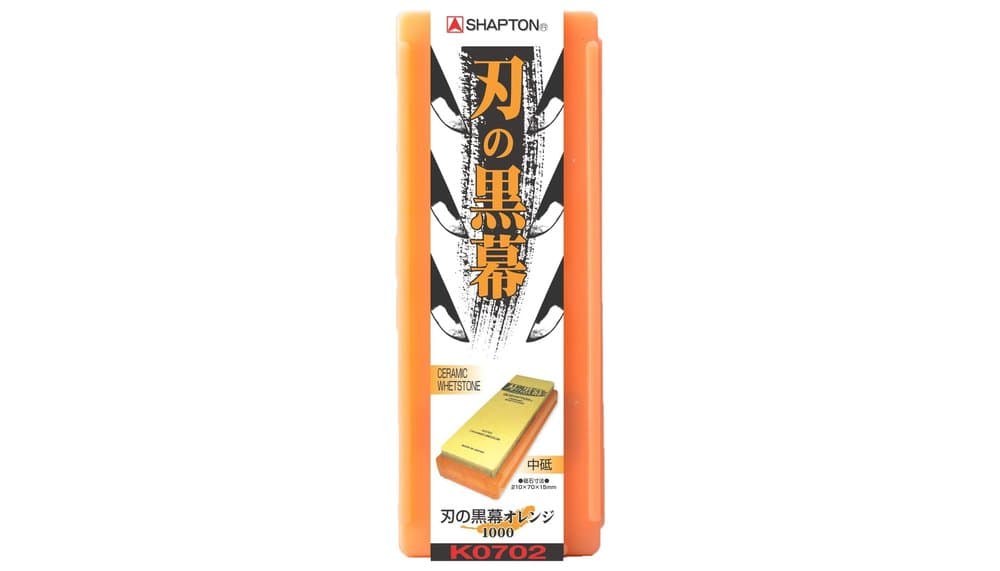
| Product Name | Shapton Kuromaku Ceramic Whetstone Grit 1000 |
| Brand | Shapton |
| Grit | #1000 (Medium) |
| Abrasive Type | High-density synthetic ceramic |
| Use Type | Splash and Go (Moisten and use) |
| Dimensions (L x W x H) | Approximately 21 x 7 x 2.5 cm |
| Color | Orange (Kuromaku color code) |
| Included Accessory | Storage case / base stand |
| Maintenance | Clean with water, air dry |
What Users Say
An analysis of thousands of customer reviews and expert online discussions reveals very clear trends.
Praise is concentrated on several points:
- Formidable Effectiveness: The terms "fast," "effective," "cuts well" come up repeatedly. Users are impressed by the speed with which it restores an edge, even on steels known to be hard.
- Convenience of "Splash and Go": This is a highly praised advantage. Users appreciate not having to anticipate a 10-20 minute soak, making sharpening more spontaneous.
- Perceived Durability: Many note that after months or years of use, the stone has not dished and seems like new, confirming its status as a durable purchase.
- Practical Stand: The case serving as a base is systematically mentioned as an ingenious detail that simplifies setup.
- Ideal Single Stone: For many enthusiasts, this #1000 stone is presented as the perfect and sufficient stone for routine maintenance of all kitchen knives.
Criticisms or reservations are less numerous but recurring:
- Need for a Finishing Stone: Several users specify that the obtained edge, although very sharp for cooking, is "aggressive." They recommend following it with a 3000 or 5000 grit stone for a more polished, "razor" edge, especially for purists.
- Particular Feel: Some feedback mentions the "icy" sensation or the fact that the stone dries out quickly, requiring re-wetting with a wet hand during use.
- Grit Perceived as Coarser: Some experienced users with other brands estimate that the Shapton #1000 grit behaves more like a 700-800 from other brands, producing a more biting but less refined edge.
Conclusion
The Shapton Kuromaku Ceramic Whetstone Grit 1000 is not a stone with an enveloping sensory experience or perfect polish. It is much more than that: it is a reliable, robust, and incredibly effective professional tool. Its analysis from the "buy-it-for-life" perspective is unequivocal: the materials (dense ceramic), construction (low wear), and design (splash and go with integrated stand) are all oriented towards maximum longevity and practicality.
For the serious cook who uses their knives daily and seeks a simple, durable way to keep them perfectly sharp, this stone is a near-perfect choice. It handles the vast majority of steels, from soft to the hardest, with aplomb, and its simple operation encourages regular maintenance. Its only "flaw" – an aggressive rather than perfectly polished edge – is actually its greatest strength in the kitchen: a biting edge that tears tomato skins and slices root vegetables with authority.
If you are looking for the single, high-performance maintenance stone that will last as long as your knives, the Shapton Kuromaku 1000 is a decision in which you can invest with your eyes closed. For those who wish to go further with polish, it will constitute a solid and rapid progression base, to which it will always be a pleasure to return.