SOARFLY Electric Knife Sharpener Review & Test
Introduction
On a site dedicated to durable and high-performance kitchen tools, the arrival of an electric sharpener like the SOARFLY Electric Knife Sharpener naturally sparks a mix of curiosity and skepticism. We, enthusiasts of Japanese white steel knives, Western VG-10 blades, and meticulous sharpening on whetstones, wonder: can such a device have a place in a demanding kitchen, where longevity and edge preservation are paramount? This article is not based on a physical test, but on an in-depth analysis of technical specifications, community feedback, and expert opinions available online. Our goal is to evaluate this electric sharpener through the demanding lens of "buy-it-for-life" and determine if it can be an ally for regular maintenance or a risk to the integrity of our precious blades.
Key Strengths Identified
Based on manufacturer data and user feedback, the SOARFLY presents several strengths that explain its immediate appeal.
Ease of Use and Speed. This is its main selling point. The process is simplified to the extreme: one button, a single pull-through motion of the blade. The community notes that a functional edge is achieved in seconds, which strongly contrasts with the learning curve of a whetstone. For quick maintenance of common kitchen knives, this represents an undeniable time saver.
Advertised Versatility. On paper, the device promises to handle a wide range of tools: Western kitchen knives, scissors, and even some garden tools. This "do-it-all" capability makes it an attractive product for the general public seeking a single solution.
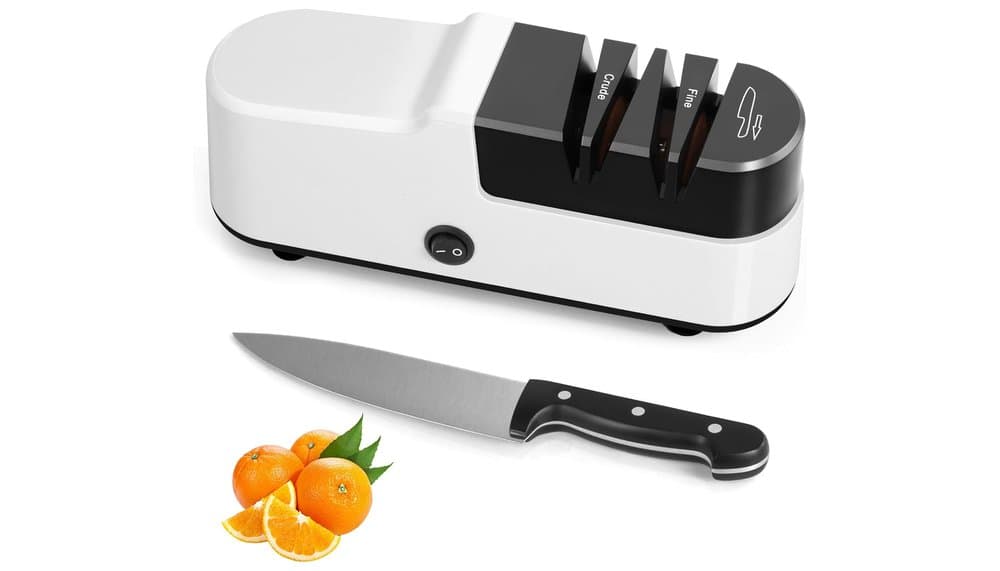
Compact Design and Practical Features. Its square format and small size (4x4x4 cm) make it a discreet and easy-to-store object. Users appreciate the presence of a non-slip base for stability and USB charging, a practical and modern option that avoids dependence on batteries.
Weaknesses and Structural Limitations
Analysis of expert reviews and negative feedback reveals limitations that take on another dimension when evaluating the device for serious and durable use.
Inability to Handle Hard Steels and Quality Knives. This is the clearest breaking point. Testers emphasize that the device struggles quickly with high-carbon steels and high Rockwell hardness (HRC > 60). The mechanism struggles to remove metal effectively and, more problematically, it manages the formation of the burr (the "wire edge") very poorly. The resulting edge can be irregular and degrade quickly with use.
Clogging and Overheating Issue. The lack of a cooling system (water or oil) is a major flaw. The abrasive discs clog quickly with metal particles, drastically reducing their effectiveness after a few uses. The built-in "dressing" mechanism is deemed ineffective by experts, requiring tedious manual cleaning. This clogging can also lead to excessive blade heating, which is detrimental to the steel's temper.
Long-Term Durability and Uncertain Maintenance. No reliable information is available on the exact composition of the grinding wheels, their grit, or the availability of replacement parts. From a "buy-it-for-life" perspective, this opacity is a deal-breaker. The device seems designed as a sealed unit, not repairable.
Detailed Analysis: Confrontation with the "Buy-It-For-Life" Requirement
Materials and Construction: The Worrying Opacity
The specifications mention a stainless steel housing, a positive point for corrosion resistance. However, the heart of the device – the abrasive discs – remains a mystery. Their composition (diamond, ceramic?), their actual grit, and their binder are unknown. For a site discussing VG-10 and Shirogami, this lack of transparency is a red flag. A product designed to last should offer the possibility of replacing its consumables.
See pricePerformance on Different Blade Types: A Contrasted Reality
- Entry/Mid-range Western knives (AUS-8, X50CrMoV15, HRC ~55-58): This is the SOARFLY's domain of expertise. According to feedback, it restores an acceptable edge for daily tasks, even if the edge will not be as fine and durable as with a mastered manual sharpening.
- Japanese or high-end Western knives (VG-10, Aogami, ZDP-189, HRC > 60): The device is clearly unsuitable. It risks creating a poor burr, rounding the edge, or generating damaging heat. For these tools, the whetstone remains the only recommended method.
- Other tools (scissors, pruners): The versatility is real, but with the same reservations about the fineness of the result and increased clogging.
Comparison with Traditional Methods: Speed vs. Mastery
The SOARFLY bets on convenience. It is infinitely more accessible than a stone. However, sharpening on a stone offers total control over the angle, pressure, burr removal (via stropping), and allows grit selection for a custom edge, from the most robust to the razor-like. The electric sharpener standardizes and mechanizes a process that, for fine knives, is a craft.
Ergonomics and Prolonged Use
Users describe simple handling and stable operation thanks to the non-slip base. The motor is reported as relatively quiet. Ergonomics are therefore not a negative point for short maintenance sessions.
Technical Specifications Summarized
| Feature | SOARFLY Detail | Note / Analysis |
|---|---|---|
| Type | Electric sharpener with abrasive discs | |
| Power | Integrated battery, USB recharge | Practical, but long-term battery life unknown. |
| Housing Material | Stainless Steel | Positive for durability and hygiene. |
| Abrasive Discs | Undetailed information (most likely diamond/oxide) | Critical point. Grit and quality unknown, no info on replacement. |
| Functions | Single sharpening, wheel "dressing" mode | The integrated dressing is deemed ineffective by experts. |
| Versatility | Kitchen knives, scissors, tools | Functional for a basic edge, but results vary. |
| Safety | Non-slip base, blade engagement mechanism | Conforms to consumer electric sharpener standards. |
| Dimensions | 4 x 4 x 4 cm (Compact) | Advantage for storage. |
What Users and Testers Say
The synthesis of 264 customer reviews (average rating of 4.1/5) and online expert analyses reveals a clear dichotomy:
Recurring Positive Points are highlighted by users with modest expectations, often owners of standard knives. They praise the simplicity, the speed ("done in 30 seconds"), and the fact that the device "works well" to give a new lease on life to dulled everyday knives. The ease of cleaning the removable stones (in theory) is also mentioned.
Critical Negative Points come from more demanding users or those who encountered technical limits. The problem of clogging ("the discs clog fast") and the burr ("the knife cuts but is not well sharpened") recurs as a leitmotif. Several report a drop in effectiveness after several months of regular use, raising the question of irreversible disc wear. The failure on hard steels is clearly documented by testers.
The Trend is clear: the SOARFLY is appreciated as a convenient and quick "crutch" for maintaining common household knives, but it is unanimously discouraged for high-quality or collection knives. It does not replace professional or skilled manual sharpening.
Conclusion: A Practical Tool, But Not a Lifetime Companion
The SOARFLY Electric Knife Sharpener occupies a well-defined niche. It is the technological answer to a legitimate need: maintaining simply and quickly a set of household knives without investing time in learning to sharpen on a stone. For the occasional cook or household using standard knives, it can extend the active period of use between two serious sharpening sessions.
However, in light of our community's strict criteria – extreme durability, preservation of precious steels, professional-grade results – this electric sharpener shows its undeniable limits. Its opacity regarding abrasive materials, its inability to handle hard steels, its chronic clogging issue, and the lack of prospects for repair or replacement of wear parts distance it from this ideal.