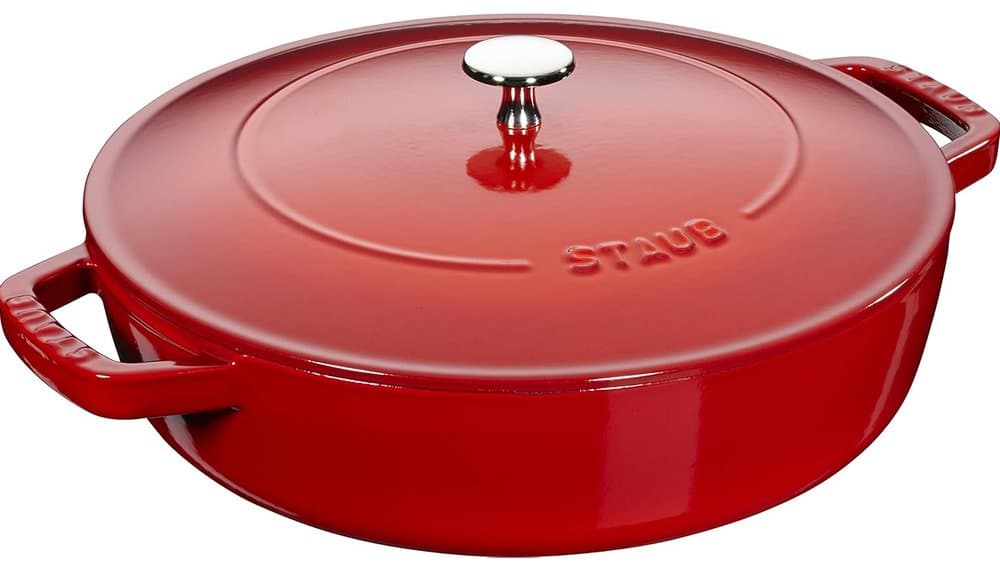
STAUB Chistera Sauté Pan Test & Review
Introduction: A Sauté Pan for Life?
In the world of kitchen utensils designed to last, enameled cast iron occupies a unique place, halfway between a family heirloom and a professional tool. The STAUB Chistera Cast Iron Sauté Pan presents itself as one of the most accomplished incarnations of this philosophy. On our site dedicated to durable tools—Japanese knives, carbon steel woks, and sharpening stones—we do not judge lightly. Here, we talk about culinary heritage, long-term investment, and uncompromising performance.
This analysis is not based on a personal test, but on a rigorous examination of the product's technical specifications, cross-referenced with the numerous and detailed feedback from the user community and comparative analyses from experts. We will dissect this sauté pan to determine if it deserves its place in the kitchen of a demanding amateur or serious cook, with a decidedly "buy-it-for-life" perspective.
Strengths and Weaknesses: A Quick Overview
Strengths
- Exceptional manufacturing and durability: Enameled cast iron made in France, renowned for its virtually unlimited longevity with proper care.
- Versatile cooking performance: Excellent heat retention and distribution for searing and braising, with the Chistera system under the lid for even moisture redeposition.
- Robust black interior enamel: More resistant to scratches and discoloration than some light-colored enamels, it develops a natural non-stick patina over time.
- Complete versatility: Compatible with all heat sources, including induction, and oven-safe.
- Ergonomics and finish: Sturdy, well-sized handles for a secure grip, even with oven mitts.
Weaknesses
- Considerable weight: At 5.4 kg, handling and cleaning require some physical strength.
- Necessary precautions: Sensitive to thermal shock and requires a gradual temperature increase to preserve the enamel.
- Significant initial investment: A high-end product that represents a significant budget, justified by its durability.
- Thermal conductivity: Cast iron heats slowly and may have hot spots on some induction cooktops if the size is not perfectly matched.
Detailed Analysis: The STAUB Chistera Under the Microscope
The Star Material: STAUB Enameled Cast Iron
Here, there is no VG-10 steel or carbon with a specific Rockwell hardness. The material is the absolute protagonist: cast iron. The latter does not have a "hardness" expressed in HRC like a blade, but its hardness and resilience are legendary. The enamel that coats it is a layer of glass fused at high temperature. It is this vitrification that makes all the difference. It makes the piece impermeable, acid-resistant, and flavor-neutral—no reaction with food, unlike raw cast iron which requires seasoning. According to experts and feedback, STAUB's matte black enamel is often described as slightly more resistant to scratches and discoloration than the light sand-colored enamel of its main competitor, Le Creuset. It is a "living" enamel: with use, fats embed themselves in its porous micro-texture to create a natural non-stick layer, a seasoning that improves over time.
See priceCulinary Performance: Mastered Heat and Moisture
The magic of cast iron lies in its thermal mass. Once hot, it retains and diffuses heat exceptionally evenly. This eliminates cold spots and allows for perfect cooking, whether for searing a duck breast or braising a bourguignon for hours. It is this capability that makes it a tool of choice in professional kitchens, an observation corroborated by several user reviews from those who have worked in the restaurant industry.
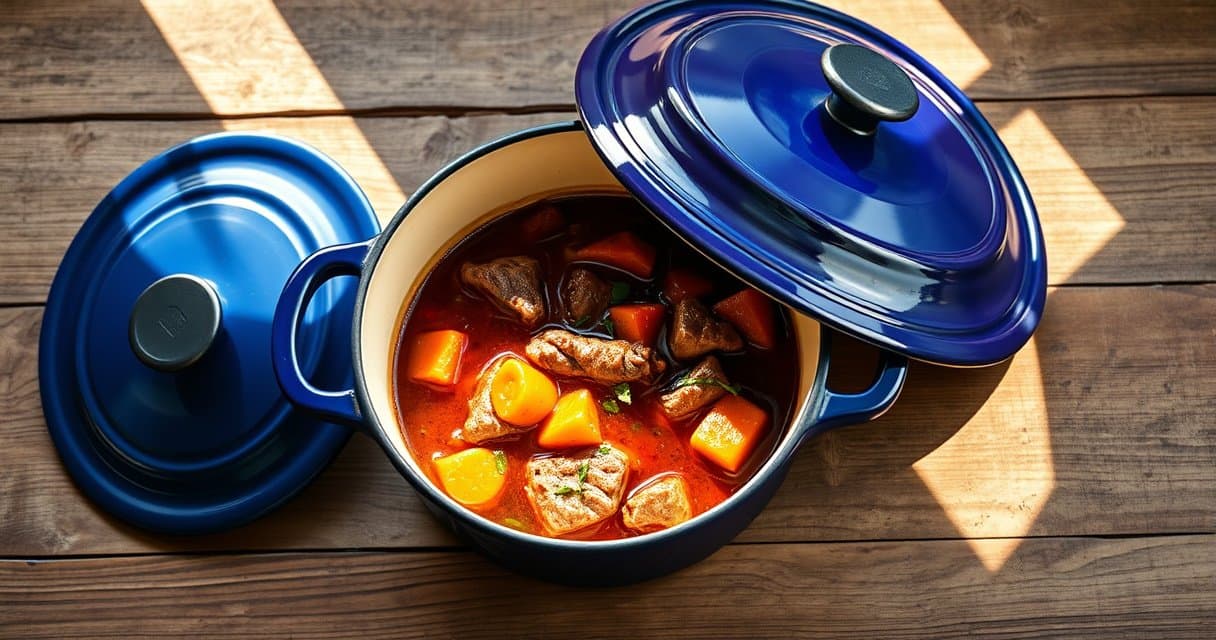
The lid and its Chistera system (raised studs on the inside) constitute a notable innovation. While condensation on a regular lid drips down the sides, the studs capture the moisture and make it fall back in fine droplets over the food. This "continuous basting" cycle keeps dishes particularly juicy and tender during long cooking, while requiring less added liquid. Testers emphasize that this feature is a real plus for braises and stews.
Ergonomics and Handling: Heavy, But Solid
An object weighing 5.4 kg is not to be taken lightly. The handles, firmly riveted to the body of the pan, are however designed to offer a comfortable and secure grip. The community notes that their size and shape allow for a good grip, even with thick oven mitts. This is clearly a utensil that you place on the heat and leave there, more than a pan for tossing food with a quick flick of the wrist. For cleaning, its weight is undeniably a factor to consider, especially when full.
Durability and Maintenance: A Potential Heirloom
This is where the "buy-it-for-life" concept makes full sense. A STAUB Chistera properly used and maintained is a hand-me-down object. Feedback frequently includes mentions like "I've had mine for 30 years" or "this tool lasts without issue." The key to this longevity lies in respecting simple but imperative rules:
- Gradual preheating: Always start on low/medium heat (1/3 of max power) for 5 minutes before increasing.
- Avoid thermal shock: Never plunge a hot pan into cold water.
- Gentle cleaning: Use a non-abrasive sponge and dish soap. It is advertised as dishwasher safe, but most connoisseurs recommend hand washing to preserve the enamel over the very long term.
- Complete drying: Wipe dry immediately after washing to avoid any trace of moisture.
The enamel, while extremely resistant, is not unbreakable. It can crack or chip in case of a violent impact or mishandling of the lid (some users note that one side may fit better than the other, caution is advised). These precautions are an integral part of the experience of using a tool of this quality.
Technical Specifications
| Characteristic | Detail |
|---|---|
| Product Name | STAUB Chistera Cast Iron Sauté Pan |
| Main Material | Enameled cast iron |
| Diameter (total) | 28 cm |
| Bottom Diameter | 22 cm |
| Volume | 3.7 L |
| Weight | 5.4 kg |
| Interior Finish | Matte black enamel |
| Lid System | Chistera studs for moisture distribution |
| Induction Compatible | Yes |
| Oven Compatible | Yes (lid knob resistant up to 250°C) |
| Washing | Dishwasher (but hand washing recommended) |
| Manufacturing Origin | France |
| Warranty | 2 years |
What Users and Experts Say: Summary of Feedback
The analysis of hundreds of customer reviews and available expert comparisons paints a very strong consensus.
The praise is massive and recurring:
- Build quality and aesthetics: Words like "magnificent," "superb finish," "impeccable quality," and "French savoir-faire" come back as a leitmotif. The perception of value and luxury is immediate.
- Culinary performance: Users praise its excellent heat distribution, its non-stick character that improves over time, and the juicy results obtained thanks to the Chistera lid. Many describe it as a "magic" tool for roasts and braised dishes.
- Perceived durability: Numerous testimonials report STAUB products used for decades, reinforcing the idea of a lifetime purchase. The comparison with Le Creuset is frequent, with both brands considered the undisputed leaders, with a slight preference for STAUB in cooking for its black enamel.
- Versatility: Its ability to go from stovetop to oven and its size adapted for a family make it a "replacement" for several pots.
Points of caution or criticism are fewer but instructive:
- Weight is the most frequently cited drawback. It's the price to pay for performance, but it can be a deterrent for some.
- The need to learn how to use it: Several detailed reviews, including a particularly comprehensive one from an experienced user, insist on the crucial importance of slow preheating and maintenance techniques (drying, light oiling after washing). Not following these rules can damage the enamel.
- Precautions with the lid: A few comments mention the need to place the lid carefully to avoid chipping the enamel on the rim of the pan.
- Price: Although we do not mention it directly, the consensus is that it is a significant investment, but justified by its lifespan.
The overall average rating, extremely high, confirms that for those who accept its constraints (weight, precautions), satisfaction is guaranteed.
Conclusion: Who is the STAUB Chistera For?
The STAUB Chistera Cast Iron Sauté Pan is not an ordinary kitchen utensil. It is a professional tool designed to last for generations. Its analysis from the "buy-it-for-life" angle is clear: the materials, manufacturing, and user experiences point towards exceptional durability.
It perfectly suits the serious cook, amateur or pro, who:
- Seeks optimal thermal performance for searing and slow cooking.
- Understands and accepts the specific maintenance rules for high-quality objects.
- Appreciates the versatility of a single utensil that goes from stovetop to oven.
- Values robustness and artisanal know-how over flashiness or gimmicky innovation.
Conversely, it will be less suitable for those looking for a lightweight and quick-to-handle utensil, or who do not wish to dedicate a minimum of care to their cookware.
Ultimately, if you are ready to acquire a demanding but extremely rewarding kitchen companion, the STAUB Chistera represents a solid and accomplished choice. It embodies that ideal where the tool, over the years and meals, becomes much more than a simple object: a part of your culinary heritage.