WECOOK! Carbono Induction Wok 32 cm Test & Review
Introduction: A Carbon Steel Wok for Induction, a Promising Compromise?
For serious cooking enthusiasts, choosing a wok is almost a matter of philosophy. The ideal? A traditional carbon steel wok, light, seasoned, that responds instantly to the violent heat of a gas burner. But in kitchens equipped with induction hobs, this ideal collides with a physical reality: compatibility. The WECOOK! Carbono Induction Wok 32 cm presents itself as a solution to this dilemma. It promises to combine the king material of professional Asian cuisine – carbon steel – with modern induction technology thanks to an adapted base. But does this hybridization deliver on its promises from a buy-it-for-life perspective? Through an analysis of the specifications, community feedback, and technical constraints, we separate fact from fiction about this product that visibly divides opinions.
Strengths & Weaknesses: A Mixed Balance
Before diving into the details, here is what emerges from the available data.
Strengths
- Induction compatible: Its main asset. It fills an obvious gap in the market by offering a carbon steel wok usable on this dominant type of cooktop.
- Fast heat-up: Carbon steel, even with an adapted base, retains good thermal responsiveness. Testers highlight that it heats up quickly and efficiently.
- Light and maneuverable: At approximately 1.19 kg for the 32 cm, it is significantly lighter than a cast iron wok, making the stir-frying motion easier.
- Large practical capacity: The 32 cm diameter and 5-liter capacity make it a suitable tool for cooking for a family or preparing several portions without overcrowding.
- Original non-stick coating: The included Quantanium coating (PFOA-free) avoids the initial seasoning phase for novices and allows for immediate use with little fat.
Weaknesses
- Coating durability questioned: This is the major flaw reported by users. Many reviews indicate coating peeling or scratching after a few months of use, even with suitable utensils (wood, silicone).
- Maintenance conflicting with promises: The product sheet states "dishwasher safe," which is anathema for any quality carbon steel utensil (seasoned or coated). This recommendation contradicts the product's longevity.
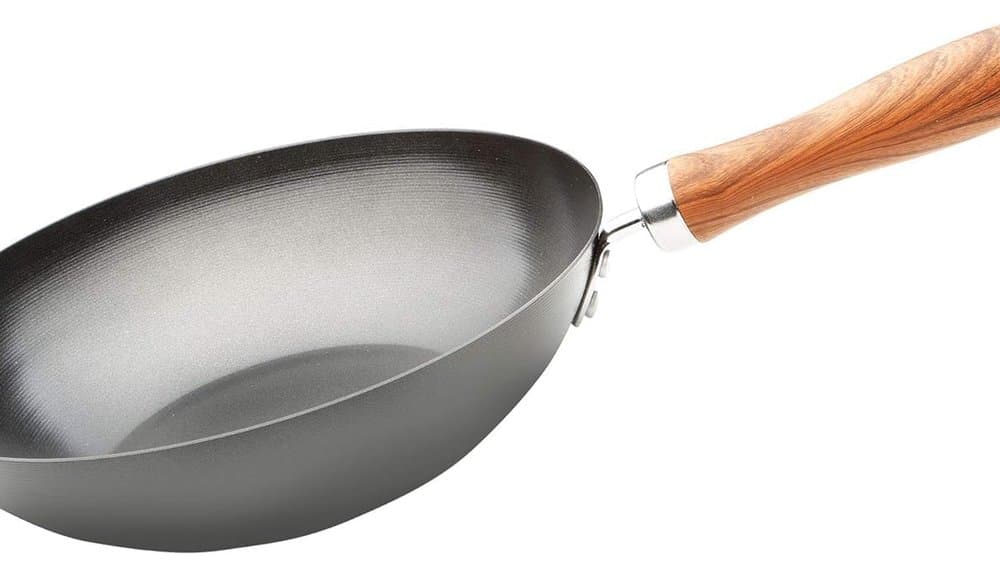
- Flat bottom, a compromise on tradition: To function on induction, the wok has a flat bottom. This slightly limits the "on the walls" cooking area and impairs the perfect circular food movement characteristic of round-bottomed woks.
- "Wok hei" inaccessible: Like any wok used on an induction hob (even a high-performance one), it can never reach the extreme thermal power (beyond 20,000 BTU) of a professional gas burner needed to achieve the "breath of the wok" (wok hei) flavor.
- Handle with mixed comfort: The Bakelite wood-imitation handle is considered too short or not very ergonomic by some, and according to reviews, can get hot during prolonged cooking.
Detailed Analysis: Materials, Construction, and Real-World Use
The Material: Carbon Steel, a Solid Base but... Coated
The mention "carbon steel" immediately catches the enthusiast's eye. It is indeed the historical material of restaurant woks: it is reactive, develops a natural non-stick surface through seasoning, and is extremely durable. Here, however, the buy-it-for-life potential of the bare steel is immediately hindered by the presence of the 3-layer Quantanium non-stick coating. This fundamentally changes the nature of the product. It is no longer a tool that improves with time and care (like a bare carbon steel wok or a cast iron pan), but a product whose performance relies on the integrity of an applied coating. The question of long-term durability therefore shifts entirely to the resilience of this coating, a point on which customer feedback is alarming.
See priceConstruction and Induction Compatibility
The construction seems robust with a weight consistent with its size. The key to induction compatibility lies in its base, which must incorporate a ferromagnetic diffuser disk. According to the manufacturer's specifications, it is designed for fast and even heat transmission. This is technically successful: reviews confirm good heat-up. However, experts remind us that induction, even high-performance, primarily heats the base. The heat then spreads to the walls, which is less effective than the direct flame envelopment of a gas burner for evenly heating the entire curved surface of the wok.
Ergonomics and Handling
The handle is made of Bakelite, a thermosetting material known for its good heat resistance. Its "wood imitation" finish aims for a certain comfort. However, the community notes two pitfalls. Firstly, its length and shape do not seem optimized for the balanced grip needed for vigorous "stir-frying" motion. Secondly, feedback indicates it can heat up during prolonged use over high heat, suggesting that the thermal insulation between the steel body and the handle may not be as effective as on high-end utensils. This point is crucial for comfort and safety during intensive use.
Maintenance and Durability: The Heart of the Problem
This is the most critical chapter from a buy-it-for-life perspective. The product sheet displays two contradictory pieces of information:
- Material: Carbon steel (which, when bare, requires immediate drying and oiling to prevent rust).
- Maintenance: Dishwasher safe.
Customer reviews are unequivocal: those who followed this "dishwasher" recommendation or even those who washed carefully by hand see the coating degrade prematurely – chipping, scratching, loss of non-stick properties. This leads to two conclusions. Either the Quantanium coating does not live up to its durability promise against regular use. Or, more fundamentally, the combination "carbon steel" + "non-stick coating" + "aggressive washing" is a concept doomed to limited longevity. A quality carbon steel wok is a lifelong tool, but only if it is bare metal and receives proper care. Here, the product seems designed for immediate ease of use, at the expense of its potential lifespan.
Technical Specifications
| Characteristic | Detail |
|---|---|
| Model | WECOOK! Carbono Induction Wok 32 cm |
| Diameter | 32 cm |
| Main Material | Carbon Steel |
| Inner Coating | Quantanium (3 layers, with titanium particles, PFOA-free) |
| Compatibility | Induction, Ceramic, Gas, Electric |
| Base Type | Flat (adapted for induction) |
| Weight | 1.19 kg |
| Capacity | 5 liters |
| Handle Material | Bakelite (wood imitation) |
| Maintenance | Advertised as dishwasher safe (but advised against based on reviews) |
| Max. Temperature | 180°C (limit related to the coating) |
What Users Say: A Marked Polarization
Analysis of customer reviews (overall rating 3.4/5) reveals a clear polarization, typical of products with a promising concept but a deal-breaking flaw for some buyers.
The satisfied (4-5 star reviews) highlight: perfect induction compatibility, fast heat-up, good initial non-stick finish ("nothing sticks"), practical size, and lightness. For them, the product fulfills its basic function effectively.
The disappointed (1-2 star reviews) focus their criticism on one single, but massive, point: the poor durability of the coating. Testimonies are numerous and clear: "the coating doesn't hold," "scratched from the first use," "part of the coating peeled off after a few months," "very poor quality, it's already all damaged." Many emphasize having used wooden utensils and soft sponges, with no impact on durability. This perceived weakness turns a durable purchase into a product with a limited lifespan, generating frustration and disappointment.
Some users also point out the average handle comfort and confirm that, for real high-temperature Asian cooking, the power of an induction hob remains a limiting factor.
Conclusion: Who is this Wok For?
The WECOOK! Carbono Induction Wok 32 cm is a compromise product. It brilliantly answers a specific technical need: having a functional wok on an induction hob. Its thermal performance is good, and its capacity is suited for family use.
However, from the perspective of a buyer looking for a professional and durable tool (buy-it-for-life), the compromises are significant. The combination of carbon steel (a noble material) with a non-stick coating whose durability is widely questioned by users, and the dishwasher maintenance recommendation, place it more in the category of utensils with planned obsolescence through wear than that of culinary heirlooms.
Our verdict: This wok may suit an occasional cook, using induction, who wants a practical and immediately operational tool for daily stir-fries and dishes, provided it is washed exclusively by hand with great care and accepting that its lifespan may be limited to a few years. On the other hand, for the demanding serious home cook, aiming to acquire a tool for decades to come and willing to maintain a seasoning, it will be wiser to look either for a bare carbon steel wok (if induction compatibility exists, often with a thick flat bottom), or to consider an alternative solution like a separate gas wok burner, or accept the compromise of a multi-ply stainless steel wok for induction. The WECOOK! Carbono Induction is appealing for its concept, but fails to reconcile material authenticity and durability in practice.