YOSUKATA 14 Inch Carbon Steel Wok Pan Review & Test
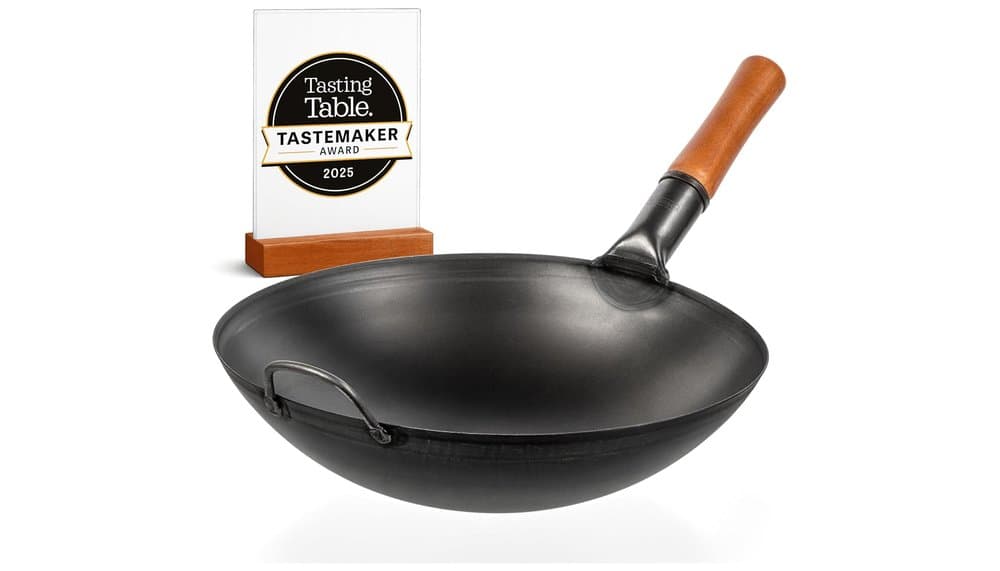
Comprehensive Analysis of the YOSUKATA 14 Inch Carbon Steel Wok Pan
For the serious user looking to equip their kitchen with definitive tools, the wok is a cornerstone. It represents the archetype of a buy-it-for-life utensil, designed to be passed down through generations. In this landscape, the YOSUKATA 14 Inch Carbon Steel Wok Pan has established itself as a frequently cited reference. We will dissect this tool to determine if it meets the demands of passionate cooks in search of professional performance and durability.
What interests us here is not a gadget utensil, but a work tool. The following analysis is based on the rigorous study of its technical specifications, the synthesis of hundreds of user reviews, and the consensus observed in online expert communities and tests.
Strengths and Weaknesses
Strengths
- Authentic Carbon Steel Construction: The preferred material for traditional woks, offering exceptional thermal reactivity and deep seasoning potential.
- Factory Pre-Seasoning: A major time-saver that allows for immediate use and facilitates initiation.
- Versatile Heat Source Compatibility: Works on all heat sources, including induction (with a flat-bottom model), a rarity in the world of traditional woks.
- Promised Robustness and Durability: A 16-gauge thickness (approx. 1.6 mm) and all-steel construction promise extreme longevity.
- Professional Design: The round bottom and flared shape are designed for authentic stir-fry techniques.
Weaknesses
- Weight and Ergonomics: Its weight (1.72 kg empty) and size (36 cm) can make it tiring to handle, especially for smaller-statured individuals or during long cooking sessions.
- Required Learning Curve: Carbon steel demands specific maintenance (perfect drying, oiling) or it will rust.
- Instability on Certain Cooktops: The round-bottom model requires a wok ring or a powerful burner for stability, which is not always available in a domestic kitchen.
- Fixed Wooden Handle: Although comfortable, it is not removable, which complicates storage and excludes any oven use.
Detailed Analysis
Materials and Manufacturing: The DNA of a "For Life" Tool
The heart of the YOSUKATA is its carbon steel, often referred to as "black steel" or "blue steel" in this context. It is the same type of material found in the best carbon steel kitchen knives, prized for its purity and reactivity. Unlike alloyed stainless steel or cast iron, carbon steel is a simple, dense material and an excellent heat conductor. Its longevity is legendary: it does not warp under high heat, will not scratch significantly, and its only enemy, rust, is entirely controlled by the user through seasoning.
The 16-gauge thickness (approx. 1.6 mm) is a judicious choice. It indicates a studied compromise between thermal inertia and reactivity. Thicker, and the wok would become excessively heavy and slow to heat; thinner, and it could warp and distribute heat unevenly. Based on feedback, this thickness provides a feeling of solidity and premium quality, without reaching the crushing weight of a cast iron wok.
The attachment of the wooden handle is a crucial point. Testers emphasize that it is fixed by two sturdy screws onto a metal tang integrated into the wok's body, a robust and repairable fastening method. This is a construction detail that signals an intent for durability, theoretically allowing the handle to be replaced if necessary, long after the steel wok itself has developed its century-old patina.
See priceCooking Performance: Heat and Reactivity
The raison d'être of a wok is its thermal performance. On paper, the characteristics of carbon steel promise rapid temperature rise and even heat distribution. The user community confirms this expectation: the YOSUKATA excels in high-heat cooking. It allows for achieving the famed "wok hei," that characteristic seared flavor, because it can retain and transfer a large amount of thermal energy quickly to the food.
Its traditional round-bottom shape is optimal for use on a powerful gas flame, allowing heat to be concentrated at the center and using the sloped walls for cooking zones at different temperatures. This is where its technical versatility is fully expressed. However, this performance has a prerequisite: as experts point out, it requires a sufficiently powerful burner to exploit its full potential. On electric or induction cooktops (with the adapted model), the behavior will be different, but the material's conductive efficiency remains an asset.
Seasoning: The Key to Performance and Durability
The pre-seasoning is a major selling point for YOSUKATA. It is a polymerized layer applied at the factory at high temperature (beyond 315°C/600°F). Reviews agree that it works: the wok arrives "ready to cook," without a perceptible greasy film, and immediately offers decent non-stick properties. This eliminates the sometimes intimidating initial seasoning step for beginners.
However, and this is a point all experts insist on, this base seasoning is only a starting point. The true patina, black, shiny, and perfectly non-stick, is built through use. Each cooking session with oil, followed by gentle cleaning and careful drying, contributes to thickening and strengthening this protective layer. It is this process that transforms the tool into a personalized and hyper-efficient kitchen companion. Experienced users note that after a few months of regular use, the YOSUKATA's anti-stick performance rivals that of synthetic coatings, but with infinitely superior durability and no health risks.
Ergonomics and Handling
Ergonomics is the most discussed and subjective point. The wooden handle is generally described as offering a good grip, remaining relatively cool during cooking. Its length is considered sufficient to protect the hand from the heat generated by a large burner.
The real ergonomic challenge comes from weight and balance. A wok with a 36 cm diameter, weighing nearly 2 kg empty and often over 3 kg when full, requires a certain physical strength to be maneuvered nimbly with one hand, particularly for the classic stir-frying ("wok tossing") motion. Several reviews, especially from smaller-statured individuals, emphasize that it is a heavy and cumbersome utensil. For them, it is more of a static tool that one stirs with utensils, rather than a wok that is lifted and shaken regularly. This is an essential consideration for home cooks wishing to replicate restaurant techniques.
Maintenance and Long-Term Durability
The YOSUKATA's durability is intrinsically linked to its maintenance. The rules are simple but non-negotiable: no dishwasher, cleaning with hot water and possibly a soft brush (abrasive salt is a favored traditional method), and immediate and thorough drying over heat. The slightest oversight can lead to the appearance of superficial rust. Users note this is not a product defect, but a characteristic of the material. This rust is easy to remove with a little abrasion and re-seasoning, but it requires constant vigilance.
If these rules are followed, all technical indicators and user feedback converge: this wok is designed to last several decades, if not a lifetime. There is no coating to flake, no joint to come loose, no fragile part. It is a single-piece of metal, with a removable handle. Its construction is as simple as it is robust.
Technical Specifications
| Feature | Detail |
|---|---|
| Model Analyzed | YOSUKATA 14 Inch Carbon Steel Wok Pan (Round Bottom) |
| Diameter | 14 inches / 36 cm |
| Body Material | Carbon Steel (Alloy Steel / Black Steel) |
| Thickness (Gauge) | 16 Gauge (approx. 1.6 mm) |
| Weight | 1.72 kg |
| Surface Finish | Factory Pre-Seasoned |
| Compatibility | Gas, induction (flat bottom model), electric, open flames |
| Handle | Fixed Wood (attached with screws) |
| Maintenance | Hand wash only. Immediate drying imperative. |
| Capacity | Approx. 1.6 gallons (6 liters) |
What Users and Experts Say
An analysis of over 3,000 global reviews (average rating 4.3/5) and expert feedback reveals clear trends.
The recurring praises focus on:
- The excellent perceived build quality. The terms "solid," "professional," "high-end" constantly reappear.
- The effectiveness of the pre-seasoning for a quick start.
- The cooking performance once the patina is well-established: even heat, perfect sear, development of "wok hei".
- Versatility (stir-fry, deep-frying, braising) and compatibility with different heat sources.
The most frequent criticisms and points of caution are:
- Weight and Maneuverability: This is the most cited negative point. Many users, particularly home cooks, find the wok too heavy and tiring to lift and handle with one hand during cooking.
- Instability of the Round Bottom: On a standard domestic burner without a wok ring, the wok can tilt or be unstable, requiring it to be held with one hand.
- The Learning Curve for Maintenance: A few reviews from beginners frustrated by rust appearing due to insufficient drying confirm that this material demands disciplined maintenance.
- The Need for a Powerful Heat Source: For optimal results, a powerful gas burner is strongly recommended.
Online experts confirm this analysis, highlighting that the YOSUKATA is an excellent example of a traditional wok adapted for the serious amateur market. They validate its materials, construction, and potential, while reminding that it is a tool that requires practice and care to reveal its full value.
Conclusion: Who is This Wok For?
The YOSUKATA 14 Inch Carbon Steel Wok Pan is not an ordinary kitchen utensil. It is a demanding tool that rewards the investment in know-how and maintenance with durable and authentic performance.
It is made for you if: You are a passionate cook, ready to adopt simple but rigorous maintenance routines. You primarily cook on a powerful heat source (preferably gas) and have the strength (or technique) to handle a heavy tool with ease. You are looking for a kitchen companion for life, which you can season and perfect over the years, and which will never fail you.
It is probably not ideal if: You are looking for a "plug and play" utensil without special maintenance. Your kitchen is equipped only with low-powered electric cooktops (without the adapted flat-bottom model). Lightness and ease of handling are your main criteria, or if you have physical limitations.
In summary, the YOSUKATA perfectly embodies the "buy-it-for-life" philosophy applied to cookware. It bets on the robust simplicity of traditional materials and the intelligence of the user. It is not the easiest wok to tame, but for those who accept its rules, it promises to become an unfailing pillar of high-heat cooking for decades to come.