ZWILLING Miyabi 6000 MCT Gyutoh Review
Introduction
In the universe of high-end kitchen knives, the name Miyabi, owned by the German giant ZWILLING, serves as a bridge between Japanese forging tradition and Western industrial quality standards. The ZWILLING Miyabi 6000 MCT Gyutoh 20 cm embodies this philosophy: a Japanese chef's knife (Gyuto) designed in Seki, the historic city of Japanese cutlery, yet bearing the technical demands of a European brand. For cooking enthusiasts seeking a tool for life, the central question is whether this marriage gives birth to a reliable, high-performing, and durable instrument, or if it is merely a beautiful compromise. We will dissect this product from a "buy-it-for-life" perspective, analyzing its construction, performance, and ability to meet the demands of a serious cook over the long term.
Strengths and Weaknesses
Strengths:
- Exceptional sharpness and remarkable edge retention thanks to MicroCarbide Technology (MCT) steel and high hardness.
- Impeccable finish and aesthetics, with a functional and elegant tsuchime (hammered) finish and a refined Pakka Wood handle.
- Balance and ergonomics widely praised, offering a natural and comfortable grip for precise cutting techniques.
- Versatility of the 20 cm Gyuto format, suited to a vast majority of cutting tasks in the kitchen.
Weaknesses:
- Demanding maintenance: The very hard steel is brittle and requires precautions (no bones, no frozen foods, no dishwasher washing).
- Delicate sharpening: Maintaining the optimal edge requires the use of quality sharpening stones and some know-how, excluding cheap rod sharpeners.
- Debated value for money in the high-end segment, compared to artisan brands or other Japanese series.
- Quality control: Isolated reports mention minor finishing defects (blade/handle junction).
Detailed Analysis of the ZWILLING Miyabi 6000 MCT Gyutoh
The Heart of the Blade: Steel, Hardness, and Performance
What primarily defines this knife is its core steel. Here, Miyabi uses its proprietary MicroCarbide Technology (MCT) steel, presented as a powder steel. This technology aims to create an extremely fine and homogeneous microstructure. On paper, this translates to improved toughness (impact resistance) and the ability to achieve a very fine edge, while allowing for a significant amount of hard carbides for edge retention.
The announced Rockwell hardness (HRC) is 63. This figure is crucial. It places this knife in the category of very hard blades, typical of high-end Japanese knives.
- Edge Retention: An HRC of 63 promises exceptional edge retention. The knife will stay sharp much longer than a standard Western knife (typically around 56-58 HRC). User feedback overwhelmingly confirms this point: "exceptional sharpness," "long-lasting edge," "the best in my collection" are recurring expressions.
- Ease of Sharpening: This is the flip side. Steel this hard will be slower and more difficult to sharpen than softer steel. It requires fine-grit stones and proper technique. Testers and the community agree: maintaining this edge is reserved for those willing to use sharpening stones or regularly entrust their knife to a professional. It is not at all suited to quick-friction sharpeners that would tear the metal.
The blade is forged using the San Mai ("three layers") process, with a core of MCT steel sandwiched between two layers of softer steel. This adds some resistance to bending and protects the hard core. The Cryodur treatment, mentioned by the manufacturer, involves quenching at very low temperature (cryogenic quenching) which stabilizes the steel structure and contributes to both hardness and, theoretically, better corrosion resistance compared to a simple carbon steel.
See priceConstruction, Balance, and Handling
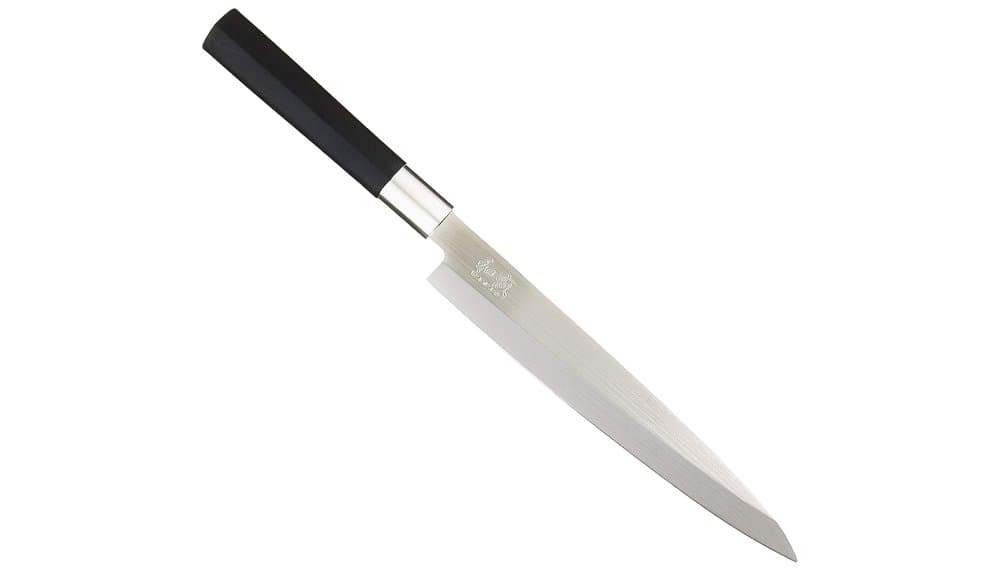
The Gyuto is the Japanese chef's knife, the equivalent of the Western chef's knife but generally lighter, with a flatter profile toward the tip and a more pronounced belly. The 20 cm (approximately 8 inches) format is an excellent choice for versatility, suitable for most hand sizes and tasks, from mincing herbs to cutting large vegetables or pieces of meat.
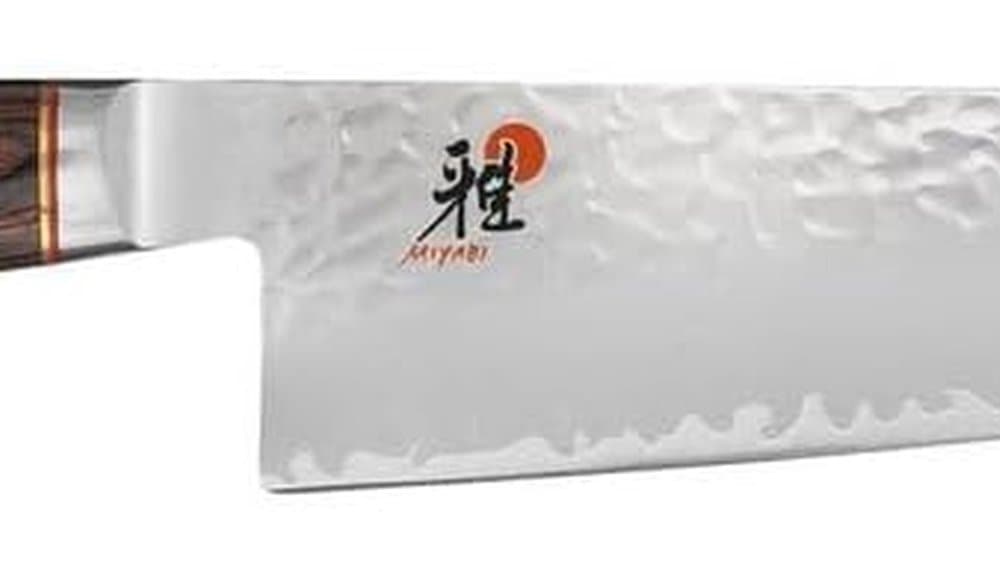
The tsuchime (hammered) finish is not just aesthetic. It has an anti-adhesion function: the small cavities create air pockets that reduce the contact surface with food, thereby limiting sticking on the blade. Several users confirm this, noting that slices of vegetables or fruit come off easily.
The handle made of Pakka Wood (stabilized, laminated composite wood) is a wise choice. It combines the beauty and tactile warmth of wood with much greater resistance to moisture and thermal shock compared to solid wood. Its so-called "D-shaped" form is designed to fit the palm of the hand, offering a natural tactile orientation. The overall balance of the knife is frequently cited as a major strength. According to feedback, the center of gravity is typically located at or just in front of the junction between the blade and the handle (the ricasso), giving a feeling of control and lightness in motion, reducing fatigue during prolonged use.
The construction is full tang, where the blade extends the full length of the handle, ensuring robustness and durability. This is an essential criterion from a "buy-it-for-life" perspective. The junction between the blade and the handle must be perfect to avoid any moisture infiltration.
Target Audience and Usage Context
The ZWILLING Miyabi 6000 MCT is not a universal knife. It clearly targets:
- The passionate home cook who understands and respects the maintenance of a precision tool.
- The professional seeking a high-performing and aesthetic tool for à la carte service or precision work.
- The knife enthusiast who appreciates the marriage of Japanese design and German technology.
It excels in the precise cutting of vegetables, fruits, herbs, boneless meats, and fish. Conversely, it is absolutely forbidden to: cut bones, freeze, slice frozen foods, twist the blade, or use on glass, ceramic, or granite cutting surfaces. A soft wood, bamboo, or polyethylene cutting board is mandatory.
Technical Specifications
| Characteristic | Detail |
|---|---|
| Model | ZWILLING Miyabi 6000 MCT Gyutoh |
| Blade Length | 20 cm |
| Blade Type | Gyuto (Japanese Chef's Knife) |
| Profile | Double bevel (50/50) |
| Core Steel | MicroCarbide Technology (MCT - Powder Steel) |
| Construction | San Mai (3 layers) with Cryodur treatment |
| Hardness (HRC) | 63 |
| Blade Finish | Tsuchime (hammered) |
| Original Sharpening | Honbazuke (fine stone sharpening) |
| Handle Material | Pakka Wood (composite wood), D-shaped form |
| Handle Construction | Full tang with hidden rivets and mosaic pin |
| Weight (approximate) | 210 g |
| Dishwasher Safe | No - Manual cleaning mandatory |
| Place of Manufacture | Seki, Japan |
What Users and Experts Say
A synthesis of customer reviews (with an overall rating of 4.6/5) and expert analyses reveals a strong consensus, with some nuances.
Praise is unanimous on several points:
- Initial Sharpness: The first use is consistently described as a "wow factor." The edge is called "razor-sharp," "exceptional," "perfect." The original Honbazuke sharpening delivers.
- Cutting Quality: Users report incredible cutting ease, with food that "gives way effortlessly." The hammered finish is noted for its effective anti-stick effect.
- Comfort and Balance: Terms like "perfect," "light," "feels good in the hand," "optimal balance" constantly recur. The Pakka Wood handle is appreciated for its secure grip and comfort, even during prolonged sessions.
- Aesthetic Finish: The knife is described as "magnificent," "superb," "an eye-catcher." Details like the mosaic pin and the brown finish of the handle are praised.
Criticisms and warnings mainly concern:
- Fragility: All testers and informed comments emphasize that this is a precision tool, not a brute. Its use must be careful. A knock against a bone or a drop onto a hard surface has a high chance of damaging the edge, or even chipping the blade.
- Demanding Maintenance: The necessity of sharpening on stones is repeated as a given. For a novice user, this represents an additional investment in time and equipment (quality stones). Hand washing and proper storage are prerequisites.
- Quality Control: A few isolated reports, a very small minority compared to the praise, mention defects like irregularities at the tang or small gaps at the blade/handle junction. This suggests that a visual inspection upon receipt is recommended.
Conclusion: A "For Life" Investment?
Is the ZWILLING Miyabi 6000 MCT Gyutoh 20 cm a "buy-it-for-life" purchase? The answer is conditional.
Yes, if you are looking for a Japanese chef's knife with phenomenal sharpness, impeccable finish, and you are ready to care for it like a precision instrument. Its high-end materials (MCT steel, HRC 63, Pakka Wood, full tang), Japanese manufacturing, and thoughtful design give it all the intrinsic qualities to last for decades. It is a professional tool that will gladly meet the demands of an exacting, passionate cook.
No, if you are looking for an all-terrain, dishwasher-safe knife, capable of cutting a chicken with its bones or surviving rough use in a busy family kitchen. Its durability is intimately linked to the rigor of its user.
Ultimately, this Miyabi 6000 MCT is not just a knife, it is a demanding kitchen partner. It rewards mastery and care with unmatched cutting performance and great user satisfaction. For the serious cook who accepts the rules of the game of high-end Japanese cutlery, it represents a justified and durable investment, capable of becoming the cornerstone of their kitchen arsenal for years to come.