HIGO NO KAMI Aogami Warikomi Pocket Knife Review
Introduction: A Timeless Japanese Folding Pocket Knife
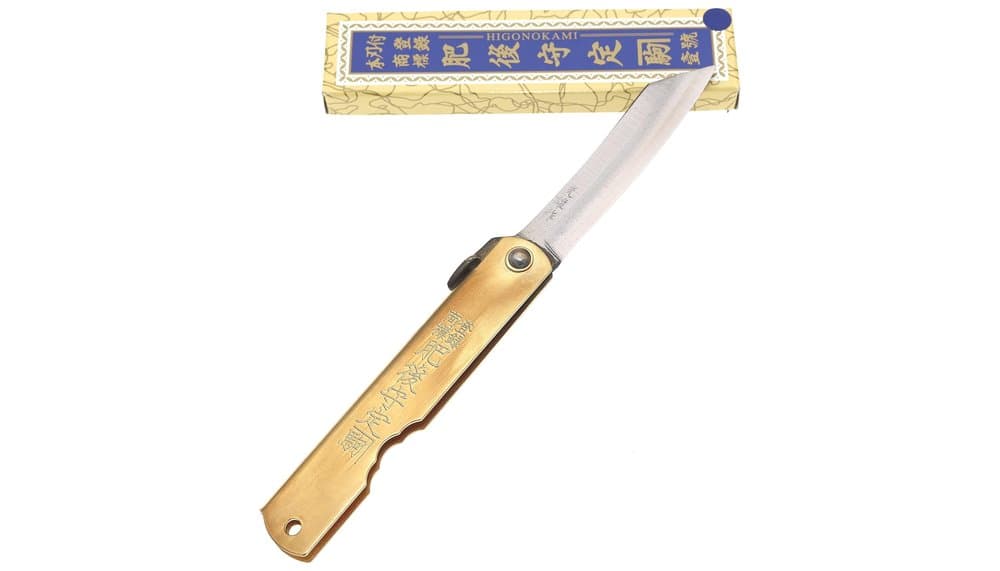
In our quest for high-performing and durable tools, objects with timeless design and artisanal craftsmanship hold a special place. The HIGO NO KAMI Aogami Warikomi folding pocket knife is one such object. It is much more than a simple pocket knife; it is a piece of Japanese industrial history, a refined form of minimalist utility that has endured since the late 19th century. Our analysis aims to determine if this iconic knife, forged from legendary blue steel, can meet the criteria of a "buy-it-for-life" object for enthusiasts of fine tools. We will examine its heritage, its technical specifications, and cross-reference available data to assess its relevance against the demands of a discerning user.
Strengths and Weaknesses
Strengths
- Exceptional and Long-Lasting Sharpness: The blade is made of Aogami (Blue Paper Steel), a very high-quality carbon steel, hardened to HRC 62. This promises exceptional edge retention and the ability to achieve an extremely fine edge.
- Pure Artisanal and Historical Craftsmanship: Authentic Higonokami manufactured by the Nagao Kanekoma family, the registered trademark holder. It is a collector's item carrying over a century of tradition.
- Simplicity and Mechanical Reliability: The lack of a complex mechanism (no spring, no latch) significantly reduces potential points of failure. The one-handed opening via the "chavelure" (lever/opening tab) is intuitive.
- Featherweight and Flat Profile: At only 47 grams and with a thin brass handle, it literally disappears in the pocket, ideal for discreet daily carry.
- Lifetime Sharpening: The blade, made of non-stainless carbon steel, is designed to be sharpened and resharpened indefinitely. It is a tool designed to be maintained and passed down.
Weaknesses
- Absence of Blade Lock (Friction Folder): The blade remains open solely by friction on the pivot. Experts and user feedback emphasize that this requires an adapted grip and caution during lateral pushes or forceful cuts.
- Basic Ergonomics for Prolonged Use: The thin brass handle, with no contouring or guard, can become uncomfortable during sustained tasks. It is not designed for power, but for precision and light cutting.
- Rigorous Maintenance Required: The Aogami steel, while high-performing, is prone to corrosion. It requires immediate drying and sometimes light oiling after each use, especially in humid environments or when in contact with food.
- "Raw Forged" Finish: The entirely manual fabrication can lead to aesthetic imperfections (blade not perfectly centered, forging marks), which are part of its character but may surprise those seeking industrial perfection.
- Lack of Modern Features: No pocket clip, no opening thumb hole, no guard. It is a tool that refuses any compromise on its original design.
Detailed Analysis: Performance and Durability
The HIGO NO KAMI Aogami Warikomi forces us to evaluate durability from a different angle. It is not about resistance to extreme shocks, but about the longevity of a design that has survived obsolescence.
Construction and Materials: The "Less is More" Philosophy The construction is radically simple: a folded sheet of brass forming the handle, a forged steel blade held by a riveted pivot. This simplicity is its strength. There is almost nothing to break. The rivet can be adjusted to set the blade's opening tension, offering a rudimentary but effective maintenance possibility. The perceived solidity is high for its intended use. However, this construction does not allow for easy disassembly for deep cleaning, a point to consider for some users.
Blade Performance: The Excellence of Blue Steel This is where the product excels. Aogami is a Warikomi (laminated) steel, where a core of high-carbon steel is wrapped in softer steel. This traditional technique combines the exceptional sharpness capability of the hard steel (HRC 62) with a degree of resilience. Testers and the community agree: this knife takes a razor edge with relative ease (for such hard steel) and retains it much longer than standard steel. It is perfect for precision work: whittling, fine slicing, peeling. Its "drop point" shape and double bevel make it ambidextrous and versatile.
Ergonomics and Daily Use The user experience is polarizing. For short daily tasks (opening a package, cutting string, sharpening a pencil), its light weight and quick deployment are appreciated. On the other hand, for any work requiring a firm and prolonged grip, the thinness of the brass handle and the lack of a physical guard make themselves felt. One must adapt their grip to prevent the hand from sliding onto the blade, especially in the absence of a lock. It is not a knife for brute force, but a tool of precision and tradition.
Maintenance and Patina: A Relationship to Cultivate Like any quality carbon steel tool (a wok, a cast iron skillet, a Shirogami kitchen knife), the HIGO NO KAMI demands an active relationship. It cannot tolerate prolonged moisture or acidity. User feedback confirms that even a short lapse can lead to rust. This is not a defect, but a characteristic. In return, with proper care (cleaning, drying, light oiling), it will develop a protective and personal patina. Its ability to be sharpened indefinitely on a waterstone makes it a companion literally for life.
Technical Specifications
| Characteristic | Detail |
|---|---|
| Model | HIGO NO KAMI Aogami Warikomi |
| Manufacturer | Nagao Kanekoma (the official trademark holder) |
| Blade Length | 7 cm |
| Total Length (Open) | Approximately 16.5 cm |
| Blade Thickness | 3 mm |
| Blade Material | Aogami Steel (Blue Paper Steel) in Warikomi (laminated) construction |
| Hardness (HRC) | 62 |
| Grind | Double Bevel (V-Grind) |
| Handle Material | Brass |
| Mechanism | Friction folder (friction pivot, no lock) |
| Weight | 47 grams |
| Finish | Hand-forged, raw finish |
| Warranty | Legal warranty of conformity (2 years in the EU) |
| Included | Typical cardboard/canvas storage sleeve |
What Users and Experts Say
A synthesis of customer feedback and expert analyses reveals a clear consensus.
The praise is recurrent and focuses mainly on three aspects. Users are unanimously impressed by the exceptional sharpness upon receipt, often describing it as a "razor edge." The historical design and authenticity generate strong emotional attachment; many buy it as a collector's item and a tangible piece of Japanese culture. Its lightness and simplicity are also highly appreciated for non-bulky daily carry.
The criticisms and warnings are just as consistent. The number one point of caution is the absence of a lock. Many comments remind users that it must be used with awareness and an adapted grip to avoid any risk. Sensitivity to corrosion is the second negative point raised, with several user reports of finding rust after a lapse in care. Finally, some receive a knife with finishing imperfections (slightly off-center blade, marks) or damaged packaging, which seems to be an integral part of the purchasing experience for this artisanal product. As connoisseurs point out, this is not a manufacturing defect in the modern sense, but the mark of handwork.
Conclusion: For Whom is This a "Buy-It-For-Life" Item?
The HIGO NO KAMI Aogami Warikomi folding pocket knife is not a universal tool. It is an object with a strong identity that imposes its own conditions.
It perfectly embodies the buy-it-for-life philosophy in terms of material durability and repairability. Its simple construction, its high-quality steel capable of being resharpened for decades, and its artisanal heritage make it an object designed to last well beyond a lifetime. It will develop a unique patina and history.
However, it will only be the ideal companion for a specific user profile: the knowledgeable enthusiast, the collector, or the purist who primarily seeks impeccable sharpness for light and precise tasks, and who is willing to maintain their tool as one maintains a precision instrument. One must accept its limitations regarding active safety (no lock) and ergonomics for heavy-duty work.
If you are looking for a modern, carefree, liner-lock pocket knife, ready for all the brutal trials of daily life, other choices will be more suitable. But if you value history, functional simplicity, and absolute sharpness and see maintenance not as a chore but as a ritual that is part of the pleasure of ownership, then the Higonokami Aogami is much more than a knife: it is a pocket heritage you can pass on.