Kamberg 0008023 28 cm Frying Pan Removable Handle Test
Introduction
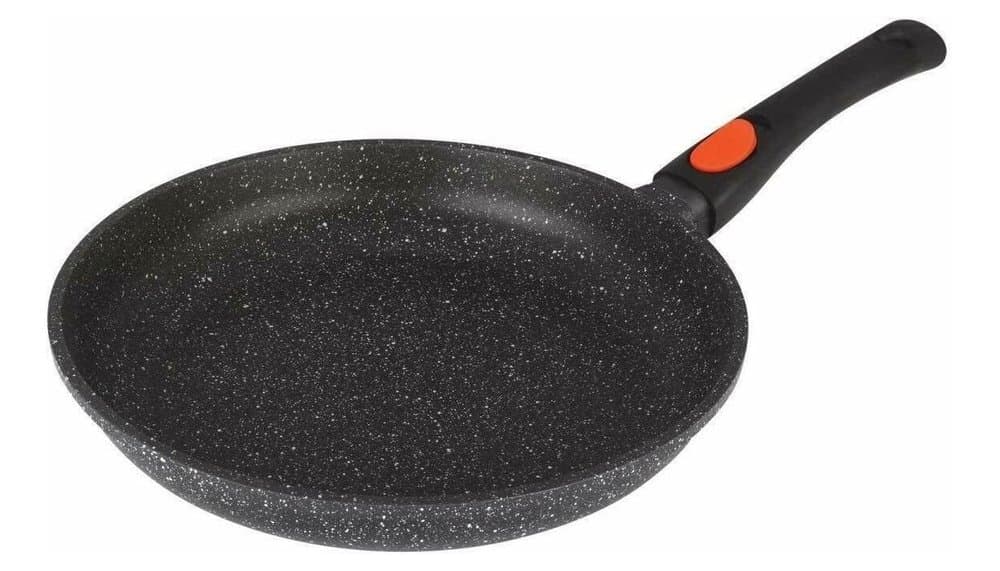
On a site dedicated to durable and high-performance kitchen tools, the arrival of a product like the Kamberg 0008023 28 cm Frying Pan with Removable Handle raises an immediate question. Can it find its place alongside the cast iron, carbon steel, and forged knives that make up the ecosystem of the discerning enthusiast? Here, we analyze this pan not as a heirloom piece, but as a mass-market utensil, dissecting its technical promises in the light of user feedback and expert tests. The goal is clear: to determine whether it qualifies as a lifelong kitchen companion or a practical solution with a limited lifespan.
Strengths & Weaknesses: A Balanced Summary
Before diving into the details, here is what emerges from aggregating specifications and field feedback.
Strengths:
- Practical and versatile: The removable handle is unanimously praised for making storage easier and allowing for oven use.
- Lightweight and maneuverable: At 1.02 kg, it is much lighter than a cast iron or carbon steel pan of similar size, which users appreciate for daily use.
- Excellent initial non-stick performance: When new, the "stone-type" coating ensures fat-free cooking and exceptionally easy cleaning.
- Universal compatibility: Works on all stovetops, including induction, without needing an adapter.
- Perceived value for money: Its entry cost is seen as very competitive for the features offered.
Weaknesses:
- Limited coating durability: This is the major Achilles' heel. The non-stick performance degrades significantly over time, according to feedback.
- Non-premium base material: The cast aluminum does not offer the heat retention, thermal inertia, or intrinsic robustness of cast iron or steel.
- Questionable mechanical reliability: Persistent doubts exist about the long-term sturdiness of the handle attachment mechanism and the perfect flatness of the bottom.
- Contradictory maintenance: Although advertised as dishwasher safe, experts recommend gentle hand washing to try and preserve the coating.
- Low maximum temperature: The 220°C limit is quickly reached, prohibiting high-temperature searing.
Detailed Technical Analysis: The Devil is in the Details
Materials and Manufacturing: Cast Aluminum in Question
The pan's body is made of cast aluminum. This is an industrial choice aimed at economic efficiency and good thermal conductivity. However, from a "buy-it-for-life" perspective, this material falls short on several fronts. It is sensitive to physical shocks (risk of deformation) and violent thermal shocks. Unlike cast iron or carbon steel, aluminum does not improve with age. It cannot be seasoned (creating a natural non-stick polymer) and its only means of protection and non-stick performance is the coating applied to the surface, an inevitable point of failure.
The handle is made of Bakelite, a thermosetting plastic material known for its good heat resistance. Its ergonomics are judged as adequate by users, but its main feature is being detachable. The clip-on attachment, while practical, introduces a mechanical element where the riveted or forged handles of high-end products offer immutable simplicity and reliability.
See priceThe "Stone-Type" Coating: Marketing vs. Reality
This is the heart of the product's marketing, but also the subject of all nuance. According to expert analyses, it is not a pure mineral coating, but a non-stick PTFE coating (the "Teflon" family) into which silica (stone) particles are integrated. This formulation aims to increase abrasion resistance compared to a classic non-stick coating. Initially, the effectiveness is there: users confirm excellent non-stick performance and remarkable ease of cleaning. However, medium-term tests and feedback indicate inevitable degradation. The non-stick performance weakens, requiring the use of more fat, and the coating can eventually become scratched or chip locally. Its lifespan is therefore intrinsically limited, contradicting any claim of being a lifelong purchase. The PFOA-free mention has become the industry standard and no longer constitutes a distinctive quality argument.
Cooking and Usage Performance
Heat distribution: Aluminum is a good conductor. The pan heats up quickly and fairly evenly, aided by a bottom described as "five-layer". It is therefore responsive. On the other hand, it sorely lacks thermal inertia. As soon as cold food is added, the temperature drops sharply, making it difficult to achieve a perfect crust on a steak, for example. This is the exact opposite of the behavior of a thick cast iron or steel pan.
Daily use: Its lightness is a comfortable asset for quick handling. The removable handle is a genuine functional success for drawer or cabinet storage. The 1-liter capacity and 28 cm diameter make it a versatile model for a small family. However, several testers note that the attachment mechanism can leave black soot marks on fingers, which is unexpected and frustrating on a new product.
Maintenance and Longevity: This is where the gap widens with a philosophy of durable tools. Although dishwasher safe, all experts agree that aggressive detergents and shocks during washing accelerate the degradation of the coating. Hand washing with soapy water and a soft sponge is imperative to hope to extend its life. Furthermore, metal utensils must be avoided, as well as overheating (above 220°C). It is an object that requires precautions, not out of love for culinary heritage, but to delay its own obsolescence.
Technical Specifications
| Characteristic | Detail |
|---|---|
| Model | Kamberg 0008023 |
| Diameter | 28 cm |
| Weight | 1.02 kg |
| Body Material | Cast aluminum |
| Coating | "Stone-type" non-stick (PTFE with particles) |
| Stovetop Compatibility | Induction, gas, ceramic glass, electric |
| Handle | Removable, Bakelite material |
| Oven Safe | Yes (without the handle) |
| Max Temperature | 220°C |
| Care | Dishwasher safe (not recommended by experts) |
| Features | PFOA-Free |
What Users and Testers Say: The Voice of the Field
The synthesis of nearly 2700 customer reviews and available online expert analyses paints a nuanced consensus.
The praise focuses mainly on the initial experience. Words like "perfect", "doesn't stick at all", "easy to clean", and "practical" come up repeatedly in 5-star reviews. Users are won over by the lightness, the efficiency of the new non-stick coating, and the cleverness of the removable handle. Several note having bought multiple sizes, a sign of genuine immediate satisfaction.
Criticisms and disappointments emerge over time and reveal the structural weaknesses. One user summarizes the central problem: after only a year of moderate use (2-3 times/month), the coating is no longer smooth and risks damaging the induction cooktop. This is the antithesis of durability. Others point out the black soot issue around the handle attachment, or the fact that the handle, too long for small models, can unbalance the empty pan. The worst-case scenario, although rare, is reported by a user whose handle would detach automatically during use, which they rightly describe as "dangerous".
Expert testers confirm this duality: a good deal to start with, performant and practical, but whose materials and design destine it for a limited lifespan. They clearly classify it in the entry-level product category, with a life expectancy well below that of an 18/10 stainless steel, raw cast iron, or carbon steel pan.
Conclusion: A Practical Solution, but not an Heirloom
The Kamberg 0008023 28 cm Frying Pan with Removable Handle perfectly reflects a certain market expectation: a utensil that is immediately performant, hyper-practical for daily use, and has a controlled acquisition cost. It excels in this role, especially in the first months of use.
However, when evaluated through the demanding prism of buy-it-for-life, intrinsic robustness, and professional performance, it does not pass the test. Its Achilles' heel is its non-stick coating, a technology with a naturally limited lifespan. The cast aluminum and handle mechanism are not designed to last for decades.
Who is it for? For the occasional cook, the student, or as a practical and light secondary pan in a kitchen set, complementing more durable tools. It is a mid-quality consumable, to be replaced without remorse in 2 to 5 years.
Who is it not for? For the serious enthusiast seeking a lifelong culinary partner, who appreciates fine thermal control, the possibility of searing at high heat, and the evolution of a tool that develops a patina over time. In this category, investing in cast iron, carbon steel, or even a good triple-ply stainless steel pan remains infinitely more relevant and economical in the very long term. The Kamberg is a good solution, but it is not a solution for life.