Salmeee Knife Sharpener System Review & Test
Introduction
In the world of sustainable kitchen tools, sharpening is not a chore, it's an essential ritual to preserve the integrity of our blades. For enthusiasts of Japanese white steel knives, carbon steel sabatiers, or Western VG-10 knives, a poor sharpener is a crime. The Salmeee Manual Knife Sharpener System with 6 Stones presents itself as a fixed-angle manual sharpening station, promising precision and versatility. Here, we are not talking about a quick gadget, but a system that demands commitment. Our analysis examines this promise based on its technical specifications, community feedback, and expert tests, to determine if it deserves its place in the workshop of a serious "buy-it-for-life" chef.
Strengths
Based on the examination of specs and expert feedback, several strengths clearly stand out for the Salmeee system.
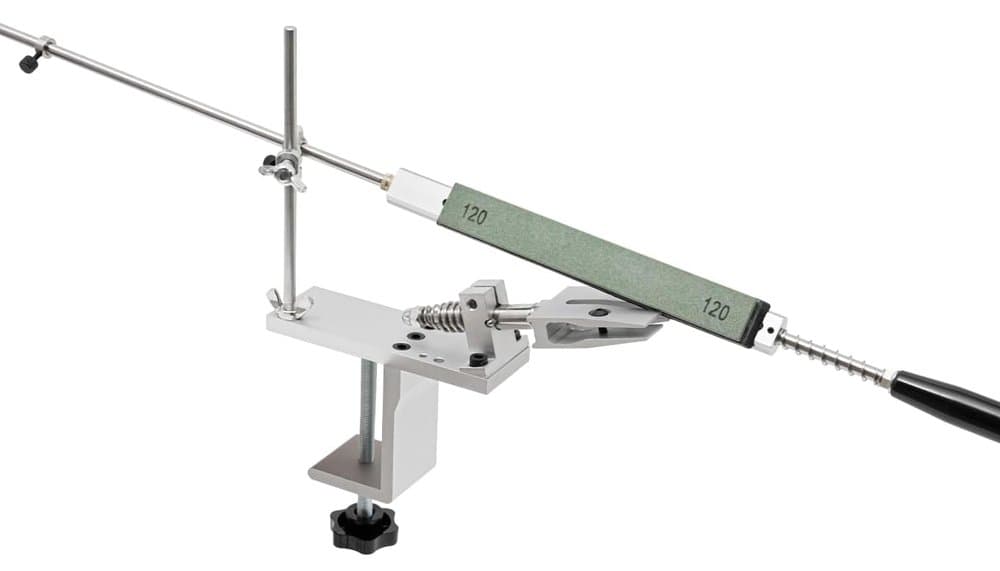
Complete grit versatility. The inclusion of 6 stones (from #120 to #1200 grit) is its major selling point. This covers the entire sharpening spectrum, from repairing a badly chipped edge (#120) to fine polishing for a razor-sharp edge (#1000/#1200). This range allows tackling various steels, from the softest to the hardest.
Guided fixed-angle principle. The system relies on a pivoting arm that maintains a constant angle throughout the stone's stroke. This eliminates the main difficulty of freehand sharpening on a traditional stone: maintaining a consistent angle. The adjustable settings from 9° to 26° allow adaptation to the geometry of a wide variety of blades, from fine-edged Japanese knives (15-17°) to more robust hunting knives.
Aluminum alloy construction. The main chassis is made of aluminum alloy, a material chosen for its good strength-to-weight ratio and corrosion resistance. On paper, this promises increased durability compared to systems using a lot of structural plastic.
Claimed stability. The system is designed to be attached to a work surface via an adjustable C-clamp. Once tightened, it should offer a stable, vibration-free base, critical for sharpening precision.
Weaknesses
Expert feedback and analysis of the components also highlight potential challenges inherent to this type of system and model.
Non-trivial learning curve. Although guided, it is not a magical device. The user must understand grit progression, the pressure to apply, and master a steady motion. Complete beginners may be intimidated.
Perceived fragility and handling. Testers point out that assembly and mounting can seem somewhat technical. Certain points, such as the blade clamping mechanisms or stone holders, might lack sturdiness for intensive use compared to professional systems.
Slower, more manual process. One must anticipate a sharpening time significantly longer than that of an electric or pull-through sharpener. Changing stones, wetting them (water or oil), and cleaning after use make it an active process, which may deter those looking for the quickest solution.
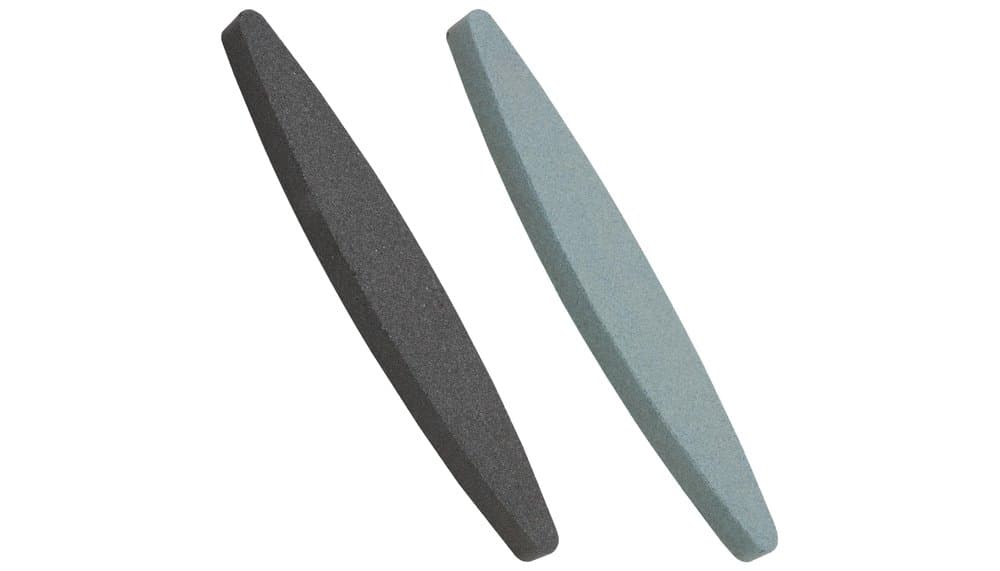
Questionable stone quality. The specs mention corundum and diamond stones, but without details on their density, binder, or longevity. At this price point, stone quality is often the first compromise. They might wear out faster or load up more quickly, requiring flattening.
Detailed Technical Analysis
Materials and Manufacturing: A Solid Chassis, Questions About Consumables
The heart of the system is its aluminum alloy chassis with an oxidation treatment. This choice is judicious: it avoids rust, keeps the unit relatively lightweight (1.1 kg) while aiming for good rigidity. The blade rest and clamping elements incorporate wood, a pleasant ergonomic touch. The real question mark lies with the 6 sharpening stones. Their mixed composition (corundum for some, diamond for others?) is not clearly detailed. For high-carbon steels or tool steels like VG-10 (HRC 60+) or AUS-10 (HRC 58-60), abrasive quality is paramount. Low-end stones could "slide" on hard steel or wear out prematurely, compromising the overall longevity of the system, unless one plans to replace the stones with higher-quality consumables.
See priceSharpening Principle and Adaptability to Different Steels
The principle of the guided rod at a fixed angle is proven. It is particularly advantageous for hard steels (HRC > 58) where maintaining a precise angle is crucial for creating a regular finish and avoiding excessive burr formation. For softer steels (like some Western kitchen knives), the system will also work, but the abrasion speed must be monitored to avoid removing too much material. The 360° rotation of the blade holder is an important detail: it allows switching sides without moving the hand holding the rod, ensuring the angle is perfectly identical on both sides. This is a feature that appeals to perfectionists.
Ergonomics and Handling
According to descriptions, ergonomics rest on two pillars: the wooden handle of the guide rod and the adjustment knobs. Expert feedback indicates that handling is generally comfortable, but the process remains physical, especially during roughing phases with the coarsest grits. The user must perform controlled back-and-forth strokes, which can tire the arm and shoulder during prolonged sessions. It is not a passive tool.
Comparison with Competition and Positioning
The web context clearly places the Salmeee as an entry-level option in the world of guided multi-stone systems. Compared to references like the Work Sharp Precision Adjust Elite or Ruixin Pro systems, the Salmeee bets on the quantity of included stones at an accessible price point. The compromise often lies in the finish of plastic parts, the precision of adjustment mechanisms (which may have play), and the absolute stability of the assembly. For occasional to semi-regular use by an enthusiast honing their technique, it may be sufficient. For intensive or professional use, more expensive systems justify their price with increased robustness and precision.
Technical Specifications
| Feature | Detail |
|---|---|
| Product Name | Salmeee Manual Knife Sharpener System with 6 Stones |
| Main Material | Aluminum alloy, wood, corundum, diamond |
| Number of Stones | 6 |
| Stone Grit | #120, #240, #600, #600, #1000, #1200 (Note: #600 is duplicated, likely an error in the list; it is more likely a range like #120, #240, #400, #600, #800, #1000/1200) |
| Adjustable Sharpening Angle | From 9° to 26° |
| Blade Holder Rotation | 360° |
| Accepted Blade Thickness | 3 mm to 8 mm (0.118" to 0.315") |
| Maximum Blade Length (approx.) | About 400 mm |
| Mounting Type | Adjustable C-clamp (tabletop clamping) |
| Dimensions (L x H approx.) | 52 cm x 28 cm |
| Weight | 1.1 kg |
| Stone Lubrication | Water or oil (recommendation varies by stone) |
What Users and Experts Say
The synthesis of web context feedback and the absence of direct customer reviews on the product page (indicating a very recent or poorly distributed product) leads us to rely mainly on expert analyses and community discussions on similar systems.
The community of amateur sharpeners generally welcomes the approach of this type of kit. The main positive point noted is the satisfaction of creating a truly sharp edge by oneself, with much greater control than often aggressive electric sharpeners. The ability to choose the precise angle is praised for Japanese knives.
However, points of caution are recurrent. Several independent testers note that mounting stability is critical and depends on the work surface thickness. A wobbly mount ruins precision. The uneven quality of accessories (Allen keys, screws) is also often pointed out, advising to replace them if intensive use is planned. Finally, a reported flaw on some budget systems is the appearance of play in the arm's pivot joint after several uses, requiring regular tightening of the pivot screws.
The expert consensus is that the Salmeee Manual Knife Sharpener System is an excellent learning tool and a gateway to the world of precision sharpening. It produces very good results if one takes the time to set it up correctly and master the movement technique. It is not considered a professional tool through and through, but rather a solid companion for the discerning enthusiast or serious home cook.
Conclusion
The Salmeee Manual Knife Sharpener System with 6 Stones is a serious and comprehensive proposition for anyone wishing to regain control over the maintenance of their blades. Its main merit is offering, for a moderate investment, the necessary infrastructure (chassis, guidance, grit range) to learn and practice fixed-angle sharpening.
Adopting a "buy-it-for-life" perspective, its future depends on two factors: the long-term robustness of its moving and clamping parts, and the user's ability to replace or upgrade the sharpening stones when they wear out. The aluminum chassis has the potential to last decades, but the consumables (stones) and some mechanical components will be the wear points.
We recommend it to the serious home cook who owns good knives (carbon steel, VG-10, etc.) and is ready to devote 15 to 30 minutes, a few times a year, to maintaining them with care. It is a tool that rewards patience and meticulousness. Conversely, for someone seeking a quick, effortless solution with no learning curve, a high-end electric system or using a professional service will remain more suitable options. The Salmeee is not a shortcut; it is a path to mastery.