SHAN ZU Santoku Knife Review & Performance Test
Introduction
In the very dense market of kitchen knives, the promise of a professional tool at an accessible price always attracts attention. The SHAN ZU Santoku Knife positions itself precisely in this category, promising Japanese sharpness with German construction. For the serious cook looking for a tool for life, promises are not enough. What interests us here is the substance behind the marketing: the materials, the manufacturing, the ergonomics, and the long-term performance. By cross-referencing official technical specifications with thousands of user reviews, we can paint a complete picture of this Santoku and determine if it deserves its place in a demanding kitchen.
Strengths
- Exceptional initial sharpness: The community agrees to describe the knife as "razor-sharp" upon receipt, allowing for clean and precise cuts with minimal effort.
- Perceived excellent value for money: For many users, the level of finish, the feel in hand, and the performance easily justify the investment.
- Appreciated balance and lightness: Its weight of 230 grams and its weight distribution are praised for reducing fatigue during prolonged use, a crucial point for an all-purpose knife.
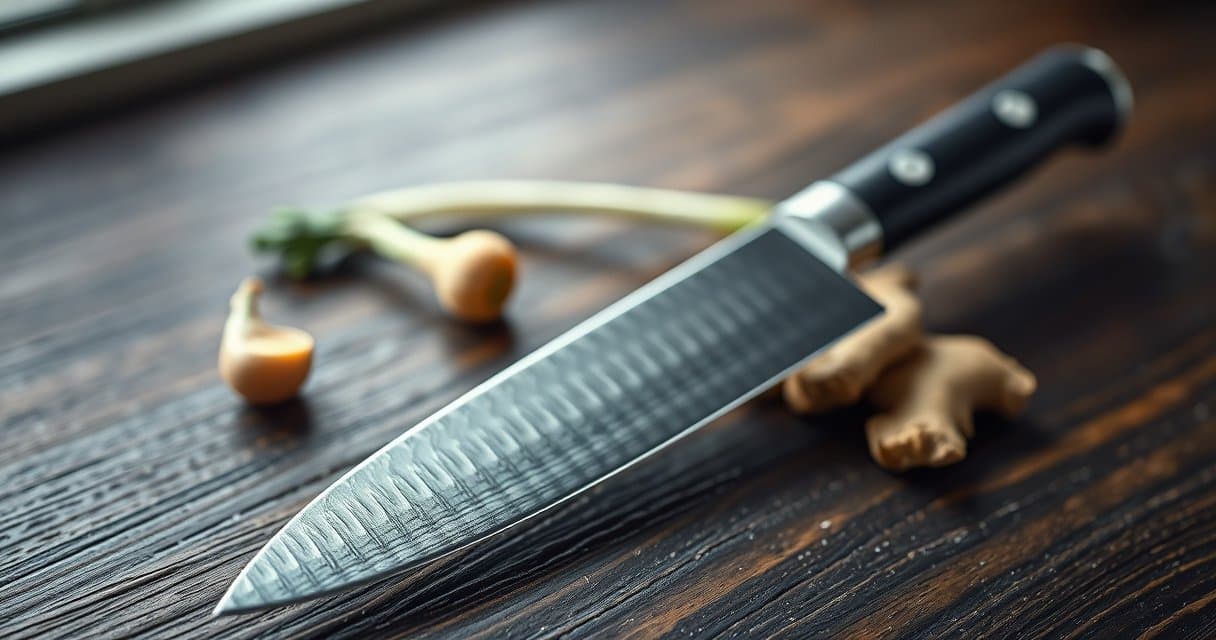
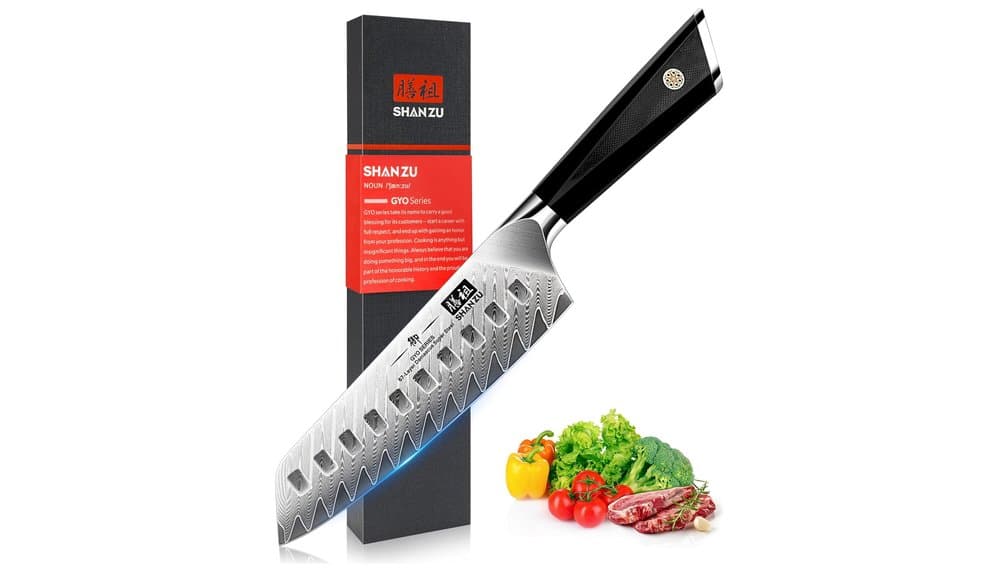
- Careful design and finish: The blade's sandblasted finish and Pakkawood handle give an impression of solidity and hygiene, meeting the aesthetic expectations of enthusiasts.
- Ease of sharpening: The advertised hardness of 56 HRC and the blade profile make it a knife that users report being able to sharpen effectively with classic methods.
Weaknesses
- Imprecise steel composition: The mention "German high carbon steel" is vague and does not correspond to a standard designation (like X50CrMoV15). This raises questions about long-term edge retention compared to specific steels like VG-10 or AUS-10.
- Potentially slippery handle: Several reviews, although in the minority, note that the Pakkawood handle can become slippery in the presence of moisture or grease, a point of attention for safety.
- Limited torsional robustness: Like any knife with a thin, hard blade, the community reminds that it is not designed for twisting tasks (deboning, cutting frozen items) under penalty of damage. It is a specialized tool, not an all-rounder.
- Lack of independent expert tests: The absence of documented comparisons with market references (like Tojiro, Mac, or even Victorinox) leaves a gray area regarding its objective performance in extended real-world conditions.
Detailed Analysis
The Blade: Technical Promises and Practical Reality
On paper, the specs announce an 18 cm (7 inch) blade forged from German high carbon stainless steel with a Rockwell hardness of 56 HRC. This hardness is an interesting choice. It sits in a middle zone: significantly harder than a standard Western knife (around 52-54 HRC) for better edge retention, but less extreme than a traditional Japanese knife in white steel (often >60 HRC). The theoretical compromise is good ease of sharpening for the average user, confirmed by reviews mentioning satisfactory results with a manual sharpener or a stone. However, edge retention over several months of intensive use remains an unknown linked to the imprecision about the exact steel. Testers emphasize that the factory edge is excellent, but that the need for regular sharpening is part of the expected maintenance.
The Santoku design, with its rounded belly and raised tip ("sheepsfoot"), is designed for the push-cut motion ideal for vegetables. According to user reviews, it indeed excels at finely chopping herbs, vegetables, and fish fillets. The thin blade (2 mm) and the hollow edge reduce food sticking.
See priceErgonomics and Handling
Where the SHAN ZU Santoku seems to score points is in its balance. With a contained weight of 230 grams, the majority of reviews describe a well-balanced knife at the heel, just in front of the bolster. This gives a feeling of control and reduces wrist fatigue. The Pakkawood handle (laminated wood and resin) offers a warm look and is reputed for its resistance to moisture. Its ergonomic shape fits the palm. However, the community notes a point of caution: some users find the finish too smooth, which can compromise the grip when hands are greasy or wet. For optimal safety during prolonged use, a perfectly dry hand is recommended.
Construction and "Buy-It-For-Life" Durability
The forged construction (as opposed to stamped) is a sign of potential durability. It implies a denser blade, with better balance and superior theoretical resistance. The seamless transition between the blade and the handle (the "bolster") eliminates points where dirt can collect, a plus for hygiene. The knife is not dishwasher safe, a classic constraint for quality tools that preserves the edge and handle in the long term.
The real test for a "buy-it-for-life" philosophy lies in the ability to be regenerated. Here, the news is good: the reasonable hardness and simple blade profile make it an excellent candidate for home sharpening on a stone. Users who maintain their tool will most likely be able to keep it for decades. However, absolute robustness is not its forte. Like any knife with a thin, hard blade, it is likely to chip if twisted or if it hits bone. Its durability is therefore conditional on correct use.
Target Audience: Who is this Knife For?
The SHAN ZU Santoku Knife is not the holy grail for the professional chef demanding super-premium steels. On the other hand, it represents a very serious entry point into the world of high-performance knives for the passionate home cook. It is the ideal tool for someone who is tired of dull commercial knives, who is ready to learn the basics of sharpening on a stone, and to respect a precision tool. It is perfectly suited for daily family meal preparation, where its Santoku versatility and lightness shine.
Technical Specifications
| Feature | Detail |
|---|---|
| Model | SHAN ZU Santoku Knife |
| Blade Length | 18 cm (7 inches) |
| Total Length | ~31.7 cm |
| Blade Material | German high carbon stainless steel (exact composition unspecified) |
| Hardness (Rockwell) | 56 HRC |
| Construction | Forged |
| Blade Profile | Santoku, with hollow edge |
| Blade Thickness | ~2 mm |
| Handle Material | Pakkawood (laminated wood) |
| Tang Type | Full (likely) |
| Weight | 230 grams |
| Maintenance | Hand wash only. Manual sharpening recommended. |
What Users Say
The analysis of over 7,500 overall reviews, with an average rating of 4.6/5, reveals very clear trends.
Recurrent praise revolves around the immediate cutting performance. Terms like "razor," "cuts very very well," "super sharp" come up repeatedly. Users are visibly impressed by the factory edge that transforms the cooking experience. The design and finish are also widely acclaimed: "beautiful knives," "elegant," "exude quality." Many emphasize the good value for money, considering it a smart purchase to upgrade without breaking the bank. The lightness and balance are also frequently mentioned as comfort assets.
Criticisms and reservations, less numerous, point to specific aspects. The most notable point is the feeling of the potentially slippery handle, a deal-breaker for some in terms of safety. Others remind, sometimes after an incident, that it is not an all-purpose knife and that it requires being used with the appropriate technique (no twisting, no bones). Finally, a few reviews point out less perfect finishes or welds on some units, a possible variance in production.
Notably, feedback from long-term users (over a year) confirms that the knife remains performant with regular sharpening, supporting the idea of correct durability for serious home use.
Conclusion
The SHAN ZU Santoku Knife is much more than just a cheap knife with a Japanese look. It is a legitimate kitchen tool that offers a transformative cutting experience from the first use, combined with a careful design and generally successful ergonomics. For the home cook who wants to move to a precision tool without diving into the investment and complex maintenance of high-end Japanese steels, it constitutes a solid recommendation.
However, its adherence to the "buy-it-for-life" philosophy comes with an asterisk. Its very long-term durability depends on two factors: the exact composition of its steel (which remains somewhat mysterious) and the rigor of its maintenance. It is not indestructible, but it is clearly regenerable. Those who learn to sharpen it will certainly be able to keep it for a very long time.
In summary, the SHAN ZU Santoku is not the ultimate knife, but it is undoubtedly one of the best current compromises in its price segment. It demands from its owner the respect due to a quality tool: hand washing, occasional sharpening, and appropriate use. In return, it transforms meal preparation into a precise, fast, and enjoyable task. For the serious amateur, it is a very likely winning bet.